Astrophotography · Galaxies
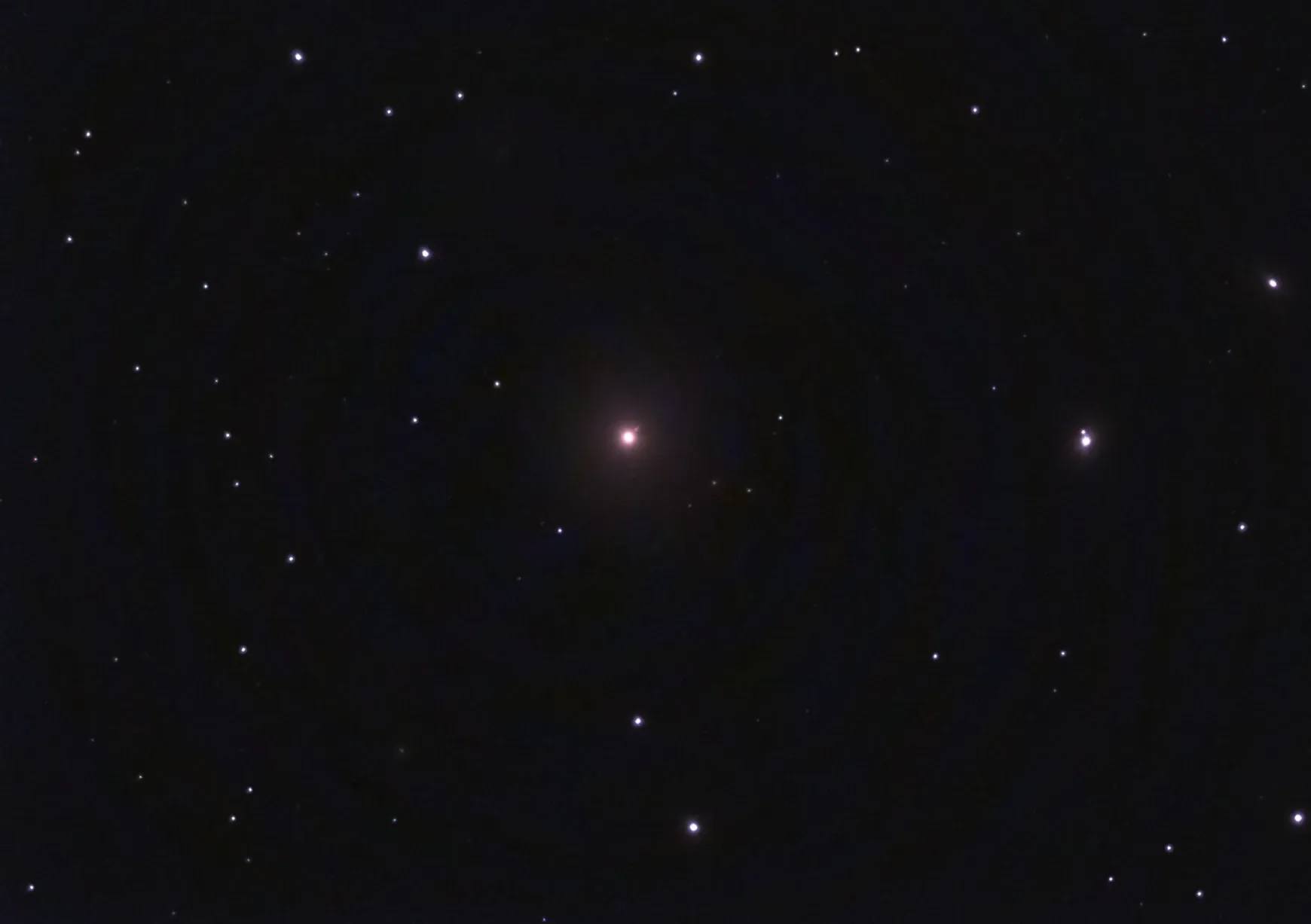
Messier 87
An Oversized Cosmic Monarch
The object · NGC 4486
Sitting quietly in the Virgo Cluster about 55 million light-years away from us, Messier 87, like an oversized cosmic monarch, is this giant elliptical galaxy that looks calm at first glance; you might even denote it as a mere soft, fuzzy ball of starlight through your neighborhood telescope. But don’t let that polite appearance fool you because at its heart resides a “supermassive black hole” billions of times heavier than the Sun, seamlessly blasting out a near-light-speed jet of plasma, inflating galactic-sized bubbles, and quite literally bending space and time around itself.
For decades, black holes remained hidden as mathematical enigmas, and in 2019, humanity did something astonishing: we took a picture. In 2019, a global team using the “Event Horizon Telescope (EHT)” finally snapped M87’s black hole “shadow,” the first direct image of a black hole’s silhouette. This remarkable achievement transformed a cosmic theory into a photograph, providing a unique perspective on gravity at its most extreme. The EHT – a global Very Long Baseline Interferometry array – combined radio dishes around Earth to achieve an effective diameter the size of our planet.
Capturing this image required an engineering feat equivalent to reading a newspaper in New York from a sidewalk in Paris. Because no single dish is large enough to see the black hole from 55 million light-years away, researchers combined telescopes from Hawaii to the South Pole. By synchronizing these sites using “atomic clocks” and the GPS, they created a virtual telescope as large as the Earth itself. This network, operating at a short wavelength of 1.3 millimeters, can see right through the dense clouds of gas that typically obscure a black hole’s boundary. While it represents the current pinnacle of human observational technology, researchers are already planning to push these boundaries further. Future upgrades aim to capture even higher-resolution images by shifting to a shorter observing wavelength of 0.87 millimeters and eventually expanding the array into space.
The stunning image reveals a dark silhouette known as a black hole shadow, which is framed by a brilliant ring of light. That glow isn’t decoration; it’s made of superheated, magnetized plasma whipping around the black hole at nearly the speed of light, like cars on the most dangerous racetrack in the universe. The gravity here is so extreme that it actually bends light itself, a trick known as strong gravitational lensing, squeezing the glow into a perfect circle called a photon ring. And here’s the fun twist: the ring shines brighter on one side because the racing plasma is hurtling toward us, its light boosted by relativistic beaming, like a headlight coming straight at us.
One of the coolest outcomes is how well the image agrees with Einstein’s theory. The ring’s size and the shadow’s shape perfectly match predictions from general relativity for a rotating (Kerr) black hole. Moreover, the asymmetric brightness reveals the black hole’s dynamics: the best-fitting models involve a spinning hole that shoots out a jet. Non-spinning models simply couldn’t launch a powerful jet like M87’s; only by tapping the hole’s spin energy (via magnetic fields) can one produce those relativistic jets. The implication is clear – M87’s black hole spins, and by extracting that rotational energy, it powers the galaxy’s spectacular jet. In fact, based on the glowing asymmetry and the angle of the jet, astronomers even figured out which way it’s turning: its spin vector points away from Earth, rotating clockwise like a colossal cosmic dial.
To really grasp how extraordinary this object is, you have to pause and sit with the number: more than 6 billion Suns packed into one place. Not millions — billions. It is the kind of figure that causes your mind to subtly surrender and exclaim, “That cannot be real.” Yet this unimaginable mass acts like the anchor of the entire galaxy, the hidden engine powering all of M87’s most dramatic outbursts and high-energy chaos. The black hole is so enormous that its event horizon — the boundary where not even light can escape — stretches across a region comparable to three times the size of our solar system. Scientists confirmed this mind-bending size by matching the glowing ring in the image with thousands of detailed computer simulations. And all the while, its gravity keeps the surrounding stars and gas locked in an endless, slow-motion cosmic dance.
More than a century after Albert Einstein first introduced general relativity, an idea born from chalkboards and thought experiments, scientists have turned Messier 87 into a visible representation of that theory. The glowing ring around its black hole is strikingly circular, just as Einstein’s equations predict for a spinning black hole. If gravity behaved differently at these extremes, the shadow would look warped or lopsided, like a funhouse mirror. Instead, it’s beautifully precise. In a realm where space and time intertwine, the laws of physics remain steadfast. And as future observations sharpen the view even further, this cosmic giant will keep challenging us, testing our understanding, and reminding us that the universe still has secrets waiting just beyond the darkness.
Written by Farhana Ferdous using this Google NotebookLM and the papers therein.
বাংলায়
এই জ্যোতিষ্কের বিস্তারিত বাংলা বিবরণ শীঘ্রই যুক্ত হবে।
- Photographer
- MD Shahadat Hossain Shahal
- Observing location
- Bandarban , Lama (21.739769,92.168984)
- Exposure
- 120 min.
- Telescope
- Unistellar eQuinox 1 (Ashvin 1), 114 / 450 mm
- Camera
- Sony IMX224, 1.27 Mpx
- Field of view
- 37′ × 28′ in arcmin (1.7 arcsec)
- Image processing
- MD Shahadat Hossain Shahal
- Processing method
- 1. Stack all calibrated frames in DeepSkyStacker (DSS). 2. Attempt plate solving inside Siril. 3. Blind Plate Solving (If Siril fails to find an astrometric solution) 4. Perform Background Extraction in Siril to remove gradients and light pollution. 5.Apply Spectrophotometric Color Calibration (SPCC) for accurate colors. 6.Remove stars from the image (using star removal tool). 7.Stretch the starless image to bring out faint details. 8.Apply noise reduction 9.Add the stars back into the processed image. 10. Apply mild sharpening to make stars cleaner and more defined. 11.Minor adjustments if needed
Astrophotographic information
- Object type
- Elliptical galaxy
- Constellation
- Virgo
- Distance
- 53.5 Mly
- Angular size
- 7.2 × 6.8 arcmin
- Physical size
- 132 Kly
- Apparent magnitude
- 9.6
Astrophysical information