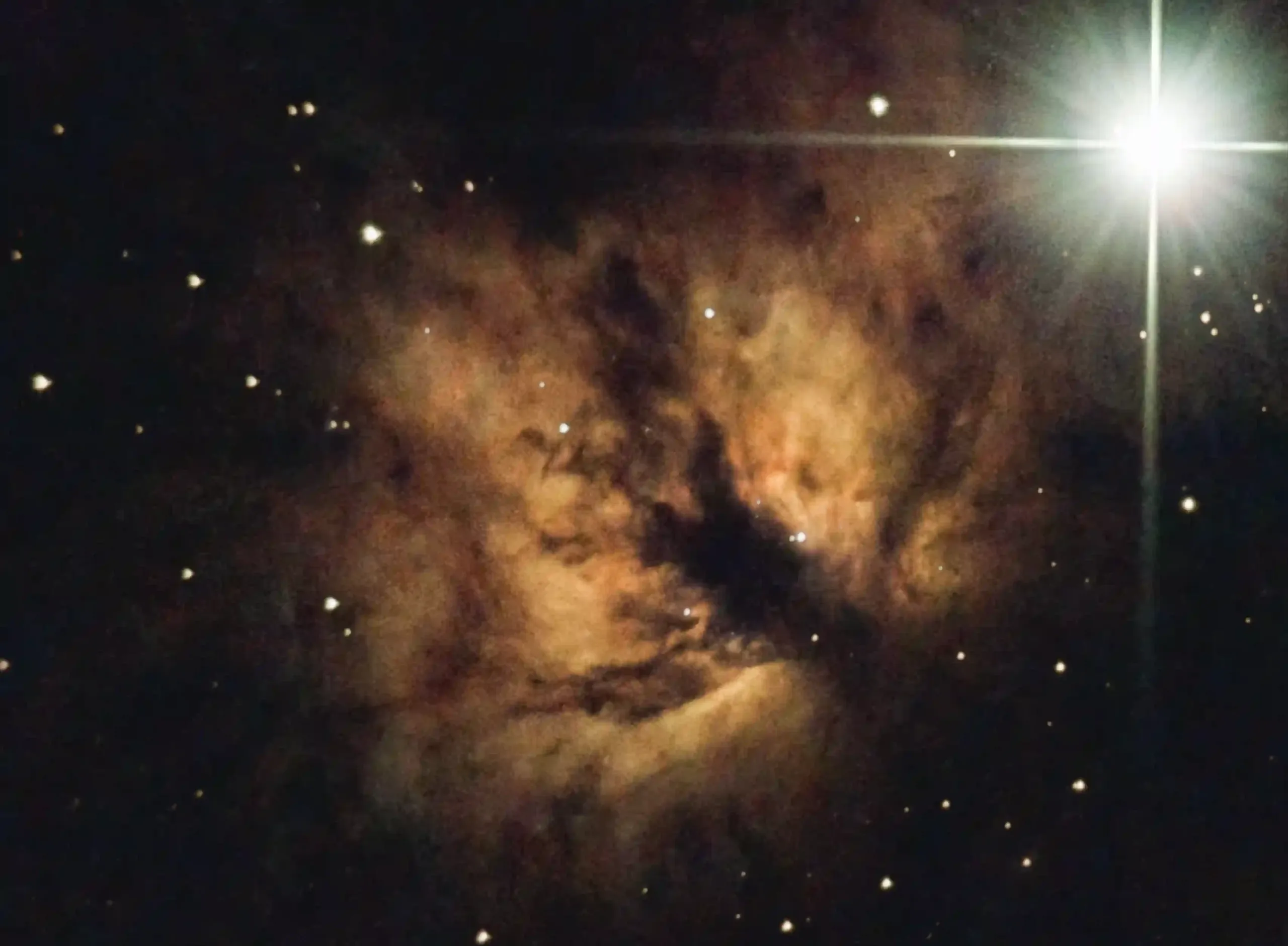
Astrophotography · Nebulae
Flame Nebula
The Mystery of a Cosmic Campfire Hidden in Orion
The object · NGC 2024
When you look up at the constellation Orion on a crisp winter night, your eyes are drawn to the three bright stars forming the hunter’s belt. Just to the east of the lowest star lies a spectacular celestial illusion known as the Flame Nebula. In photographs, it looks exactly like a roaring bonfire burning in the deep freeze of space. Giant tendrils of orange and yellow light seem to leap upward, surrounded by dark, billowing smoke. However, the universe loves to play tricks on our eyes. This striking feature is not a site of fiery destruction. Instead, it is a bustling, chaotic maternity ward where new born stars are taking their first breaths.
For decades, the true source of the nebula’s brilliant glow remained a mystery because its primary ionizing engine was hidden behind that thick cosmic dust. While several candidates were proposed over the years, near-infrared studies eventually unmasked IRS 2b, a massive, highly reddened late-O-type star, as the primary actor. This intensely hot stellar giant releases a torrent of ultraviolet radiation that powers the nebula’s emission, supported by secondary contributions from a less obscured star named IRS 1. The discovery of IRS 2b finally resolved a long-standing astronomical puzzle, as earlier candidates simply lacked the intense, high-energy radiation required to explain the observed levels of glowing helium and hydrogen within the nebula.
The Flame Nebula is not just a stage for massive stars; it is also a bustling nursery for low-mass and substellar objects, including brown dwarfs and planetary-mass candidates barely larger than Jupiter. Using the Hubble Space Telescope, researchers have surveyed over 800 point sources within the cluster, utilizing specialized filters to detect the signature water absorption features characteristic of cool, young objects. These studies reveal an exceptionally youthful population that is estimated at only 500,000 years old, making it even younger and more deeply embedded than the nearby Orion Nebula (M42) Cluster. This substellar census is crucial for helping astronomers refine the Initial Mass Function, a concept that describes how often cosmic processes produce small, faint objects versus massive stellar giants.
How did this intense star-forming activity begin? Recent kinematic analyses suggest the Flame Nebula was ignited by a massive cloud-cloud collision. Observations of carbon monoxide gas reveal two independent velocity components that appear to be physically merging. This collision, which began roughly 300,000 to 400,000 years ago, acted as a cosmic mass-collecting machine, forcefully compressing high-density gas to trigger the formation of the nebula’s most massive members. This triggered formation beautifully explains why the most luminous stars are densely concentrated within a tiny 0.3-parsec radius near the cloud’s peak, providing direct evidence that the dynamic movement and collision of molecular clouds are primary drivers for birthing high-mass stellar clusters.
Within this turbulent and radiation-soaked environment, the future of potential planetary systems hangs delicately in the balance due to a process called external photoevaporation. Astronomers have discovered propylids (protoplanetary disks of gas and dust) that are being actively boiled away by the intense ultraviolet radiation from massive stars like IRS 1 and IRS 2b. These objects appear as cometary structures with bright, glowing cusps pointing directly toward their destructive UV sources. This erosion is so aggressive that it creates a “proplyd lifetime problem,” where estimated mass-loss rates suggest these disks should vanish faster than the current age of the cluster itself. The presence of these fading proplyds in such a young region indicates that the stellar environment begins sculpting, and potentially destroying, the very reservoirs for planet formation almost immediately after they are born.
Written by [Tanzila Tabassum] using [Google NotebookLM] and the papers therein.
বাংলায়
Tab Content goes here
- Photographer
- Md Shahadat Hossain Shahal
- Observing location
- Lama, Bandarban (21.740407,92.168856)
- Exposure
- 30 min
- Telescope
- Unistellar eQuinox 1 (Ashvin 1), 114 / 450 mm
- Camera
- Sony IMX224, 1.2Mpx
- Field of view
- 0.61° × 0.46°(1.72 arcsec/pixel)
- Image processing
- Md Shahadat Hossain Shahal
- Processing method
- 1. Stack 2. Background extraction 3. Plate solve 4. SPCC 5. Star removal 5. Stretching 7. Star re-composition 8. Denoising 9. Sharpening 10. HDR processing for galaxy core. 11. Masked stretching.
Astrophotographic information
- Object type
- Emission Nebula (H II region)
- Constellation
- Orion
- Distance
- 1350 ly
- Angular size
- 30 × 30 arcmin
- Physical size
- Roughly 10-12 ly across
- Apparent magnitude
- 10
Astrophysical information