News · Milestones
CASSA Marks Milestone with Submission of Five Inaugural Research Proposals
Each year between December and January, Independent University, Bangladesh (IUB) invites its full-time faculty to submit research initiatives for the annual IUB…
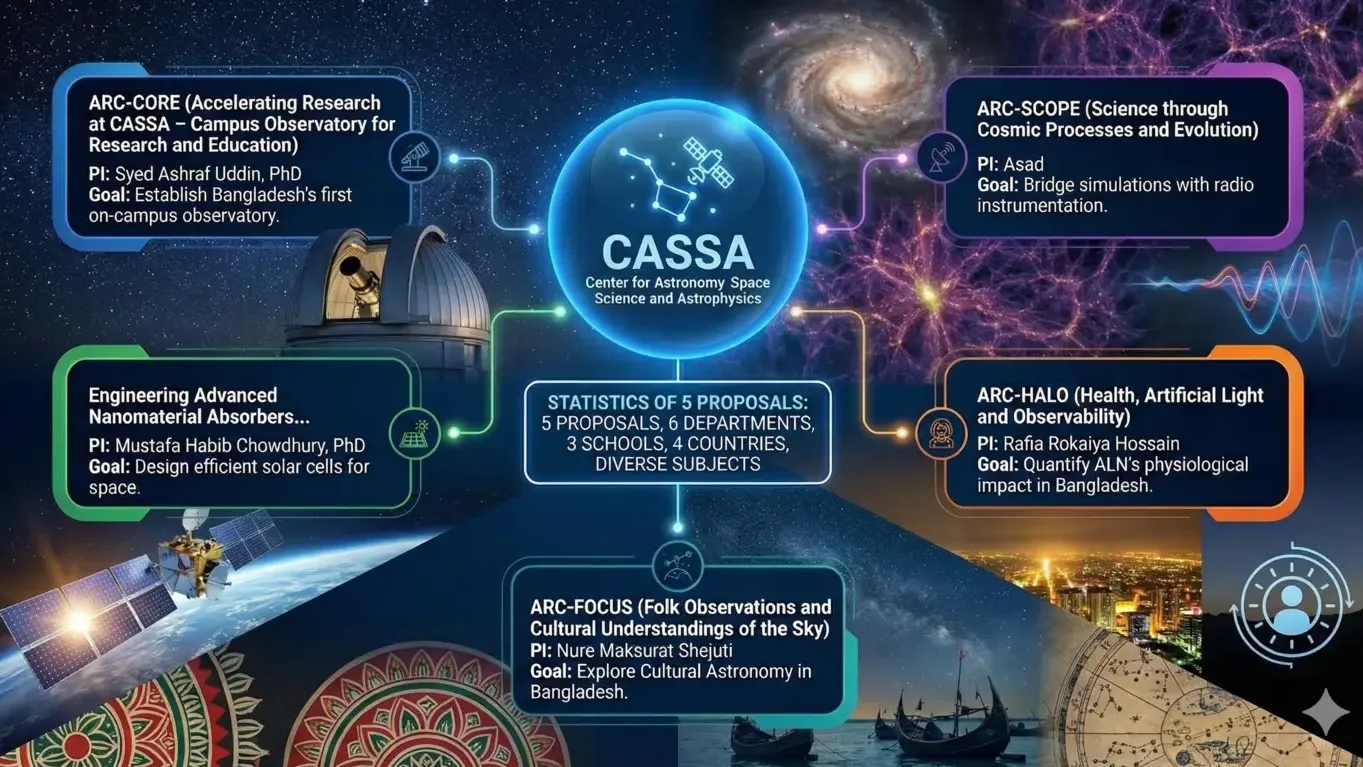
Each year between December and January, Independent University, Bangladesh (IUB) invites its full-time faculty to submit research initiatives for the annual IUB Sponsored Research Grant. For the university’s research community, this period represents an active phase of academic planning and collaborative development. Following the establishment of the Center for Astronomy, Space Science and Astrophysics (CASSA) in August 2025, the current cycle marks a significant milestone: for the first time, scholars are officially submitting proposals for future research under the CASSA banner. We are announcing that faculty members associated with the Center have submitted five distinct research proposals. These projects aim for academic rigor and reflect CASSA’s foundational objective—to facilitate interdisciplinary cooperation across the various schools of IUB, contingent upon securing the necessary funding.
Led by Principal Investigator (PI) Syed Ashraf Uddin of the Department of Physical Sciences (DPS), School of Engineering, Technology and Sciences (SETS), alongside Co-Investigator (CI) Khan Muhammad Bin Asad, the ARC-CORE (Accelerating Research at CASSA – Campus Observatory for Research and Education) proposal aims to establish Bangladesh’s first research-grade on-campus astronomical observatory. This planned infrastructure project is focused on institutional capacity building, with the goal of equipping a dedicated facility with a 14-inch telescope and automation systems for remote operation. By serving as a pedagogical laboratory, the observatory would provide undergraduate and graduate students the opportunity to move beyond secondary datasets, allowing them to collect primary astronomical observations for thesis work and laboratory assignments. Furthermore, this facility would support IUB’s involvement in international “time-domain astronomy” by enabling the optical follow-up and characterization of transient celestial phenomena, such as Type Ia Supernovae.
Led by PI Khan Asad, alongside CI Uddin and External CIs (ECIs) Anowar J Shajib (University of Chicago), Tabassum S Tanvir (Iowa State University), and Syeda Lammim Ahad (University of Waterloo), the ARC-SCOPE (Science through Cosmic Processes and Evolution) proposal outlines a framework to bridge theoretical simulations with radio instrumentation. This initiative seeks to examine the “inside-out” assembly of massive elliptical galaxies while analyzing the influence of a variable Initial Mass Function on star formation efficiency. To manage the requirements of future big-data astronomy, the project intends to integrate Artificial Intelligence through the RGC package, which would use Convolutional Neural Networks to automate the morphological classification of radio Active Galactic Nuclei. In addition to analysis, the proposal seeks to address technical developments in radio astronomy by utilizing the 24-element TART (Transient Array Radio Telescope). In a separate technical component, the team also proposes to develop signal-cleansing models designed to detect faint cosmic signals, including 21-cm emissions from the Cosmic Dawn.
Led by PI Mustafa Habib Chowdhury, alongside CI Kh Shahriya Zaman, both of the Department of Electrical and Electronic Engineering (EEE), SETS, the proposal titled “Engineering Advanced Nanomaterial Absorbers for High-Efficiency Perovskite Solar Cells for Space-Based Applications” addresses the energy requirements of next-generation orbital infrastructure. By combining computational electromagnetics with quantum mechanical methods, the study intends to use electromagnetic simulations to design solar cells capable of withstanding the vacuum, radiation, and thermal extremes of the space environment. To assist in future material discovery, the research would utilize Artificial Intelligence and evolutionary algorithms to evaluate crystal structures for thermodynamic stability and optimal bandgaps. This initiative aims to address the cost barriers associated with traditional Group III-V cells by offering a path toward lightweight, non-toxic, and radiation-hardened photovoltaic solutions for energy needs in future space exploration.
Proposed by PI Rafia Rokaiya Hossain of the Department of Pharmacy, School of Pharmacy and Public Health (SPPH), alongside CIs Asad, Kamran ul Baset (Department of Public Health), Akib Bin Rahman (Department of Pharmacy), and external expert Reynier Peletier (University of Groningen), the ARC-HALO (Health, Artificial Light and Observability) proposal seeks to establish an interdisciplinary framework to quantify Artificial Light at Night (ALN) and its physiological impact in Bangladesh. To address the current lack of high-resolution sky glow data, the project proposes the use of ground-based Sky Quality Meter (SQM-LE) sensors paired with SDGSAT-1 satellite imagery to monitor light pollution. This environmental data would be correlated with human health through psycho-physiological surveys and wearable technology designed to monitor circadian markers, sleep patterns, and hormonal fluctuations in melatonin and cortisol. Ultimately, this research seeks to study how the shift toward blue-rich LED lighting affects biological rhythms, providing an evidence base for future policy discussions regarding sustainable urban health.
Spearheaded by PI Nure Maksurat Shejuti of the Department of Social Sciences and Humanities (DSSH), School of Liberal Arts and Social Sciences (SLASS), alongside CIs Asad, Bokhtiar Ahmed (DSSH), and Dilshad Hossain Dodul (Department of Media and Communication, SLASS), the ARC-FOCUS (Folk Observations and Cultural Understandings of the Sky) proposal explores the field of “Cultural Astronomy” in Bangladesh. This interdisciplinary project aims to document and study the astronomical heritage of the Sundarbans and Chattogram Hill Tracts, viewing the sky as a source of local knowledge and tradition. Adopting an approach that prioritizes local perspectives, the research would use a dual methodology: astronomical reconstruction using horizon scanning to determine celestial visibility, and ethnographic fieldwork to record oral histories and cosmogonical accounts. By investigating how these communities use celestial markers for survival activities—such as agricultural and fishing cycles—the project seeks to connect the physical sciences with the social world.
Ultimately, these five proposals—uniting faculty from six departments across three schools and involving international collaborations spanning four countries—represent a comprehensive plan for scientific inquiry at IUB. Covering diverse subject areas ranging from astrophysics and artificial intelligence to pharmacy, public health and anthropology, this collective effort will help establish CASSA as a center for interdisciplinary research and contribute to the nation’s scientific development. By integrating the study of radio astronomy and orbital energy with public health and cultural preservation, CASSA aims to demonstrate the relevance of astronomical research to the broader advancement of society. For Bangladesh, the successful implementation of these projects offers the potential to foster a tradition of discovery, encouraging a new generation to study both their cultural heritage and the scientific future.