Center for Astronomy, Space Science and Astrophysics, Independent University, Bangladesh (IUB)
Events · Colloquium
CASSA Colloquium 7: Strong Gravitational Lensing as a Probe of Cosmology
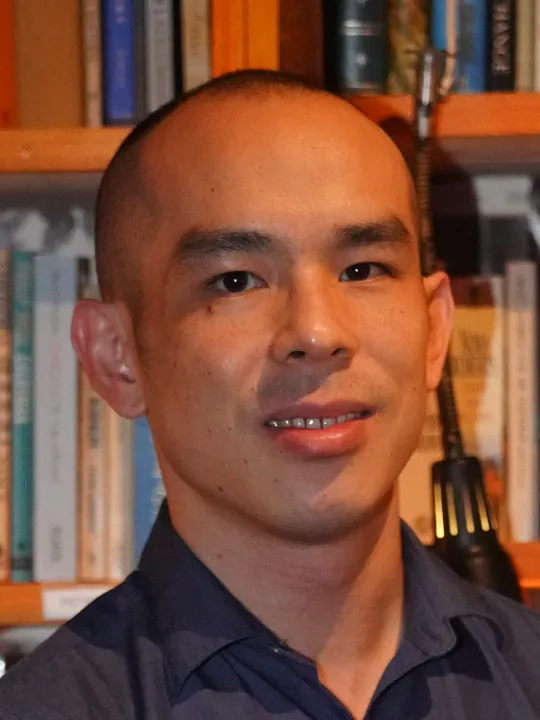
Speaker (online): Kenneth C.
Speaker (online):Kenneth C. Wong, PhD, Assistant Professor, Research Center for the Early Universe (RESCEU), University of Tokyo, Japan.
Abstract
Strong gravitational lensing is sensitive to the total mass distribution along the line of sight, making it a unique probe of dark matter in galaxies and clusters, and useful for studying resolved properties of the magnified background sources. Strong lensing is also valuable for constraining cosmology through lensed quasars, which can be monitored to measure the “time delay” between the multiple images and constrain the Hubble constant (). This method of measuring is independent of type Ia supernovae and CMB observations, and may shed light on the tension between local universe and CMB measurements. The latest results from the TDCOSMO project constrains to be km/s/Mpc in a flat Lambda CDM cosmology with a precision of . This result is maximally conservative with respect to galaxy mass profiles, and is consistent with independent determinations of using type Ia supernovae calibrated by the distance ladder method. To improve this measurement, as well as leverage the power of strong lensing to study galaxy structure and magnified background sources, we require deep wide-area imaging surveys to build up a statistical sample of lenses, which in general are rare objects. The Hyper-Suprime Cam SSP is an optical survey using the Subaru Telescope that covers deg of the sky to a depth of . The HSC SSP strong lensing working group is focused on searching for new lenses of all types and scales and using these systems for studies of galaxy structure and cosmology. We have developed a variety of lens search methods, including recent machine learning techniques that can be applied to future datasets such as LSST and Euclid.