
Table of Contents
Solar System
The solar system consists of the Sun and all the objects under its gravity. It includes eight planets, several dozen dwarf planets, hundreds of moons, asteroids, and comets. Each planet in this system is different, and there is also a wide variety among the asteroids and comets. The entire system is surrounded by a vast Oort Cloud made of billions of icy fragments. But beyond all this diversity, the underlying order of the solar system stands out. Most of its components revolve around the Sun in a thin disk and in nearly the same direction. For those that have both revolution and rotation, the directions of both motions are usually the same. This order suggests how our system formed 4.5 billion years ago from a giant cloud of gas and dust. The trace of that cloud’s motion remains in every object that fragmented long ago and formed from it.
Near the center of the solar system is the Sun, whose mass is more than 700 times the combined mass of everything else in the system. Our star is basically a gaseous sphere composed of about 71% hydrogen and 27% helium. However, there are also small amounts of other chemical elements in gaseous form.
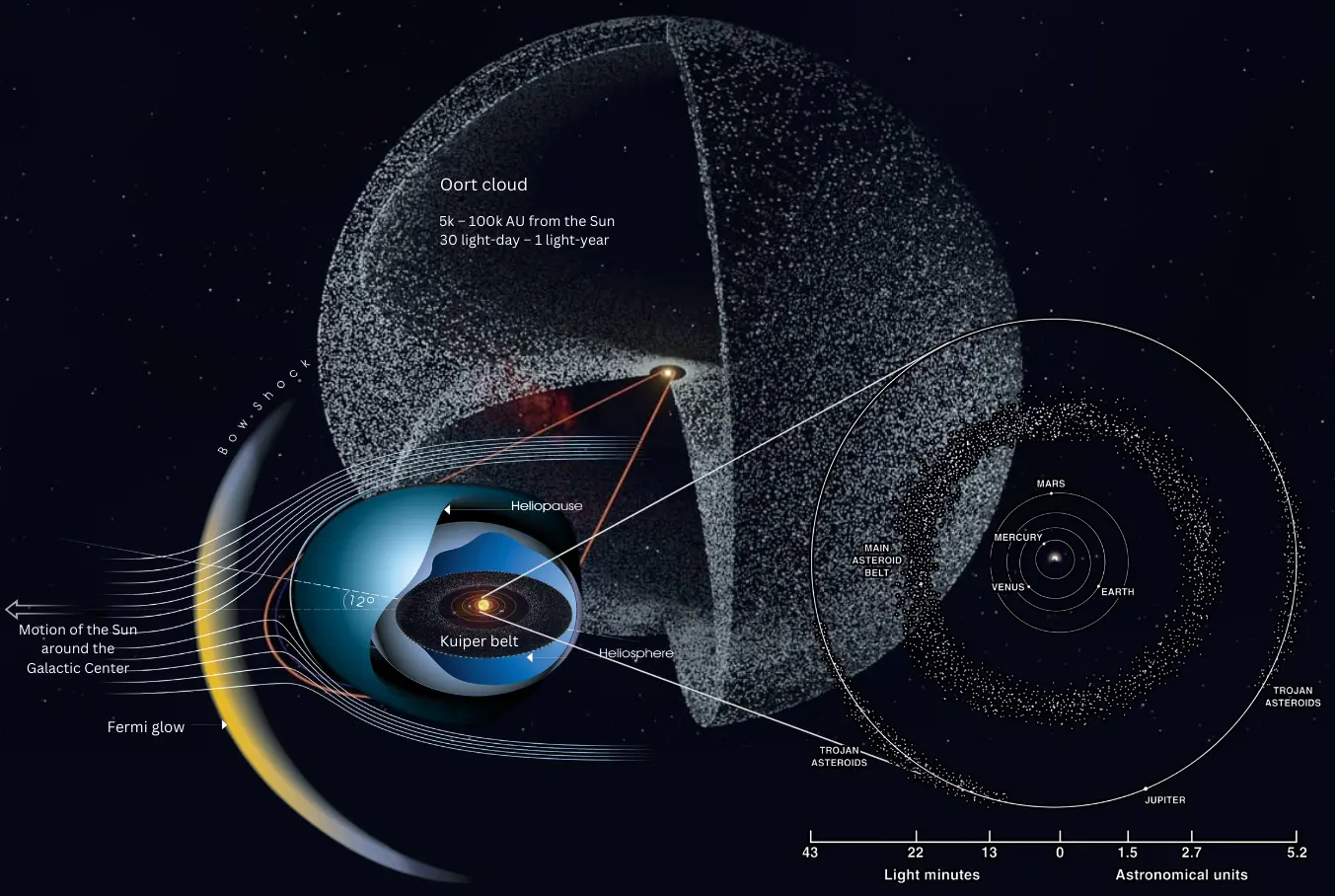
Closest to the Sun are the four inner planets (Mercury, Venus, Earth, Mars), whose orbits are shown in the bottom right corner of the above figure. These are primarily made of rock and have either very thin or no atmospheres. The orbits of the four outer planets (Jupiter, Saturn, Uranus, Neptune) are shown in the bottom left, although Jupiter’s orbit is also enlarged on the right. These planets are mostly made of gas and liquid, are much larger than the inner four, and have hydrogen-rich, thick atmospheres. Jupiter’s diameter is ten times that of Earth, and its mass is 318 times greater. The inner planets are often called terrestrial planets because they are Earth-like, while the outer planets are sometimes referred to as Jovian planets because they are like Jupiter (Jove).
There are also many dwarf planets in the solar system, the best example being Pluto, which is even smaller than our Moon. Pluto’s orbit extends far above and below the solar disk. Eris, which is larger than Pluto, is actually located closer to the Sun. Dwarf planets are nearly spherical like planets but have not cleared their orbits to become gravitationally dominant.
Most planets have moons orbiting them, commonly referred to as moons after Earth’s Moon. Jupiter and Saturn have more than sixty moons each, Uranus has twenty-seven, Neptune has fourteen, Mars has two, and Earth has one; only Venus and Mercury have no moons.
The solar system contains trillions of objects much smaller than planets and moons. Asteroids are mainly composed of rock and metal. Due to their small mass, they cannot become spherical. The largest asteroid, Vesta, is shaped like an egg and is about 500 km long—while Earth’s diameter is 12,000 km and the Moon’s is 3,500 km. The rocky asteroids closest to us lie in the asteroid belt between Mars and Jupiter (bottom right of figure), where hundreds of thousands of asteroids exist. Some asteroids are also found in Jupiter’s orbit and are called Trojans.
Beyond Neptune lies the Kuiper Belt (bottom left of figure), which also contains some asteroids, but most of its objects are icy bodies—small chunks of ice. However, the greatest number of icy bodies is found in the Oort Cloud, whose scale is shown in the top panel of the figure. The Kuiper Belt lies only 50 AU from the Sun, but the outer edge of the Oort Cloud lies at 100,000 AU, or about 1 light-year. Between these two belts may lie nearly a trillion icy bodies, each averaging 10 km in size. When these bodies fall into highly elliptical orbits and approach the Sun, we see them as comets. The comet’s tail forms from ice vaporizing due to the Sun’s heat.
The Sun’s solar wind cannot reach as far as the Oort Cloud. It stops where it is pushed back by the interstellar wind after crossing the Kuiper Belt—this boundary is called the heliopause. Just beyond the heliopause, the collision between the solar and stellar winds creates a bow shock in the direction the Sun moves around the center of the Milky Way, shown at the bottom left of the top panel. This marks the full extent of our heliosphere.
1. Planets
This table presents the average distance (in astronomical units, AU), number of moons, mass ($10^{24}$ kg), density (grams/cc), and observed and predicted temperatures of the eight planets in the solar system. Comparing these properties gives an overview of the entire system.
| Name | Distance | Moons | Mass | Density | Observed $T$ | Predicted $T$ |
|---|---|---|---|---|---|---|
| Mercury | 0.39 | 0 | 0.33 | 5.4 | 100–725 | 451 |
| Venus | 0.72 | 0 | 4.87 | 5.2 | 733 | 260 |
| Earth | 1.00 | 1 | 5.97 | 5.5 | 288 | 255 |
| Mars | 1.52 | 2 | 0.64 | 3.9 | 215 | 222 |
| Jupiter] | 5.20 | 95 | 1898.6 | 1.3 | 124 | 104 |
| Saturn | 9.54 | 60 | 568.5 | 0.69 | 95 | 79 |
| Uranus | 19.2 | 27 | 86.8 | 1.32 | 59 | 58 |
| Neptune | 30.1 | 14 | 102.4 | 1.64 | 59 | 55 |
From the distance column, we can see there is a large gap between Mars and Jupiter, which is where the asteroid belt orbits the Sun with its hundreds of thousands of asteroids. Aside from this gap, the distances between the planets are relatively regular. The inner rocky planets have few moons, but the outer giant planets have many—Jupiter alone has 95 known moons. Looking at density, we see the rocky four planets are four to five times denser than water, while the gas giants have densities around 1 gram/cc, with Saturn being notably less than water.
The difference between observed and predicted temperatures is worth reflecting on. How planetary temperature is predicted is explained in the Planet article. Mercury’s average temperature is close to the prediction but varies from 100 to 725 K, because it has no atmosphere and takes 176 Earth days to rotate once on its axis, even though it orbits the Sun in 88 days—so one Mercury day equals two Mercury years. One year is all day, another is all night, leading to very hot and cold sides. Without an atmosphere, the temperature difference between day and night is even greater.
Venus has a temperature far higher than predicted due to the intense greenhouse effect of its thick atmosphere. Venus’s atmosphere has over 96% carbon dioxide, no oxygen, pressure 700 times that of Earth’s, and sulfuric acid rain falls from its skies. Earth’s surface temperature is also 33° higher than predicted due to the greenhouse effect. This effect made Earth habitable, but if CO₂ keeps rising, it will no longer be beneficial. That’s what’s happening due to the industrial revolution over the past hundred years—temperature is rising and glaciers are melting. Uranus and Neptune have temperatures close to prediction. Jupiter and Saturn show some differences, still unexplained.
Every planet has been visited by at least one satellite, spacecraft, or space probe. Many satellite data are available on NASA Eyes Website. The most successful spacecraft sent to Mercury was Messenger, which orbited from 2011 to 2015. It discovered ice deposits at Mercury’s poles. Magellan mapped Venus’s entire surface before 1994. The Opportunity rover operated on Mars from 2003 to 2019 and found mineral fragments nicknamed “blueberries” in 2004, which confirmed that liquid water once existed on Mars.
NASA’s Juno satellite has been orbiting Jupiter since 2016. Juno discovered that the east-west flowing belts on Jupiter’s surface extend as deep as 3,000 km. Previously, it was thought Jupiter had a solid core, but Juno showed that the core’s boundary is fuzzy and mixed with surrounding hydrogen. Saturn has been most explored by Cassini-Huygens, which operated until 2017. It showed that Saturn’s moon Enceladus has all the ingredients necessary for life—prompting scientists to consider ocean worlds around other stars as important.
Only Voyager 2 has flown by Uranus and Neptune, now moving beyond the solar system into the interstellar medium. It flew closest to Uranus in 1985 and Neptune at 4,800 km in 1989. It discovered 10 new moons and two new rings on Uranus, and six new moons and four rings on Neptune. The best images of the four gas giants to date have been captured by the Webb Telescope, shown below.

2. Chemical Composition
The chemical composition of the solar system is measured in two main ways: by analyzing the spectrum of light from the Sun’s photosphere, or by chemical analysis of various carbonaceous chondrites (the oldest rocks in the solar system), which fall to Earth as meteorites or are found in space. Many meteorites on Earth contain these chondrites. The element abundances in chondrites can be measured very precisely, but it is uncertain whether those quantities were the same when the solar system formed, because over billions of years, many volatile elements may have been lost. In contrast, analyzing the Sun’s photosphere gives a better idea of the original solar nebula. But that analysis is less accurate than chondrite studies—it’s hard to determine element abundances from light spectra alone.
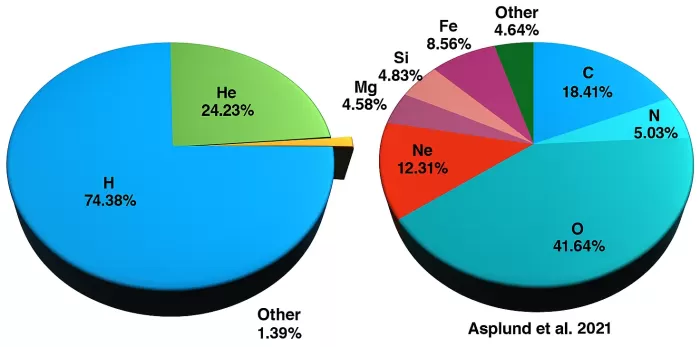
The pie chart above shows the percentage of elements in the solar system: over 98% is just hydrogen and helium. The elements making up the four inner planets account for less than 2% of the solar system’s mass. Among those, oxygen, carbon, neon, nitrogen, iron, silicon, and magnesium are most abundant. In the gas giants’ atmospheres, along with hydrogen and helium, there are significant amounts of sulfide, water, methane, and ammonia.