
Table of Contents
This is an old revision of the document!
5. Chemical Age
Juno: Our boat is now moving from the Brahmaputra into the Jamuna, this is just the right time to start talking about the Chemical Age, because through Krishna of Mathura and the Taj Mahal of Agra the Jamuna has a profound symbolic connection with life. But to begin this age we need to brush up a little on Earth’s 4.5-billion-year history, because the first 4.0 billion years of it will be our terrestrial Chemical Age.
Socrates: So in the Chemical Age we will focus only on Earth?
Juno: Since we know the history of complex chemistry on only one planet, it is logical in this age to think about Earth. But at the end of the discussion we will also talk about ways of searching for complex molecules and life on other planets, inside or outside the Solar System. In fact, our plan here is quite similar to that of the Planetary Age. In the Planetary Age Hermes mainly focused on the Solar System, but in the end he also spoke about the discovery of planets around other stars.
Socrates: Good plan. Then begin.
1. Seas and Atmosphere
Juno: About 4.5 billion years ago Earth was born. For the first 500 million years the surface was very hot and full of volcanoes, and it spun very fast on its own axis, taking only 12 hours for one rotation. On top of that, many leftover pieces of rock and comets from the construction of the inner four planets kept crashing onto Earth from space during the Late Heavy Bombardment. This period is called the Hadean Eon. Some intact zircon (ZrSiO$_4$) crystals from that time have been found, from which we understand that oceans already existed then.
Socrates: How did the oceans form?
Juno: Through volcanoes and all the cracks in the crust, water vapor rose from inside Earth into the atmosphere, this process is called outgassing. After Earth cooled, this vapor formed clouds, and clouds produced rain. One reason for the oceans is this rain. But a large part of ocean water probably also came through asteroids and comets during the bombardment. At that time the whole Earth was probably surrounded by ocean, with no large continents. Scattered across the ocean were volcanic islands, the peaks of various volcanoes. There was oxygen in vapor and water, and oxygen in zircon, but there was no free molecular oxygen (O$_2$) in the atmosphere at all.
Socrates: Is the rise of oxygen in the atmosphere what this figure shows?
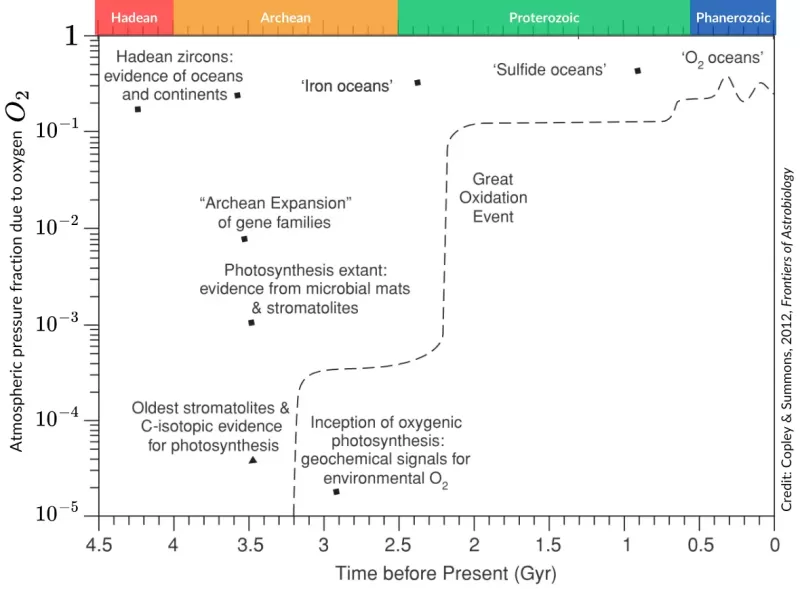
Juno: I am showing not only the increase of oxygen in the air, but also important changes in the chemical composition of the oceans. After the Hadean, the Archean Eon began 4.0 billion years ago. But Earth’s crust began to stabilize around 3.8 billion years ago, when the precursors of today’s continents, various microcontinents, started forming. In the figure you can see that many important events took place 3.5 billion years ago. At that time there were microbial mats, that is, layered colonies of cyanobacteria on the surface of the ocean water. The top layer of cyanobacteria had already begun producing oxygen by combining sunlight, carbon dioxide, and water, a process called photosynthesis. Over time these mats thickened and eventually turned into rock, known as stromatolites. By analyzing stromatolites we have learned how long ago free oxygen first began to be produced.
Socrates: On the X axis the figure shows time, but on the Y axis it does not show oxygen content directly, it shows the contribution of oxygen to atmospheric pressure, where 1 means 100%, 0.1 means 10%, 0.01 means 1%. Does this basically indicate oxygen concentration?
Juno: Yes, you can take it that way. At present oxygen makes up about 21% of the atmosphere, and it began to rise from zero around 3.2 billion years ago, where the dashed line starts. The earliest photosynthesis was not oxygenic, meaning it did not produce oxygen. At that time bacteria mixed oxygen with iron and water to form iron compounds on the ocean floor. Oxygenic photosynthesis began properly around 3.0 billion years ago. At the same time microcontinents were joining to form various continents. The newly produced oxygen reacted with iron on the seafloor, filling the oceans with iron. In the figure this is what is meant by “Iron Ocean.”
Socrates: From the figure it seems that for a long time after free oxygen began to be produced the amount of oxygen in the atmosphere did not increase. Oxygen production began about 3.1 billion years ago, but the Great Oxidation Event happened 2.1 billion years ago. For almost a billion years did oxygen in the air fail to rise because of the iron in the oceans?
Juno: Yes, iron was one reason. Another reason may have been microbes in the ocean that lived by metabolizing oxygen. Only after the amount of oxidizable iron in the ocean decreased did the oxygen produced by cyanobacteria start mixing into the air, and in a very short time oxygen in the atmosphere rose to nearly 1%. Because of this oxygen, sulfur was oxidized and began to mix into the ocean, giving us the “Sulfide Ocean.” How oxygen rose from 1% to 20% is a subject for the Biological Age, not now.
Socrates: Then now go back to the beginning of the Chemical Age. You have mentioned zirconium, silicon, oxygen, iron, sulfur, carbon and many elements. But we know that after the Big Bang the universe mainly produced hydrogen and helium. Where did all the other chemical elements come from?
2. Periodic Table
Juno: Before understanding where they came from, we need to look once at the periodic table. The pier you see on the left is actually in Shakhahati Char, in the middle of the Jamuna. If we dock the boat at that ghat we will see a marvelous seven-story building that has been built in the form of the periodic table.
Socrates: Then let’s go.
Juno: Now you can all see it, the seven-story building faces the Jamuna, and each floor has 18 rooms. The top floor is number 1, and the very bottom one is number 7. From room number 3 on the bottom two floors, a two-story pier extends out toward the river. This pier is where the boat can be docked.
[The boat docks. Socrates and the other seven admire the building while still sitting in the boat.]
Ishtar: Then by showing us the building, explain the beauty of the periodic table.
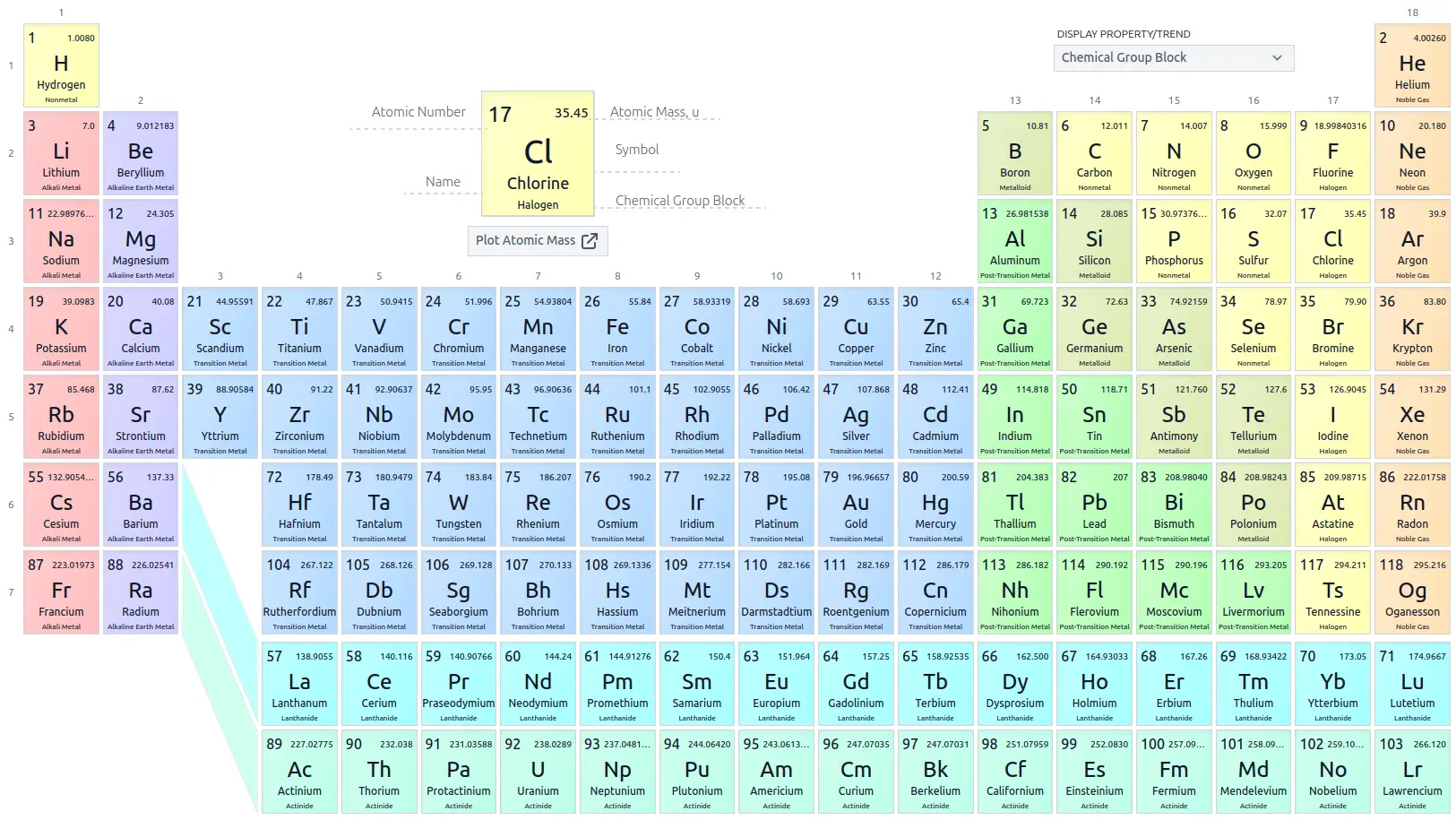
Juno: Each floor is a period (row) of the periodic table, and each room is a group (column). Since there are 7 periods, there are 18 groups. The columns can again be divided into four blocks: s, p, d, f. The first two columns make the s-block. In this block hydrogen is a nonmetal, besides that the first column are alkali metals (red), and the second column are alkaline earth metals (purple). Helium in the last column is also placed in the s-block. Except helium, everyone in columns 13 to 18 are in the p-block. Among them are metalloids, post-transition metals (green), halogens, nonmetals (yellow) and noble gases (brown). A few of these nonmetals are very important for life, especially carbon (C), nitrogen (N), oxygen (O), phosphorus (P), and sulfur (S), abbreviated as CHNOPS. Columns 3 to 12 form the d-block, everyone here is a transition metal (blue). And the pier where we have docked, all the elements here belong to the f-block (cyan), on the bottom floor the actinides (beginning with Ac), and on the floor above them the lanthanides (beginning with La); many of them are radioactive.
Socrates: Why exactly 118 rooms?
Juno: Because until now a total of 118 basic atoms have been discovered. Hydrogen’s atomic number is 1, oganesson’s is 118. In the nucleus at the center of an atom there are protons and neutrons, and around them are electrons. The number of protons in the nucleus is the atomic number. If there are as many electrons as protons, the atom is neutral; if there are more or fewer electrons than protons, ions are obtained: more means negative ion (since electrons are negative), fewer means positive ion. But the property of an atom is determined by the number of protons.
Socrates: What do you mean by property of an atom?
Juno: You will understand with an example. Gold (Au, from the Latin Aurum) has 79 protons, and gold is such a solid that even at 1000 degrees Celsius it remains hard, to melt it requires 1064° Celsius. But by adding just one proton to it we get mercury (Hg), which melts and becomes liquid already at −40° Celsius, which is why at room temperature mercury is liquid inside a thermometer. That means just one proton can change the property of an atom so drastically.
Socrates: I see. So the element Moscovium at number 115, does that mean it is found only in Moscow?
Juno: You should cut down your annoying comedy, Socrates.
Socrates: Leave aside judgment and give the answer.
Juno: Uranium’s nucleus has 92 protons, plutonium heavier than that has 94. Heavier than this are not found naturally in nature, scientists synthesized them artificially in the lab. In making Moscovium, Moscow’s scientists had the greatest contribution, that is why such a name.
Socrates: Why are there no elements heavier than plutonium in nature?
Juno: To understand that we need to go back to the story of the Particle Age. We heard from Ravi that if you bring two particles with the same charge very close, then stronger than their electromagnetic repulsion becomes the attraction of the strong force. That is why so many protons with positive charge can stay together in a nucleus. But if there are more than 94 protons, the nucleus cannot remain stable. That is why they are not in nature, they have to be made in the lab.
Socrates: Suppose we made them in the lab, but how did so many elements form naturally? In the Particle Age we saw that after the Big Bang the universe mainly produced hydrogen (76 percent) and helium (24 percent). Where did all the other elements come from?
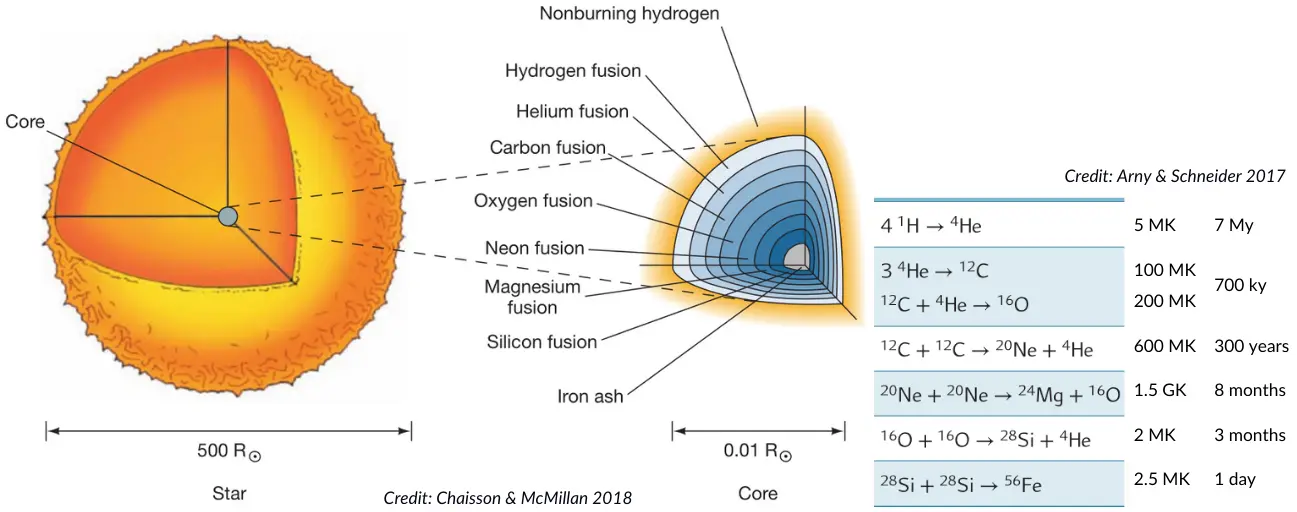
Juno: That is what is shown in this diagram, through a star 500 times bigger than the Sun. A few elements heavier than helium were produced in very small amounts right after the Big Bang, but almost all the elements of the periodic table were born inside stars. The first generation of stars were much more massive than the Sun, which is why they were able to produce many heavy elements. How that happens we heard in the Stellar Age.
Socrates: Actually we did not hear. Mars said that in the cores of massive stars elements up to iron are created, but he did not explain well how.
Juno: Then look again at the diagram above. You will see that in the final stage of life the core of a massive star looks like an onion, meaning it has many layers. At the very center is iron, outside it are several shells: first shell silicon, then successively magnesium, neon, oxygen, carbon, helium, and hydrogen shells. The star has built these shells of elements throughout its life. Let us hear again how. After all the hydrogen in the core has been converted into helium, nuclear fusion stops, and without outward pressure gravity compresses and heats the star. Then at one point the helium at the core’s center produces carbon, while outside remains a shell of helium. After all the helium in the core turns into carbon, fusion again stops, and as before the star compresses and heats up. As a result carbon in the core produces oxygen, outside remains a shell of carbon, and outside that still the previous helium shell. In this way, through the interplay of fusion and gravity, one layer after another is born. The heaviest element is at the center, the further out we go the lighter the elements we find.
Socrates: On the right side of the diagram is it showing how long each reaction takes?
Juno: It is showing how long each reaction continues in the womb of the star, and along with that the temperature required for each fusion reaction is shown in megakelvin and gigakelvin units. Hydrogen fusion that happens at 5 megakelvin lasts for 7 million years. But silicon fusion that happens at 2.5 gigakelvin takes place within just 1 day. That means the iron core of a massive star is made in just one day, this day can be called the last day of its life.
Socrates: But iron has only 26 protons. Then where did all the elements from cobalt with 27 protons up to plutonium with 94 protons come from? The star, you said, has already reached the last day of its life.
Juno: In the Stellar Age we heard that at death such massive stars explode as supernovae. At death through one enormous explosion the star gives us all the other elements as a gift. This is the star’s last donation to the universe. Let me explain how. Elements heavier than iron cannot be formed through normal fusion, because to make them requires investing more energy than is returned after they are made. Nature does not allow such losing reactions to happen. But during a supernova explosion suddenly such a vast amount of energy is released inside the star that it can be invested in reactions to make heavier elements. At the moment of explosion within only a few seconds many elements heavier than iron are born. But besides supernovae there are also some slower processes through which heavy elements can be made. We will not go into that detail.
3. Life on Earth
Socrates: Excellent. Now while our boat is docked at this periodic table pier, I think you should tell us how life arose on Earth. We already heard about the origin of the oceans. Let’s assume that 4 billion years ago oceans were present on Earth. But how did all the elements from the womb of stars arrive inside those oceans?
Juno: That you can already understand. After an explosion a star spreads all the elements inside it into the interstellar medium. The interstellar cloud from which our solar system was born already contained many elements because of the explosions and deaths of many neighboring stars. Since Earth was born from such a metal-rich cloud, it can be said that from the beginning it inherited all the elements.
Socrates: Very well. Then tell us how from these inert elements we got biomolecules, microbes.
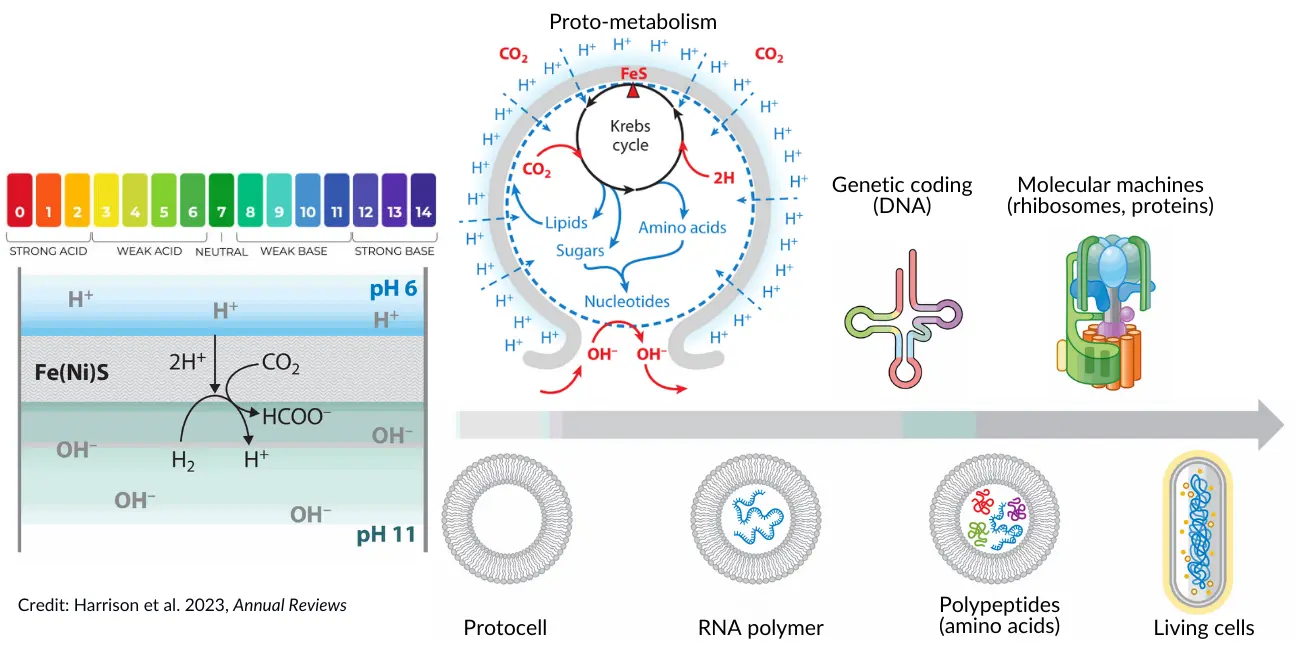
Juno: Scientists do not yet know the whole process. But the most interesting hypothesis is shown in the diagram above. On the far left is a hydrothermal vent on the ocean floor. Scientists think that in such seafloor vents life first arose about 3.5 billion years ago. At that time the oceans were acidic, with a pH level of 6. Inside the ocean floor vents were alkaline or basic fluids, with a pH level of 11. In the acidic ocean there were positive hydrogen ions (H$^+$), meaning protons. In the alkaline vent there were negative hydroxyl ions (OH$^-$). Between the ocean and the vent there was a wall of iron–nickel sulfide, Fe(Ni)S, which created many microscopic chambers inside the wall. In these chambers, through the flow of protons coming down from the ocean water, from inert hydrogen and carbon dioxide the organic ion formate was created, with the formula HCOO$^-$. In this way, though not life, at least the organic was born from the inorganic.
Socrates: Will it be enough just to make formate? Is life such a simple thing?
Juno: Of course not. Formate is just one example. On the right side of the vent in the diagram the arrows above and below show the next steps. The first appearance of life actually took place through primitive metabolism, which is seen in the large cycle at the top.
Socrates: I have heard of meatball, but I don’t know what metabol is, on top of that metabolism!
Juno: I had wanted to explain, but after hearing your silly sarcasm the desire is gone. Ask your AI what metabolism is, not me. Let us return to the picture of proto-metabolism. You see a well-like structure resembling a cell, through whose wall protons (H$^+$) could enter, because the ocean outside the wall was positive and the inside was negative. With the flow of protons like a battery, possibly a primitive Krebs cycle was running inside this well, the biochemical cycle through which life obtains nutrients, meaning gathers energy from nutrients. Here the nutrients, meaning the inputs, were mainly hydrogen, hydroxyl, and carbon dioxide. And the outputs were four kinds of biomolecules most essential for life: lipids, sugars, amino acids, nucleotides. Life makes its cell walls from lipids, gets energy from sugars, makes proteins from amino acids, and makes RNA and DNA, that is, the genetic code, from nucleotides.
Socrates: Is it the birth of all these things that is being shown next?
Juno: Yes. Probably first protocells were made with walls of lipids, which floated in the stream of geochemical energy inside the vents. Inside these cells the very first thing needed is an information-processing system, or self-information. Without information the formation of life is not possible, it is not possible for thousands of bodies to replicate from one body. From nucleotides the first information system to arise was ribonucleic acid (RNA). The work of copy-paste was first begun by RNA. But the system became stronger when deoxyribonucleic acid (DNA) began to be produced. The work of coding information was taken over by DNA, RNA got the role of messenger. According to the code of DNA, various molecular machines, ribosomes and proteins, began to be made. With these the first living cell was formed. The first cells were not like human cells. Our eukaryotic cells are basically round, the primitive prokaryotic cells were elongated, and they did not have a nucleus. Thread-like DNA (shown in blue) floated in the fluid of the cell, not coiled in the center like our chromosomes.
Socrates: Explain this genetic code thing. Processor, code, information, copy-paste — these are words we understand in the case of computer coding. What relation does a computer have with the cell of life?
Juno: If you can once write down the perfect instructions for making something as a code, then with that code you can make that thing as many times as you wish, if the raw material is there. It was about 3.5 billion years ago that Earth first understood this on the chemical and biological scale. The alphabet in which computer code is written has only two letters, 0 and 1. With only these two letters an infinite number of “words” of different lengths can be made. In the cells of life the code is written with a four-letter alphabet, the four letters are the English A T C G.
Socrates: What physically are A T C G?
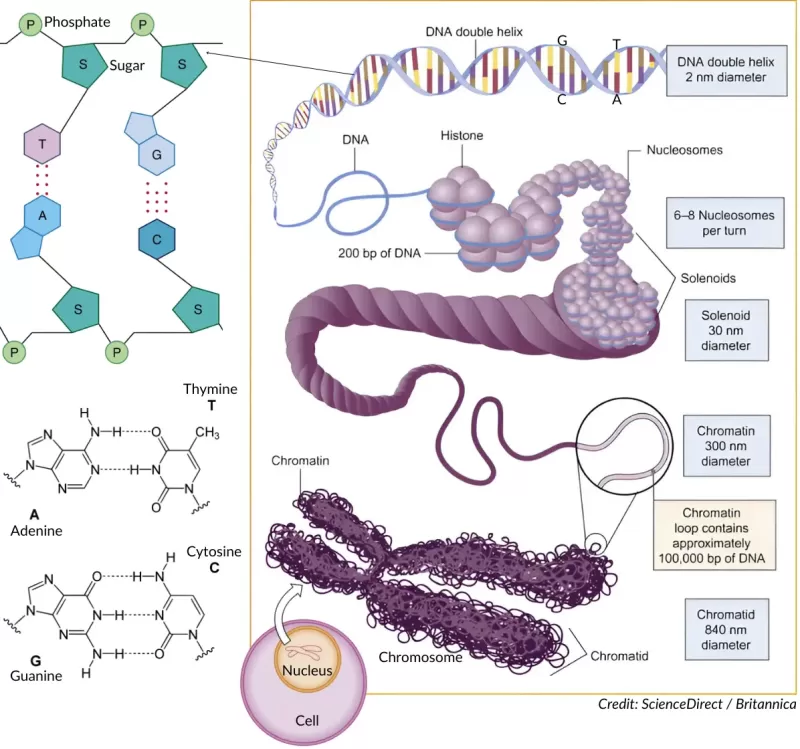
Juno: A T C G are four nucleotide bases arranged one after another between the two helices of DNA, called nitrogenous bases because they are made with nitrogen. The diagram shows the DNA of our body. At the very top you see the two twisted helices. A base of one helix is bonded with a base of the other helix, two bases from the two helices together form a base pair (bp). Much like a spiral staircase: if the two railings of the staircase are the two helices, then the steps are the bases attached to the helices. On the left side you can see more clearly, the ribbon of the helix is made with phosphate and sugar, and inside them are set the bases. Bonds of A with T and C with G are shown. The structures of the ATCG bases are also given at the bottom left, you can see many carbons, nitrogens, oxygens, hydrogens. Three consecutive base pairs together form a codon, or triplet. Codons that come together to make a specific protein can be called a gene. From here the concept of the genetic code came.
Socrates: Below the double helix I see many more things, with their sizes written.
Juno: Yes, it is showing the packaging of DNA inside the cell. DNA base pairs (bp) of 2 nanometers (nm) in size are wound around histone proteins. 200 bp wrapped around a histone together make an 11 nm nucleosome, which in turn coils again into a 30 nm solenoid, each turn of which contains 6–8 nucleosomes. Many solenoid fibers together form 300 nm chromatin, which condenses into even thicker chromatids, 840 nm in diameter. Two chromatids joined with a bridge in the middle make one chromosome. Inside the nucleus of our cells there are 46 such chromosomes.
Socrates: A gigantic tangle.
Juno: In reality the tangle is even greater, I just simplified it.
Socrates: Then to untangle it answer this question: through geochemical energy in this way, could the birth of life from the inorganic take place on any planet?