
Table of Contents
3.4. Stellar remnants
1. White Dwarf
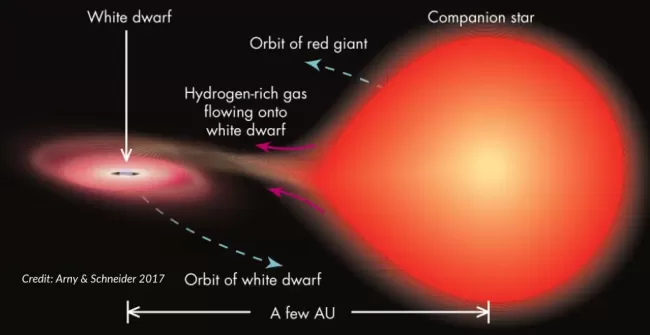
While a solitary small star quietly fades away as a white dwarf, the fate of a white dwarf in a binary star system can be far more dramatic. As illustrated, if a white dwarf shares a close orbit—separated by only a few astronomical units (AU)—with a larger companion star, often a red giant, their gravitational interaction changes everything. The immense gravity of the incredibly dense white dwarf begins to siphon off material from its bloated companion. This process creates a steady stream of hydrogen-rich gas that flows continuously onto the surface of the white dwarf, gradually increasing its mass.
As this stolen gas accumulates, the white dwarf is pushed toward a critical breaking point. The added mass significantly increases the pressure and temperature within the already hyper-dense stellar remnant. If the white dwarf accumulates enough material to reach a specific mass threshold, it triggers a sudden, runaway nuclear fusion reaction throughout its entire interior. This cataclysmic event results in a Type Ia supernova—a thermonuclear explosion so phenomenally bright that it completely obliterates the white dwarf, leaving no remnant behind and scattering newly forged elements across the galaxy.
2. Neutron Stars

While small stars end their lives as white dwarfs, the fate of massive stars is far more extreme. When a massive star exhausts its nuclear fuel, its core can no longer support the crushing weight of its outer layers. The core collapses violently, triggering a cataclysmic supernova explosion that blows the star’s outer envelope into space. If the collapsed core’s mass is within a certain range, the immense gravitational pressure forces protons and electrons to merge into neutrons. This creates a neutron star—an incredibly dense stellar remnant, typically measuring only about 10 kilometers across, packing the mass of a star into a sphere the size of a small city.
In many cases, the collapse that forms a neutron star drastically dramatically increases its rotation speed and amplifies its magnetic field. As illustrated, this rapid rotation powers twin beams of intense electromagnetic radiation that shoot outward from the star’s magnetic poles. If the neutron star’s magnetic axis is misaligned with its rotation axis, these radiation beams sweep through space much like the rotating light from a lighthouse. When one of these beams sweeps across our line of sight, instruments detect a sharp, regular pulse of radiation, creating a distinctive peak in its observed light curve. These highly regular, rapidly spinning neutron stars are known as pulsars.
3. Black Hole
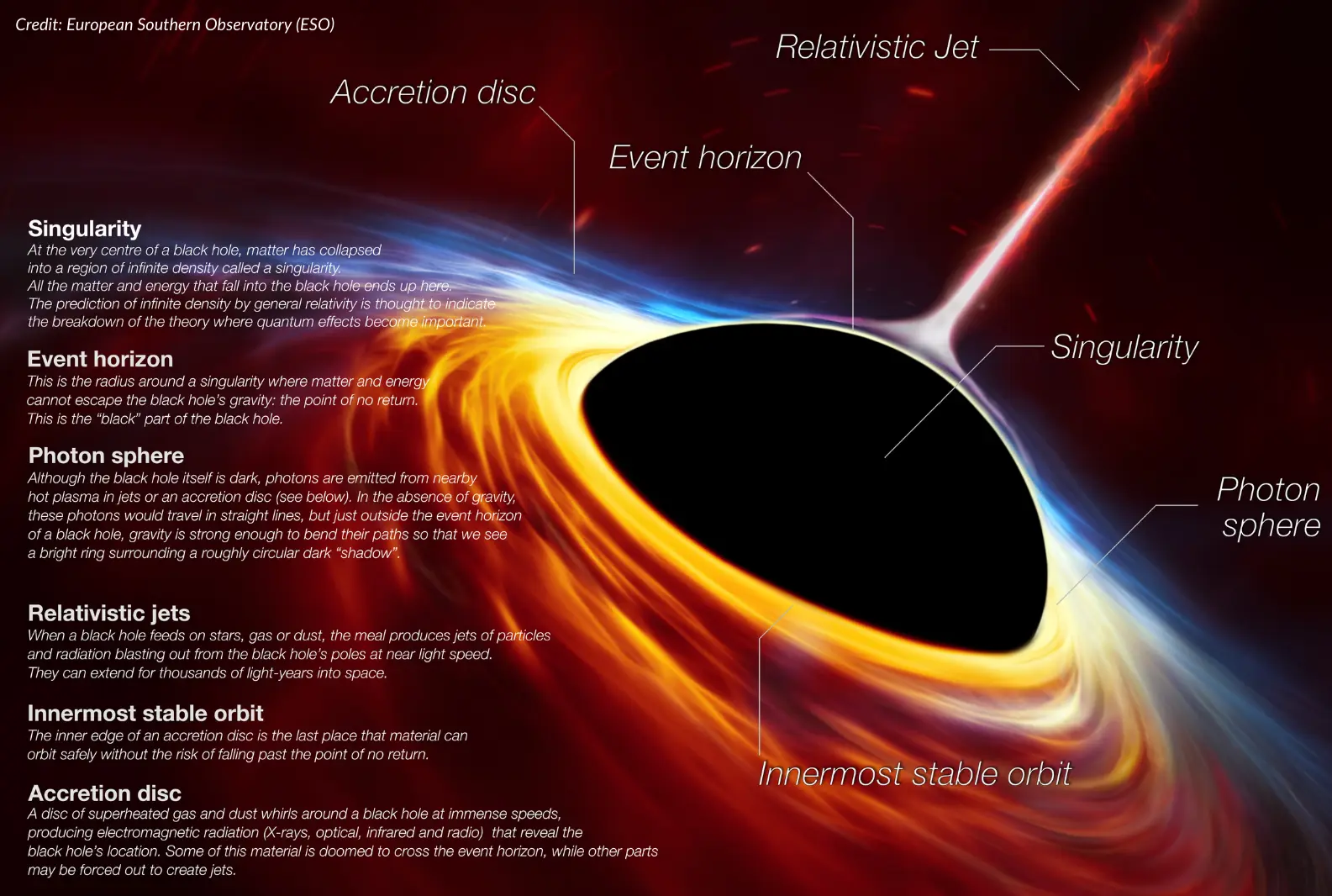
While white dwarfs are supported against gravity by the outward push of compressed electrons, and neutron stars by the resistance of tightly packed neutrons, there is a strict limit to how much mass these quantum mechanical pressures can hold. If the collapsing core of an exceptionally massive dying star exceeds a critical mass threshold, gravity ultimately wins. The crushing inward pull overpowers the neutron pressure, resulting in a total, catastrophic collapse. The core’s material shrinks infinitely inward until all its mass is concentrated into a single point. This creates a black hole—an object with a gravitational field so intense that not even light moving at ultimate speed can escape it.
Although black holes themselves are invisible, they are often defined by highly energetic surrounding structures. At the very center lies the singularity, the region of infinite density where matter and energy end up and known physics breaks down. Surrounding this is the event horizon, the “black” boundary representing the absolute point of no return. Just outside this horizon is the photon sphere, where extreme gravity bends the paths of emitted light to form a bright ring around a circular dark “shadow.” Further out, superheated gas and dust whirl at immense speeds in an accretion disc, glowing intensely with electromagnetic radiation. The inner edge of this disc is marked by the innermost stable orbit, the last safe zone before material risks falling past the event horizon. Finally, as the black hole feeds on this orbiting material, it can blast particles and radiation outward from its poles at near light speed, creating massive relativistic jets that stretch for thousands of light-years into space.