
This is an old revision of the document!
The Sun
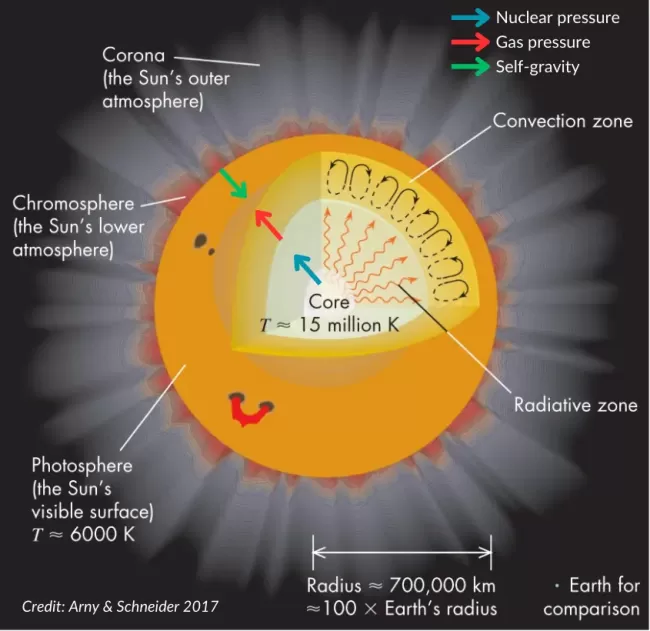
The Sun’s interior structure is defined by a balance between inward gravity and outward pressure, organized into three distinct concentric layers. At the center lies the core, a region extending 200,000 km where temperatures of 15 million Kelvin drive the nuclear fusion of hydrogen into helium. Surrounding the core is the radiation zone, where energy travels slowly as photons through ionized gas, taking up to a million years to traverse the 500,000 km layer. This transitions into the convection zone, where the gas becomes opaque; here, energy is transported by the physical churning of rising hot plasma and sinking cool gas, a motion that creates the mottled “granulation” pattern visible from the outside.
The visible boundary of the Sun is known as the photosphere, a relatively thin layer approximately 500 km deep with a temperature of roughly 5,800 Kelvin. While the Sun appears to the naked eye to have a sharp, solid edge, this is an optical illusion; the photosphere is simply the depth at which the solar gas becomes transparent to visible light. It acts as the surface interface, radiating the energy generated deep within the core out into space.
Above the photosphere lies the complex solar atmosphere, beginning with the chromosphere, a reddish layer about 1,500 km thick that is often visible during solar eclipses. Beyond a narrow transition zone where heat rises dramatically, the atmosphere expands into the corona, a tenuous, ghostly halo where temperatures soar to 3 million Kelvin. This outer atmosphere eventually flows continuously outward into the solar system, evolving into the stream of charged particles known as the solar wind.