
3.1. The Sun
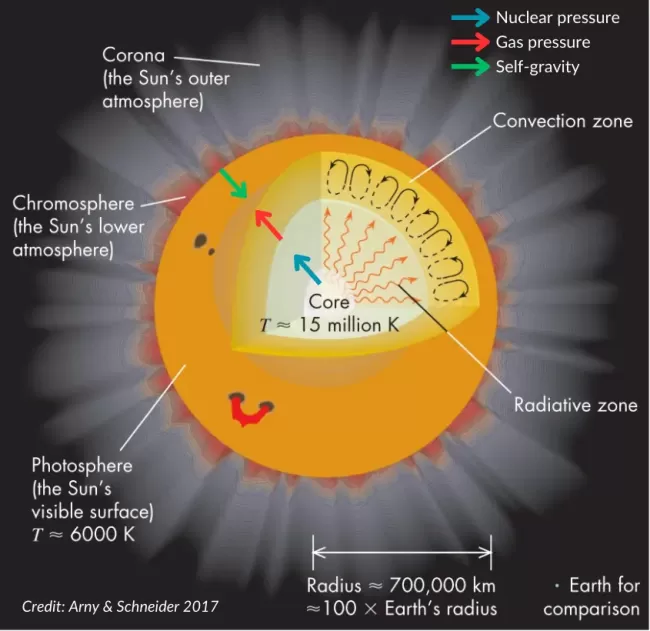
At the heart of our solar system, the Sun is a dynamic sphere of plasma held together by a delicate, ongoing battle of physical forces, as illustrated in the cross-section above. Deep within its core, where temperatures soar to an unimaginable 15 million Kelvin, extreme conditions ignite continuous nuclear fusion reactions. This intense nuclear activity generates a powerful outward push, represented by the blue arrows of nuclear pressure. Simultaneously, the immense mass of the Sun exerts a relentless inward pull, shown by the green arrows of self-gravity. To prevent the star from collapsing under its own weight, the outward nuclear pressure combines with the outward thermal gas pressure (red arrows). This perfect balance of opposing forces stabilizes the Sun.
Surrounding the nuclear furnace of the core is the radiative zone, a vast, dense region where energy begins its long journey outward. Here, the energy generated in the core travels primarily in the form of radiation. Photons of light bounce erratically among the densely packed atomic particles, taking potentially hundreds of thousands of years to navigate this thick layer. Just beyond the radiative zone lies the convection zone, characterized by the circular, looping arrows in the diagram. In this cooler outer envelope, the plasma becomes less dense and physically churns. Hot plasma rises toward the surface, releases its energy, cools, and then sinks back down to be reheated, creating a continuous boiling motion that efficiently transports heat to the surface.
The visible surface of the Sun, known as the photosphere, is a thin layer where the temperature drops to a relatively cool 6000 Kelvin. This is the boundary where the Sun’s light finally escapes into space, illuminating planets like Earth, which is dwarfed by the Sun’s massive 700,000-kilometer radius. Above the photosphere lies the solar atmosphere, beginning with the chromosphere, or “lower atmosphere.” Extending far beyond that is the corona, the Sun’s tenuous and expansive outer atmosphere. While normally invisible due to the overwhelming glare of the photosphere, the ethereal, wispy tendrils of the corona burst into spectacular view during a total solar eclipse, showcasing the dramatic and expansive reach of our star.