
2.1. Milky Way
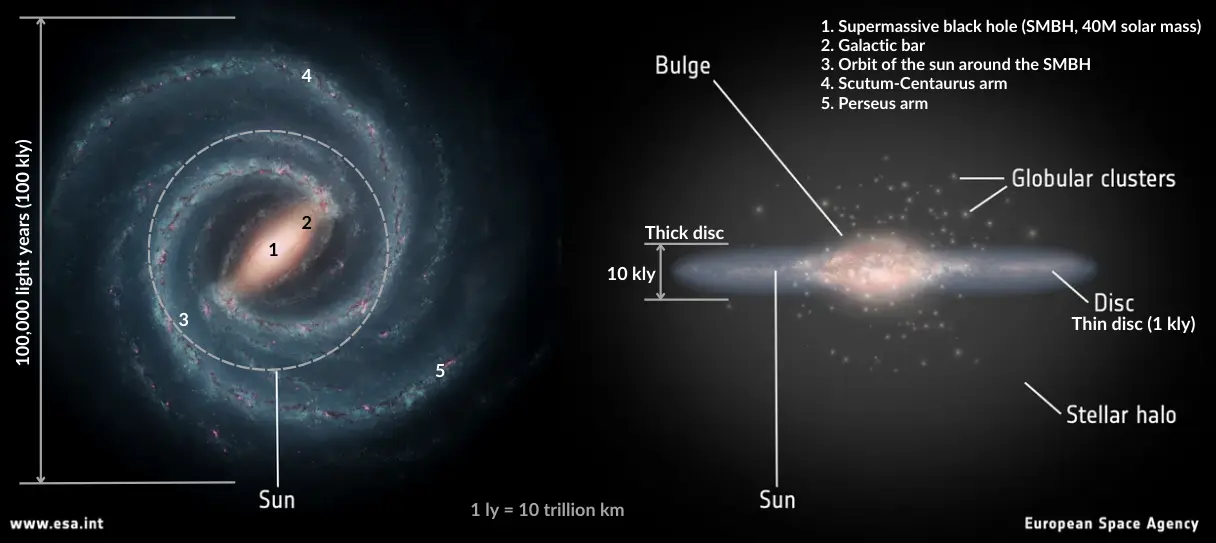
Viewed edge-on, the Milky Way Galaxy resembles a highly flattened pancake measuring approximately 100,000 light-years (ly) in diameter. Its luminous matter is heavily concentrated in a plane characterized by a young “thin” disk roughly 1 kly thick, which is embedded within an older, intermediate “thick” disk measuring roughly 6.5 to 10 kly from top to bottom. At the very center lies the Galactic bulge, a dense, football-shaped structure containing an elongated bar of stars measuring about 20 kly across. Completely enveloping the disk and central bulge is the vast, roughly spherical Galactic halo, a sparsely populated realm containing ancient, randomly orbiting stars and tightly bound globular clusters that extend far above and below the galactic plane.
Viewed face-on from far above the galactic plane, the Milky Way’s magnificent pinwheel structure is revealed, and its distinctly elongated central bar of stars—which is not so clear in the edge-on view—becomes clearly visible. Radiating outward from the ends of this central bar are the Galaxy’s swirling spiral arms, which are packed with gas, dust, and young blue stars. While it is difficult to map our Galaxy’s exact layout from the inside, observations indicate there are usually two main arms accompanied by considerable structure and smaller appendages, including the Perseus Spiral Arm and features broadly classified as the inner, outer, major, and intermediate arms. Our Sun is nestled near the edge of one of these arms, located roughly 26 kly away from the Galactic center, meaning we reside about half to two-thirds of the way out toward the disk’s edge. From this suburban location, the solar system travels in a roughly circular orbit around the center of the Galaxy at a speed of 200 km/s, taking between 225 and 250 million years to complete a single cosmic revolution.
Because we reside deep inside the Milky Way Galaxy along with our Sun, we can never travel far enough into space to look back and witness these majestic edge-on or face-on views directly. Instead, the sweeping pinwheel and flattened disk structures we picture are models painstakingly reconstructed using optical, infrared, and radio observations of stars, gas, and dust, often guided by comparing our system to distant, observable galaxies.

From our internal vantage point on Earth, peering into the plane of the Galactic disk reveals a hazy, irregular band of light stretching across the entire sky from horizon to horizon (as seen above from Namibia), formed by the merged light of countless stars mixed with obscuring dark lanes of interstellar dust. When viewed from a dark, moonless location, the appearance of this glowing band changes dramatically with the seasons as Earth orbits the Sun. In the summer, the Milky Way stretches brilliantly from Perseus in the northern horizon through Cygnus overhead, thickening toward the galactic center in Sagittarius and Scorpius in the south. By contrast, during the springtime, the Milky Way lies level with the horizon, leaving the overhead night sky largely free of its glowing band and allowing us to look unhindered out of the galactic plane toward deep, intergalactic space.