
1.4. Cosmic Microwave Background
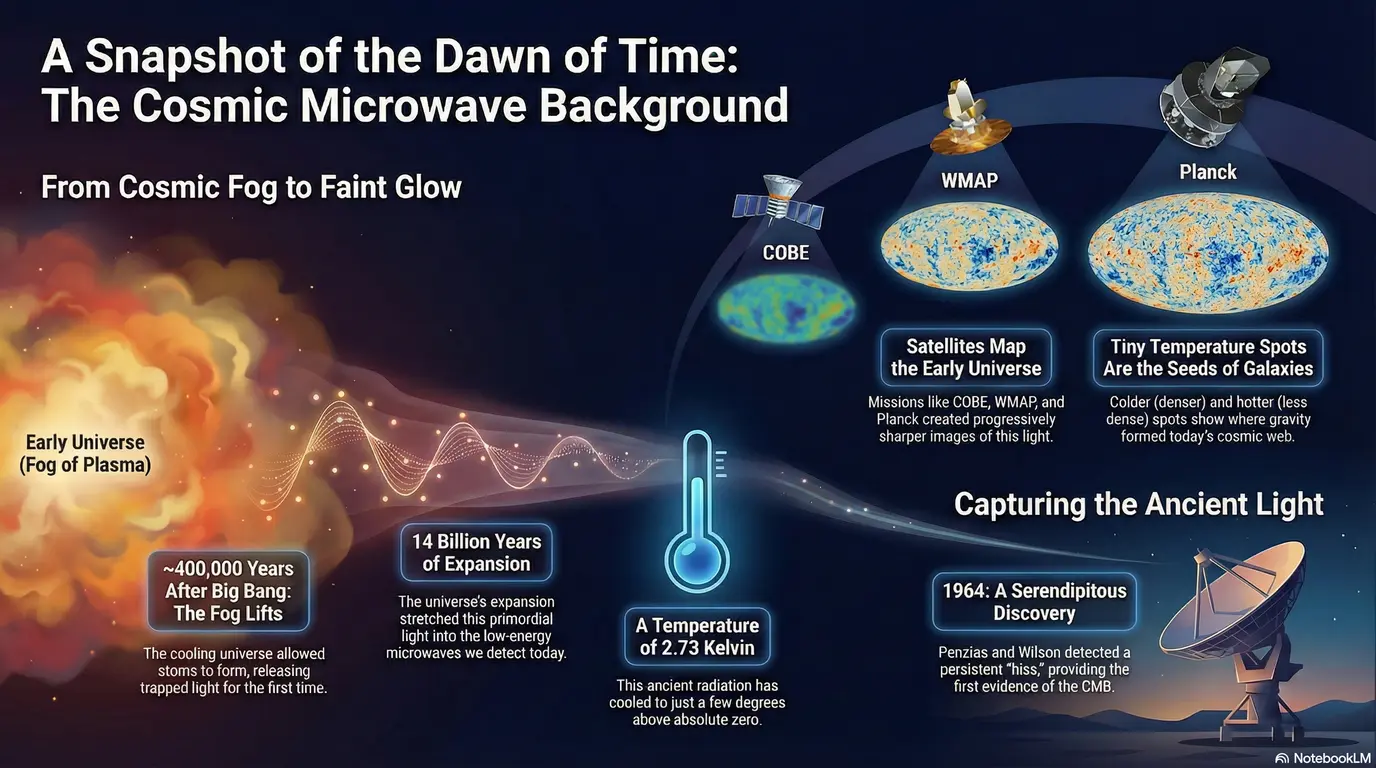
In the earliest moments of the universe, photons were trapped in a hot, dense fog of free electrons that scattered light continuously, rendering the cosmos opaque. However, approximately 400,000 years after the Big Bang, the expanding universe cooled to roughly 3000 K, a threshold low enough for electrons to combine with protons and form neutral hydrogen atoms. This pivotal event, known as recombination, lifted the fog and allowed photons to decouple from matter, finally streaming freely through space primarily as visible and infrared light. Over the subsequent 14 billion years, the relentless expansion of the universe has stretched the fabric of space itself, elongating the wavelengths of these ancient photons by a factor of roughly 1,100 through cosmological redshift. Consequently, this primordial radiation has cooled and shifted from energetic light into the low-energy microwave band, permeating the cosmos today as the Cosmic Microwave Background (CMB) radiation with a temperature of approximately 2.73 K, often rounded to 3 K.

The definitive confirmation of the Big Bang theory emerged serendipitously in 1964 when Arno Penzias and Robert Wilson (pictured above), utilizing a 20-foot horn-shaped radio antenna at Bell Labs in New Jersey, detected an inexplicable signal. While attempting to calibrate the instrument for satellite communications, they encountered a persistent, low-level background “hiss” that arrived uniformly from every direction, unwavering regardless of time or season. After rigorously ruling out terrestrial interference—a process that even involved scrubbing pigeon droppings from the antenna—they consulted Robert Dicke’s team at Princeton, who identified the “static” as the elusive CMB. This discovery provided the smoking gun for the Big Bang theory, as the radiation perfectly matched the predicted “fossil remnant” of the universe’s hot, dense origin—now redshifted to about 3 Kelvin—a phenomenon that the competing Steady State theory could not explain.
Following the initial detection of the CMB, astronomers deployed a succession of satellites to map its subtle temperature variations across the celestial sphere. NASA’s COBE satellite (1989) pioneered this effort by producing the first full-sky map, confirming the CMB’s “blackbody spectrum”—the specific pattern of light intensity emitted by an object based solely on its temperature, much like the glow of a hot iron—and detecting the minute temperature ripples (anisotropies) essential for structure formation, despite its coarse resolution. This view was radically sharpened by the WMAP mission (2001), which mapped the sky with 30 times better resolution and significantly greater sensitivity than its predecessor. Finally, the European Space Agency’s (ESA) Planck mission (2009) brought the early universe into even sharper focus, improving resolution by another factor of three and sensitivity by a factor of ten. Together, these progressively detailed maps have transformed cosmology into a precision science, confirming a spatially flat universe dominated by dark energy and dark matter.
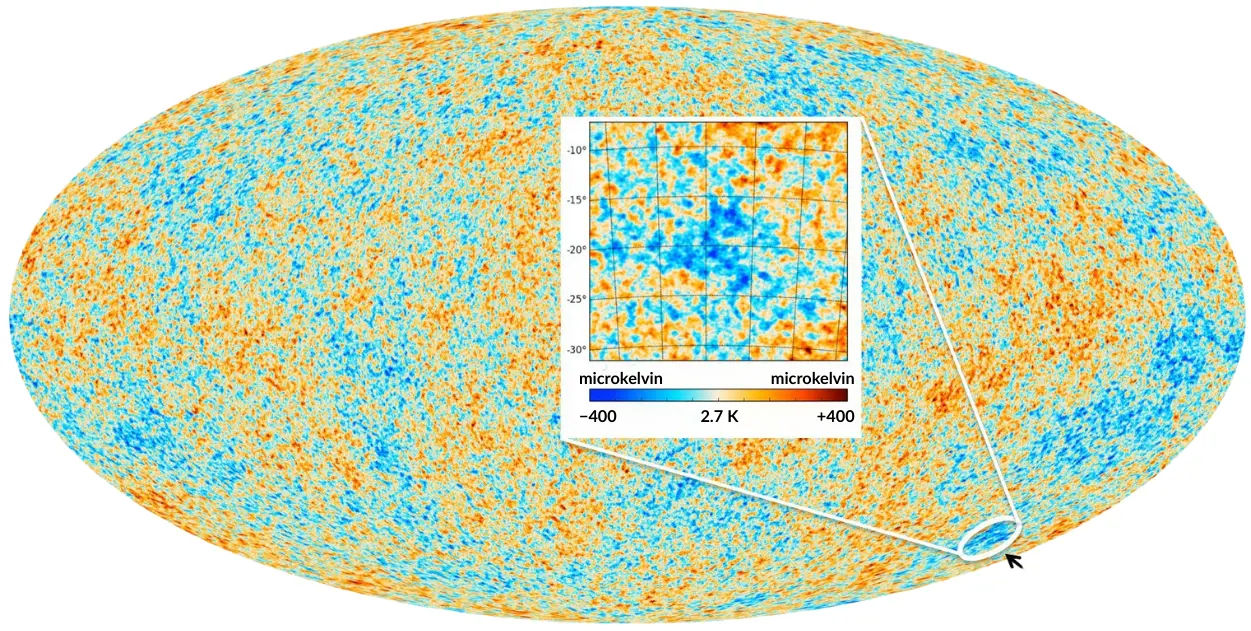
The Planck mission delivered the most exquisite all-sky map of the CMB to date, shown above. This “baby picture” of the cosmos reveals minute temperature variations, visualized as red and blue spots, representing tiny deviations from the universe’s average temperature. As indicated by the scale bar on the inset, the neutral center point sits at 2.73 K, with the chromatic differences representing fluctuations of roughly 400 microkelvin (millionth of a kelvin). These temperature differences signify regions of slightly differing density; specifically, the blue (colder and denser) and red (hotter and less dense) spots track primordial density fluctuations that acted as the cosmic “seeds” for future growth. Through the relentless influence of gravity, matter eventually coalesced in the denser regions to form the vast web of galaxies and clusters observed today, making the Planck map a direct image of the embryonic structures of our universe.
Launched in 2009, the Planck telescope operated from the “L2 Lagrangian” point, a gravitationally stable position 1.5 million kilometers from Earth where it could remain permanently shadowed from the Sun. Rather than orbiting Earth, Planck followed our planet around the Sun, scanning the entire sky (as illustrated in the video above) every six months to compile a complete map of the cosmos. To generate the final image of the Cosmic Microwave Background, astronomers had to mathematically excise significant foreground interference, most notably the microwave emissions from the Milky Way Galaxy, which appeared as a bright band in the raw data. By comparing observations taken at multiple wavelengths (ranging from 3 mm to 13 mm), scientists successfully subtracted these local signals to unveil the faint, primordial background universe at its infancy.