
Table of Contents
1.2. Formation of elementary particles
The elementary particles

This diagram presents a circular visualization of the Standard Model of Particle Physics, serving as a cosmic inventory that organizes the universe into “bricks” (elementary particles of matter) and the “mortar” (elementary particles of energy) that binds them. At the very center lies the Higgs boson, the particle associated with a field that permeates the vacuum of space. By interacting with this field, other particles gain mass, effectively transitioning from manifestations of pure energy into the building blocks of a tangible world. Without this mechanism, the fundamental “bricks” would zip through the universe at the speed of light, unable to clump together to form atoms, stars, or the complex structures of life.
The orange ring identifies the bosons, which can be thought of as the “mortar” or force carriers of the universe. Rather than solid matter, these particles are essentially discrete packets of energy—quanta—that mediate interactions. The photon ($\gamma$) carries electromagnetic energy, the gluon ($g$) manages the strong force “glue” that keeps atomic nuclei together, and the heavy $W$ and $Z$ bosons facilitate the weak nuclear force responsible for radioactive decay. In this framework, forces are not mysterious actions at a distance but the result of these energy-carrying particles being exchanged between matter, much like a ball being tossed between two players to keep them connected.
The outermost ring contains the fermions, the “bricks” that constitute all material structures. These are split into quarks (blue), which combine to form protons and neutrons, and leptons (light purple), such as the electron and the ghostly, nearly massless neutrino. To maintain cosmic symmetry, every one of these particles has a mirror-image antiparticle, such as the positron (the antimatter version of the electron). While matter and energy are often viewed as distinct, they are fundamentally linked; for instance, if an electron meets a positron, they undergo annihilation, instantly canceling each other out to release a flash of pure energy in the form of gamma-ray (extremely high energy or frequency) photons. Yet, this inventory remains incomplete, as it has yet to incorporate the “mortar” of gravity into its quantum architecture.
Origin of the particles
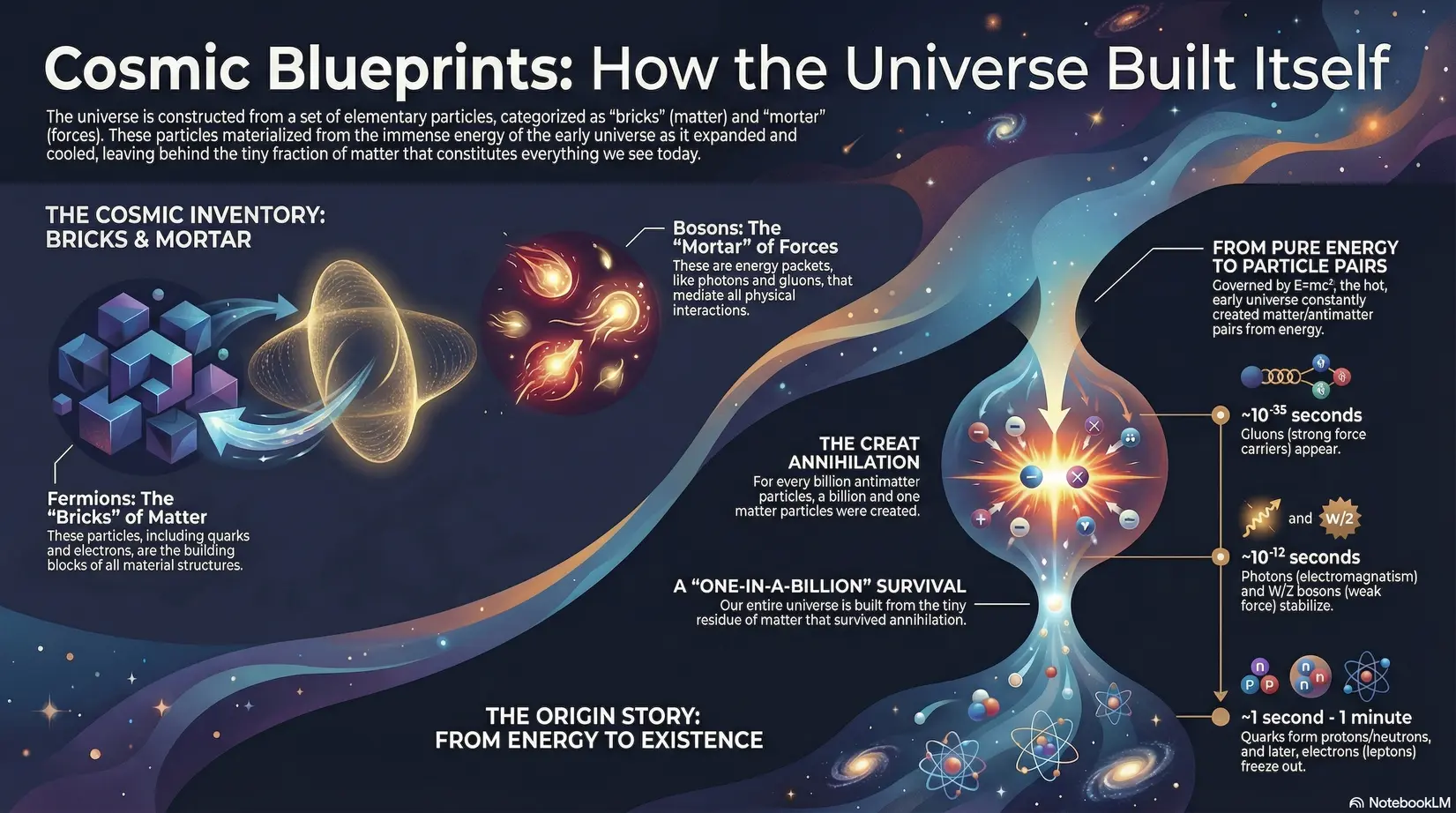
The genesis of the material universe was a process governed by the dynamic equivalence of matter and energy, formulated by Einstein’s celebrated principle, $E=mc^2$. In the intensely energetic environment of the infant universe, subatomic particles did not exist as stable entities; instead, they “materialized” from radiant energy through pair production—a mechanism in which high-energy bosons collided to generate a particle and its corresponding antiparticle. This creative flux was balanced by immediate annihilation, wherein particle pairs reverted to pure energy upon contact. However, as the universe expanded and underwent cooling caused by its rapid growth, the energy density dropped below the specific “threshold temperatures” required to sustain the production of massive particles. As a result, various types of particles “froze out” of the radiation field, becoming permanent features of the universe. This occurred because the cooling environment no longer provided enough energy to create new particle pairs, meaning that those destroyed by annihilation were no longer being replaced.
The first distinct particles to populate the cosmos were the bosons, the fundamental carriers of nature’s forces. These particles did not appear all at once, but emerged in a specific order as the universe cooled. During the Planck epoch ($t<10^{-43}$ seconds), the environment was too energetic for individual force-carriers to exist independently. The first to manifest was the hypothetical graviton, the particle responsible for gravity. At approximately $10^{-35}$ seconds, during the Grand Unified Theory (GUT) epoch, gluons appeared; these are the particles that carry the strong nuclear force and allow quarks to stick together. Finally, at roughly $10^{-12}$ seconds, as the temperature dropped to $10^{15}$ Kelvin, the last group of force-carrying particles stabilized. This included the massless photons, which carry electromagnetism, and the heavy W and Z bosons, which are responsible for the weak nuclear force.
As these fundamental forces distinguished themselves, fermions—the structural constituents of matter—stabilized in a sequence dictated by their mass. Within the first microsecond, the universe was filled with energetic gluons. In this “quark-gluon plasma,” the energy carried by colliding gluons was so intense that it constantly converted into mass, creating pairs of quarks and antiquarks. As the temperature fell below $10^{13}$ Kelvin (approximately one microsecond after the Big Bang), the quark epoch concluded; the gluons no longer had sufficient energy to create new quarks, and instead began to act purely as a “glue.” This allowed quarks to be permanently bound together to form larger particles called hadrons, primarily protons and neutrons. This was followed by the lepton epoch; by approximately one second after the Big Bang, neutrinos ceased their frequent interactions with matter, beginning their journey as leftover radiation through the expanding volume of space. By the time the universe reached an age of one minute and temperatures dropped below $10^9$ Kelvin, electrons—the lightest charged leptons—effectively “froze out,” marking the conclusion of the primary matter-creation phase.
The persistence of this material world is attributed to a subtle yet critical imbalance between matter and antimatter in the early universe. Theoretical models suggest a slight but significant disparity: for every billion particles of antimatter, a billion and one particles of ordinary matter were produced, likely due to the specific way heavy bosons decayed during the GUT epoch. As the cosmos cooled, matter and antimatter annihilated in a near-total erasure, transforming their mass back into the radiant energy that permeates the modern sky as the Cosmic Microwave Background. The vast majority of the primordial plasma vanished in this event; the entire observable universe—every galaxy, star, and human being—is constructed from the minuscule “one-in-a-billion” residue of survivors that remained after the final annihilation.