
Table of Contents
0. The Seven Ages of Universe
[On a regular street sidewalk of Barzakh]
Socrates: One, two, three, four, five, six — but where is the seventh one, Ishtar? Yesterday I was the guest of all seven of you, and in return today you were supposed to be my guests.
Ishtar: Juno is late, as always.
Socrates: If we can’t gather all seven, our conversation won’t flow properly.
Rabi: I heard Juno went to a Buddhist monastery between Manas Sarovar and Rakshastal this morning and hasn’t returned yet. How about we leave Barzakh now and descend to Earth? You can host us there.
Socrates: Not a bad idea. And the discussion with which I intend to host you will suit the shores of Manas Sarovar perfectly. Let’s go then.
[Between Manas Sarovar and Rakshastal]
Socrates: What news, Juno? We kept missing you so much that we ended up coming all the way from the sky down to Earth.
Juno: I was on my way to Barzakh, but seeing the reflection of clouds on the lake I forgot all about you. You know how rare clouds are here.
Socrates: It’s better if I don’t look too much at clouds. I’ve already heard enough abuse from Aristophanes without ever seeing a cloud.
Juno: Fine, no need to look at clouds. Come to the roof of that monastery, all of you. From the roof you can see Rakshastal, Manas Sarovar, and Mount Kailash together.
Socrates: With so many things to look at, will you still need the gift of my words?
Juno: That’s exactly the test, Socrates. Yesterday we gave you that long, heavy discussion about the constitution of an ideal state, and in return today you must offer us something so compelling that our eyes won’t wander elsewhere.
1. The Seven Ages
 [On the roof of a Buddhist monastery on the shores of Manas Sarovar.]
Socrates: I will speak about the fourteen-billion-year history of the Universe. Our successors in Europe combined “uni” and “verse” to form the word “universe.” “Uni” means one, “verse” means to turn or transform; “universe” means “to turn into one thing.” Yesterday you spoke about nations, and the reason why the institution built to create those nations is called a “university” can be found in the meaning of “universe” itself. Just as a university unites all students and teachers into a single identity of a nation, the word “universe” brings all of cosmic existence into a single entity. I have many parts—hands, feet, nose, mouth, ears, heart—but all together I am one human being. Similarly, within the cosmic web there are many galaxies, gas, stars, planets, moons, asteroids, but taken together the Universe is one single thing.
This fourteen-billion-year history of the Universe can be divided into seven ages: the Particle, Galactic, Stellar, Planetary, Chemical, Biological, and Cultural Ages. The first three hundred thousand years are the Particle Age, and the last three hundred thousand years are the Cultural Age.
Rabi: The Brahmaputra River, which is born from many glaciers near Manas Sarovar, also has seven stages.
Socrates: Exactly. And over time the river has a metaphorical relationship with time itself. What do you think?
Riya: Yes, like a river, our time flows only in one direction.
Socrates: Then we can elevate the comparison of the Universe’s time with the Brahmaputra River from metaphor to allegory. The seven stages of the Brahmaputra—Aangsi, Sangpo, Siang, Brahmaputra, Jamuna, Padma, Meghna—can be analogies for the seven ages of the Universe. Shakespeare spoke of the seven ages of a human life from childhood to old age. The Universe too, since its birth, has passed through seven ages and has now grown quite mature. Through the Meghna, the Brahmaputra flows into the Bay of Bengal. Do you see any relationship between the ocean and the time of the Universe?
Riya: If the rivers from Aangsi to Meghna represent the past and the present, then the ocean is undoubtedly the metaphor of the future.
Socrates: Exactly. The river is narrow like the past, while the ocean is vast like the future. In my past, only one set of events has occurred—bounded like a river between two banks. But in the future many things can happen; like the sea, the possibilities are endless.
Riya: Wonderful, Socrates, your introduction is excellent.
Socrates: Thank you. But remember what Rabindranath said: “When I open my eyes to this light, then your gaze will find fulfilment.” If you do not open the eyes of your mind, I will not be able to see. The responsibility of showing the relationship between each age of the Universe and each stage of the Brahmaputra lies first with you. After that, over the next seven days I will speak in detail about each age.
Riya: We agree. Who will take which one?
Socrates: You already know. Your names coincidentally match the seven days of the week—or the seven planets of our era. Rabi with Sunday and the Sun, Shashi with Monday and the Moon, Mars with Tuesday; Hermes, being another name for Mercury, matches Wednesday; Juno, being the consort of Jupiter, matches Thursday; Ishtar, the predecessor of Venus, matches Friday; and Riya, as the consort of Saturn, relates to Saturday. Rabi will begin by comparing the Particle Age with Aangsi, then one by one the others will follow, and Riya will finish by comparing the Cultural Age with the Meghna. Rabi, begin.
2. Seven Ages, Seven Rivers
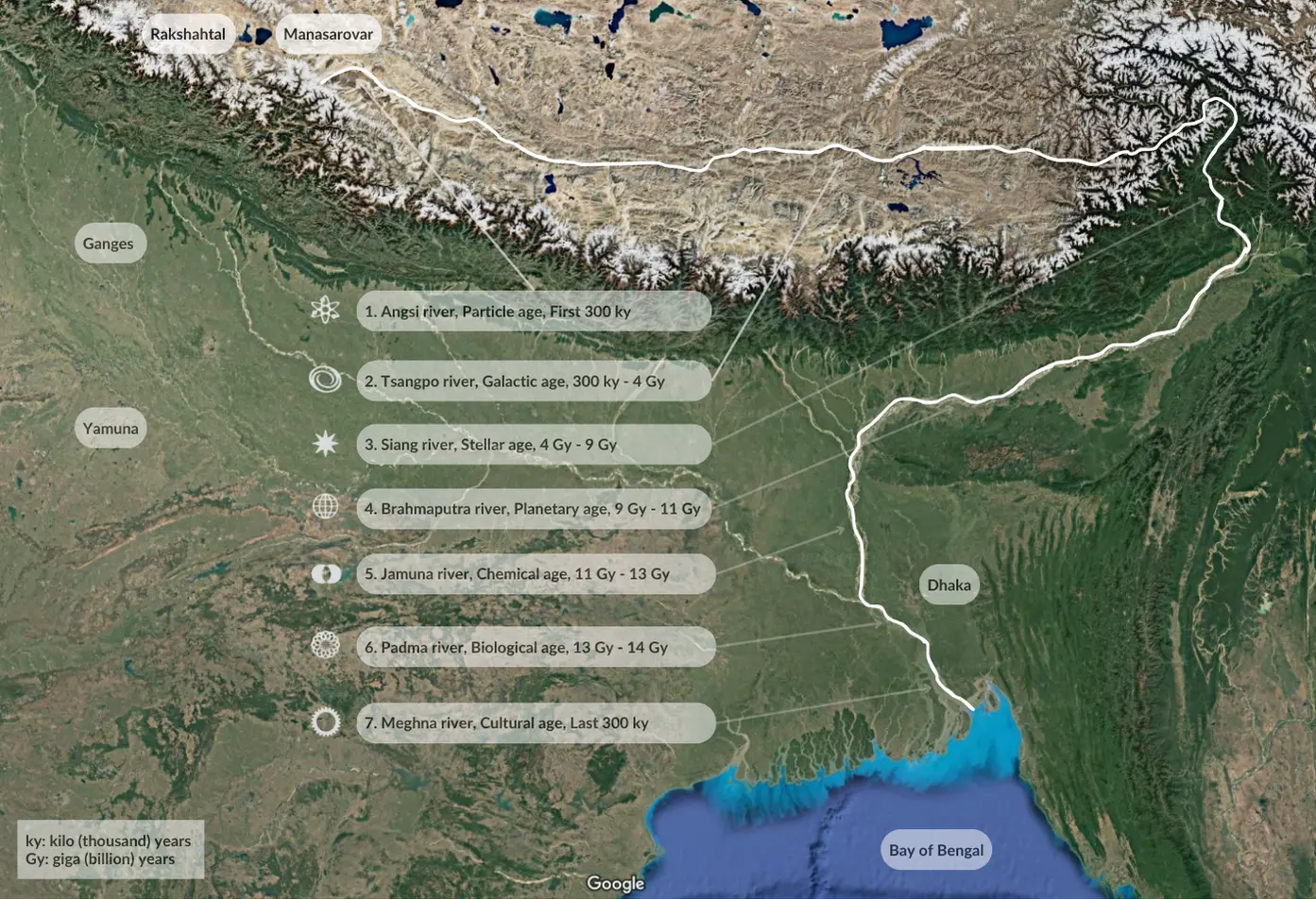
Rabi: If the Particle Age corresponds to the first three hundred thousand years of cosmic history, then finding its parallel with the Aangsi River is quite straightforward. The Particle Age is a time that humans have not yet been able to observe directly. Just as it is difficult to locate the true source of Aangsi, it is equally difficult to determine the exact origin of the Universe. The Aangsi River also makes clear a certain tension between metaphor and science. The first stage of the Brahmaputra is not merely the Aangsi; many different rivers merge into a single stream to eventually form the Sangpo. You chose only Aangsi perhaps to keep the total number at seven, or perhaps because the name sounds small and beautiful. The way brevity, beauty, metaphor, simile, and allegory work in poetry—if one tries to apply them to science, many complications will arise.
Socrates: You are absolutely right, Rabi. We will use metaphor the way Shakespeare used it. When he calls Juliet the Sun, we must remember at all times that Juliet does not literally turn into a burning sphere of gas. Shashi, now it’s your turn.
Shashi: The comparison between the Sangpo and the Galactic Age can be made even more naturally. The sense of vastness one gets inside a galaxy might also arise when looking at the whiteness of Tibet along the banks of the Sangpo. Galaxies and their clusters are the largest structures in the Universe; likewise the Sangpo is the longest stretch of the Brahmaputra. If we try to force more similarities than this, people will start calling us fundamentalists.
Socrates: This much is enough. Even comparing things to the Moon doesn’t stay pleasant for too long. Mars, begin your battle now.
Mars: Arunachal’s Siang truly is a massive battlefield—just as violent as the birth of planets and stars from giant clouds of gas and dust during the Stellar Age. The Yarlung–Sangpo Canyon is the deepest gorge on Earth, six kilometers deep. For millions of years, the Siang has carved this gorge through the Himalayas out of love for the Bay of Bengal. Anyone who has not heard the roar of this deep canyon cannot fully understand it through mere words. And no living human can ever witness with their own eyes the terrifyingly violent and terrifyingly beautiful scene of how a swirling gas cloud gives birth to a solar system.
Socrates: Perfect. Hermes, what are you thinking while looking toward Manas?
Hermes: I was thinking about the dramatic change in the river’s character when the Siang descends from the mountains into the plains of Assam. This change can easily be compared with the first one to two billion years of the Planetary Age. Immediately after its birth, Earth was blazing hot, struck continuously by thousands of rocks from space. After hundreds of millions of years of this state of war, when the uprising of oceans occurred on Earth’s surface, the inside of the seas became nests of love—factories for making life. If Arunachal’s Siang is the battlefield, then Assam’s Brahmaputra is the garden of peace.
Socrates: Such a beautiful comparison had never occurred to me. Juno, now it’s your turn.
Juno: After entering Bangladesh from Assam, the Brahmaputra becomes the Jamuna. This Jamuna has no relation to India’s Yamuna. Yet, since the word Jamuna reminds us of Radha–Krishna’s love and the Taj Mahal on the banks of the Yamuna in Agra, comparing the Jamuna with the Chemical Age feels quite natural. If the hydrothermal vents formed under the ocean during the Planetary Age were the nests of love, then in the Chemical Age these nests produced the first organisms capable of forming lineages through pairing. This union beautifully mirrors the confluence of the Jamuna and the Padma (Ganga) near Rajbari, close to Dhaka.
Socrates: This union is indeed fascinating. Think about it: the Ganga and the Brahmaputra are born almost from the same region near Manas Sarovar—the Brahmaputra from the northern slopes of the Himalayas, the Ganga from the southern slopes. After traveling long distances, they arrive at Rajbari under the names Padma and Jamuna to merge into one. If the Jamuna represents chemistry, then the Ganga can represent culture, since along the Ganga’s banks one of the oldest state-level cultures on Earth developed. Well then, Ishtar seems to be growing impatient—begin.
Ishtar: It is highly symbolic that the Biological Age begins at a place where the two largest rivers of South Asia meet. What flows from Rajbari to Chandpur under the name Padma is actually the combined result of two great rivers—the Brahmaputra as the Jamuna, and the Ganga as the Padma. In terms of flow dynamics, the Padma is one of the most revolutionary rivers in the world; therefore the comparison with the Biological Age is fitting. Because during this Age, the Universe experienced its greatest revolution: a planet filled with billions upon billions of species of plants, animals, fungi, and bacteria.
Socrates: Undoubtedly the greatest. Riya, the responsibility of finishing now lies with you.
Riya: I actually think a greater revolution than life itself was culture, and the comparison between the Cultural Age and the Meghna is the most natural. In its beginning the Universe was like a single continuous gas; that gas fragmented and gradually gave birth to many separate things, but all these creations always sought to unite with others. Culture is the best way to unite distinct things. The Meghna River does exactly that. Many rivers of Bangladesh flow into the Meghna, and the Meghna takes them all together toward the Bay of Bengal—just as culture gathers many people together and rushes forward toward the future, carrying countless dreams within the heart.
3. Space–Time–Energy–Matter
Socrates: Excellent conclusion, Riya. Since the question of time has now come up, I think we should reflect on it a bit more.
Riya: Yes, and we should step out of metaphor for a while and focus a little on real science.
Socrates: Why not? The Universe has some mathematical laws whose ultimate source humans do not know. And even we, being dead, still do not know. But the things on which those laws operate are familiar to us. Everything in the Universe that obeys law can be placed under four categories: space, time, energy, matter — collectively “STEM.” At the beginning of the twentieth century, Einstein worked exactly with these four things. His Special Relativity says space and time are the same thing, and energy and matter are the same thing. General Relativity (GR) describes the fundamental relationship between spacetime and energy–matter. I do not understand the mathematical foundation of this superstructure, although understanding it is one of the major tasks of my future eternal life.
Rabi: But if you don’t understand this mathematical foundation, is there any benefit in discussing it? What I understood about relativity from studying and researching it up to the moment of my death is this: without math, humans understand ninety percent of it wrong.
Socrates: Why ninety? I would say I myself understand ninety-nine percent of it wrong. My only wisdom is that I know nothing.
Rabi: Then the gift of your words will do more harm than good to us.
Socrates: Oh come on — I had to drink hemlock and die because my words harmed the youth of Athens. So now I am no longer afraid of harming anyone. But if you truly want no harm done, then you yourself please tell us the best way to think about the Universe’s spacetime.
Rabi: Whether I say it in Bangla or English, whatever I say is bound to be wrong — only math can tell the exact truth. Since you cannot understand the math of spacetime, then listen to the ninety-nine percent wrong version. After Einstein discovered GR in 1915, he thought that because of the enormous amount of energy–matter, the Universe’s spacetime must be highly curved. The more matter there is, the more space bends. He even built a mathematical model of this four-dimensional curvature. But neither humans, nor we, can visualize a four-dimensional box. However, if we reduce the three spatial dimensions to two, a three-dimensional model of spacetime becomes completely clear before our eyes. If I draw it on the tablet, you’ll understand. Here:
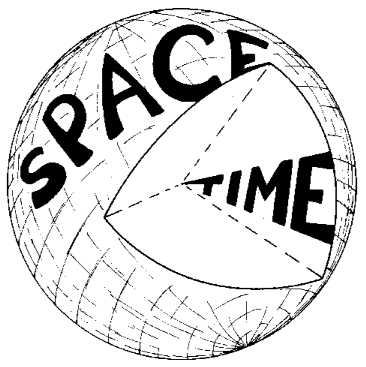
The surface of this sphere — known as Einstein’s “curveball” — is two-dimensional space, and along the radius lies time. In this model, all the Universe’s energy–matter at a given moment lies only on the surface of a sphere of a particular radius. As time increases, the radius increases, and the size of the Universe grows along with the surface area. Einstein originally did not think the radius changed; like Aristotle, he believed in a static Universe. He even added a constant — the cosmological constant — to his equation so that the radius wouldn’t change. But after evidence of cosmic expansion was found around the 1930s, he removed the constant. In the twenty-first century, humans brought this constant back — not to stop the radius, but to regulate how fast it increases.
Today we know the Universe looks the same in all directions and that its density is roughly uniform everywhere. This too can be understood through the spherical model of three-dimensional spacetime. Imagine the surface of the sphere is the surface of Earth, and imagine you are floating on a raft in a spot in the Pacific where, no matter which direction you look, you see only water — everything looks the same, and wherever you go, the density of the water is the same.
Socrates: But Rabi, if I look upward, it won’t look the same.
Rabi: Oh, Socrates, you’re as stubborn as ever. If we have already reduced the three spatial dimensions to two, then aside from the Pacific surface, can any “space” remain?
Socrates: No.
Rabi: And if no space exists beyond this surface, how will you look upward? To look upward you would need three-dimensional space again, which we already eliminated for the sake of this model.
Socrates: Alright, I get it.
Rabi: The fact that the Universe looks the same in all directions is called the cosmological principle. Using this three-dimensional model we can explain two more interesting phenomena of our Universe. The first one is this: Hubble discovered that all distant galaxies appear to be moving farther away from us, and that the farther a galaxy is, the faster it seems to recede. In reality the galaxies are not moving; spacetime itself is expanding. If we imagine the sphere above as a balloon, and each galaxy as a dot painted on the balloon’s surface, then the larger the balloon becomes, the more its radius (or time) grows, the more its surface area expands, and the more the dots (galaxies) separate from one another. Each dot will think that all the other dots are moving away from it; everyone will think they are at the center of the Universe because everything seems to recede from them. But actually, no one is the center. The surface of a sphere has no center, yet standing anywhere on that surface and looking around gives the feeling of being at the center of everything.
Socrates: Wonderful. And what about the second?

Rabi: The second is this: no matter which direction we point our telescopes from Earth, we can see up to the same distance in all directions. Because the speed of light is constant according to Einstein’s Special Relativity, our horizon is limited in both space and time. An example will make it clear. Suppose we have three telescopes — X, Y, and Z — and suppose the absolute brightness of all galaxies is the same. Then the more sensitive a telescope is, the farther it can see. Let X detect galaxies up to 1 billion light-years away, Y up to 2 billion, and Z up to 3 billion. Then X observes a Universe that’s a balloon with a radius of 1 billion light-years, Y’s balloon has a 2-billion-light-year radius, and Z’s observable Universe has a radius of 3 billion light-years.
Socrates: But that doesn’t match our three-dimensional spacetime balloon. In the picture, the balloon’s radius was time, whereas in your observable Universes the radius is space, since the unit is light-years.
Rabi: And that is exactly where we must think carefully. Though light-years are units of distance, they are directly tied to time. Seeing a galaxy 1 billion light-years away means seeing how it looked 1 billion years ago, because its light took 1 billion years to reach us. A light-year is the distance light covers in one year at 300,000 km/s — about 10 trillion kilometers. So in the observable-Universe balloon the radius is actually time. X’s balloon has a radius of 1 billion years, because it sees 1 billion years into the past.
Socrates: I have two observations here. First, isn’t the curveball picture you showed also a kind of metaphor?
Rabi: Good point. It’s true that the curveball is not a literal picture of the Universe. Our world is four-dimensional; reducing it to three dimensions is trivial mathematically but surreal mentally. Yet curveball is still not exactly a metaphor — its place is above metaphor; perhaps you could call it an analogy.
Socrates: Alright, I accept that. My second observation is this: seeing your map of the observable Universe, I feel one can never see oneself, never see the present — only others, only the past. If we cannot see ourselves, is it possible to know ourselves? I am beginning to doubt my own words now.
Rabi: If seeing the past helps us learn about the present, then by seeing others, can we not—through that seeing—learn about ourselves?
4. Timeline
Socrates: Because there is a timeline of the past, we have been able to understand the present state of the Universe properly. In society too, the present cannot be understood without the past. As for humans, I still have doubts about whether it is truly possible to know oneself by looking at others. But whatever the case, I think I can take this opportunity to show you the timeline I made.
In this timeline seven events have been taken from each age of the Universe. So in total there are 49 events. Each event has one slide, and below each slide there is a navigation bar that you can zoom in and out of, and pan left and right. It will be useful for our meditation. Browsing the timeline can become a kind of meditation—walking along a thin rope toward the history of the Universe. I think if, starting from Rabi, each of you looks at the seven events of your respective age and makes a few comments, it will be good for all of us. Rabi?
Rabi: Yes, of course. To begin with, I must repeat that, without math, this way of studying history is not honorable for me. Still, I will read. The first event of the Particle Age is of course the Big Bang, through which our Universe was born roughly fourteen billion years ago. From birth, the Universe has been expanding—sometimes fast, sometimes slow. Immediately after the Big Bang, in an episode called inflation, the Universe suddenly expanded enormously. Within a trillionth of a second, all the fundamental forces emerged. Within the first second came all the elementary particles: quarks, electrons, protons, and so on. In the first 15 minutes, multiple protons gathered to form the nuclei of elements like helium. At first the density of energy was higher than that of matter. Fifty thousand years after the Big Bang, matter overtook energy in density. And around three hundred thousand years after the Big Bang, electrons combined with the proton nuclei to form atoms, and photons were freed from the tyranny of free electrons. We can still observe these free photons today as microwaves. Through them we have created the first image of the Universe. Here the Particle Age ends. Shashi?
Shashi: I’ve looked at the seven events of the Galactic Age on the timeline. The story goes like this: at the end of the Particle Age, the Universe was essentially a single gas whose density was nearly uniform everywhere, with slight variations. In regions where the density was a bit higher, during the Dark Age those regions became denser under the influence of dark matter. One hundred million years after the Big Bang, the Dark Age ended, and about two hundred million years later, gas began to clump in the overdense regions to form galaxies and stars; this is called Cosmic Dawn. Within the first six hundred million years the intergalactic medium formed, and within eight hundred million years our own galaxy, the Milky Way, was born. One billion years after the Big Bang, the Universe filled up with galaxies, and by two and a half billion years, quasars—that is, the most massive and active galaxies—had formed. Three billion years after the Big Bang, when galaxies formed clusters, the Galactic Age ended. Mars?
Mars: The Stellar Age is taken to begin 10.4 billion years ago, about three and a half billion years after the Big Bang. At that time galaxies in the Universe were forming stars at the highest rate. Ten billion years ago, Population I stars were born—young, metal-rich stars that reside in galactic disks. Nine billion years ago, many star clusters formed and our galaxy acquired its thin disk. A billion years after that, the formation of galaxy superclusters created many voids in the Universe. Six billion years ago, repulsive dark energy won over attractive gravity, and because of this the expansion rate of the Universe began to increase. Five and a half billion years ago the Milky Way took on its spiral shape, and 4.6 billion years ago the birth of our Solar System brought the Stellar Age to an end. Hermes?
Hermes: The first important event of the Planetary Age is the birth of the inner (Sun-adjacent) planets 455 million years after the birth of the Solar System—i.e., about 4.55 billion years ago. Fifty million years later the Sun entered the main sequence and gained full status as a star. Around 4.4 billion years ago the hot Earth cooled and the oceans were born. But for nearly three hundred million years after that the Earth’s surface suffered intense bombardment by rocks from space. At the end of this catastrophe the continental crust formed—landmasses that are still moving and still changing the shapes of the continents. Three point six billion years ago, all Earth’s continents joined together to form the Vaalbara supercontinent. Here the Planetary Age ends. Juno?
Juno: Socrates, you started the Chemical Age 3.6 billion years ago, when life was probably first created from non-living matter inside hydrothermal vents at the bottom of the ocean. The first fossils of life are found from three and a half billion years ago. The first successful life forms, bacteria, came out of the sea onto land about three billion years ago. A hundred million years after that, vast numbers of cyanobacteria in the oceans began releasing oxygen into Earth’s atmosphere through photosynthesis. The first eukaryotes—cells with nuclei—appeared 2.7 billion years ago. Atmospheric oxygen rose sharply about two and a half billion years ago, and three hundred million years later the ozone layer formed. With the ozone layer, the Chemical Age ends. Ishtar?
Ishtar: In the Biological Age, the diversity of life begins to increase. One and a half billion years ago the first complex cells formed. Six hundred million years ago, many cells coming together brought the revolution of multicellular organisms. Two hundred million years after that, animals came out of the water onto land. Warm-blooded animals were born two hundred million years ago, and 65 million years ago the asteroid impact that wiped out the dinosaurs brought this Age to an end. Riya?
Riya: The Cultural Age began roughly 7 million years ago with the birth of the first hominins. Species of Australopithecus and the genus Homo appeared on Earth between 4 and 1 million years ago. And the first modern humans probably walked the Earth three hundred thousand years ago in Africa. From Africa, humans began to spread across the world about one hundred thousand years ago. Fifty thousand years ago humans initiated a great revolution in religion, music, and art. Agriculture began ten thousand years ago, and five thousand years after that the first states appeared. Five hundred years ago globalization began, whose second wave started two hundred years ago with the Industrial Revolution. Here the Cultural Age ends.
Socrates: It was truly necessary to hear it from each of your mouths. You can see that I am not telling the history of every region of the Universe; I am really telling human history. The Universe here appears as part of human history. That’s why, in the Galactic Age, we spoke of the Milky Way; in the Stellar Age, we focused mainly on the stars of the Milky Way; the central subject of the Planetary Age is the Solar System; the Chemical and Biological Ages are about Earth’s biosphere; and the Cultural Age is only about human culture. This is our history, the subject of our meditation.