
Table of Contents
This is an old revision of the document!
Seven Ages of the Universe
Slides: https://drive.google.com/file/d/1DBFDq3OmjU5NfHvFGyoQhV7ZI_SJ2e-j/view
The history of the universe is divided into seven distinct ages based on the increasing complexity of matter and life. It begins with the Particle age, spanning the first 300,000 years, where fundamental particles and the first atoms formed. This was followed by the Galactic age, lasting from 300,000 years to 4 billion years, during which the first large-scale structures and galaxies assembled. The Stellar age ensued from 4 billion to 9 billion years, marked by the peak of star formation and the creation of heavier elements. Following this, the Planetary age occurred between 9 billion and 11 billion years, seeing the birth of solar systems and solid worlds. The timeline then transitions into the Chemical age (11 to 13 billion years), where complex organic molecules began to synthesize, paving the way for the Biological age (13 to 14 billion years), representing the rise of complex life on water and land. Finally, the Cultural age occupies the most recent 300,000 years, defined by the emergence of humanity, technology, and complex culture.
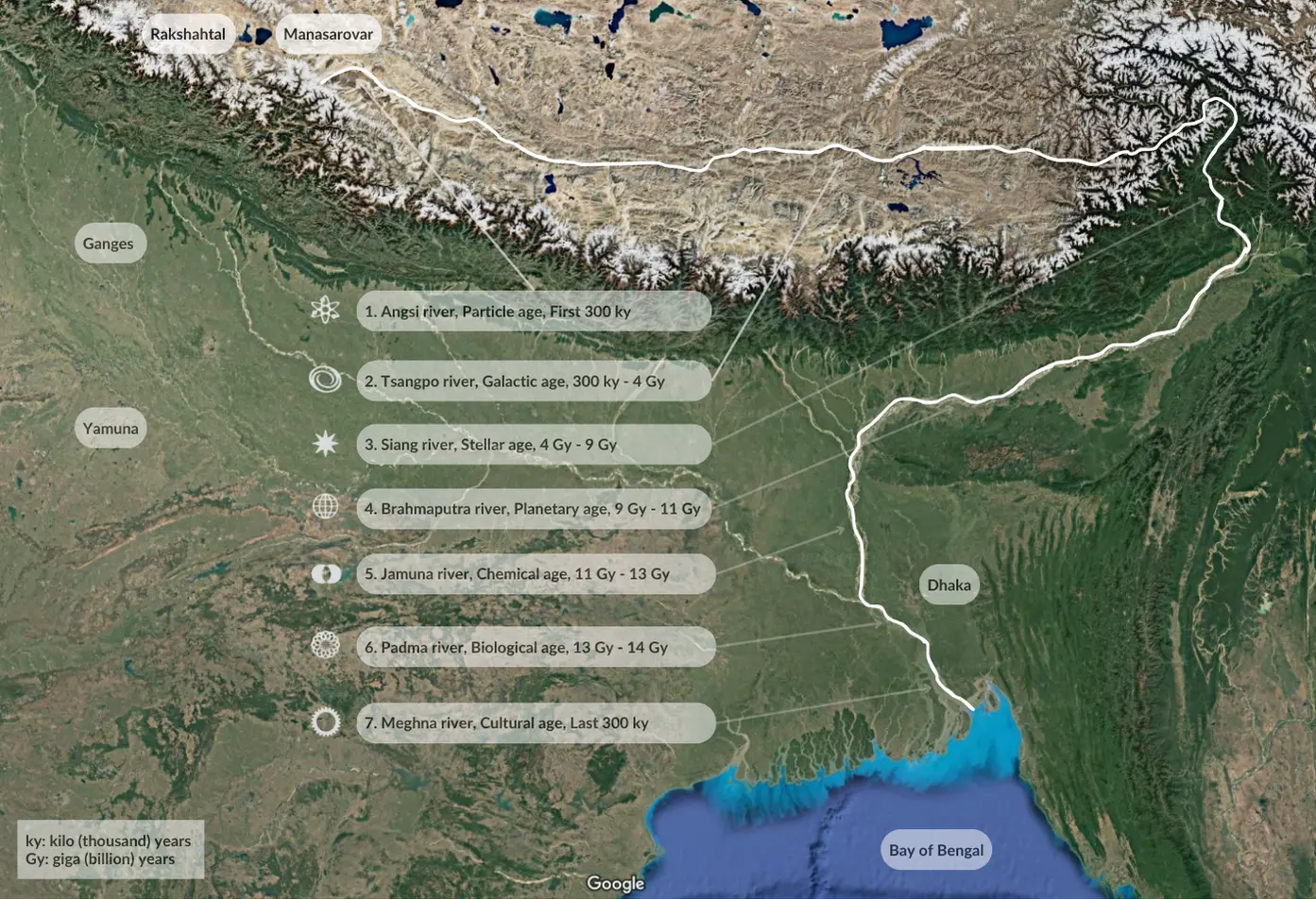
This figure creates a symbolic geography by linking these cosmic milestones to specific segments of the international Brahmaputra river’s flow through China, India, and Bangladesh. The Angsi river at the source represents the primordial Particle age, which transitions into the Tsangpo river across the Tibetan plateau, mirroring the expansive Galactic age. As the river carves through the Himalayas as the Siang river, it corresponds to the high-energy Stellar age. Upon entering the plains of India, it becomes the Brahmaputra river, symbolizing the formation of stable ground in the Planetary age. As it moves toward the Bengal delta, the Jamuna river section represents the Chemical age, while its transformation into the Padma river aligns with the Biological age of life’s complexity. The journey concludes with the Meghna river meeting the Bay of Bengal, representing the Cultural age—the most recent and complex stage of development near the river’s end and the modern human era.
The analogy between time and a river suggests that history is a directional flow that gains complexity and volume as it moves toward its destination. Just as a river begins at a narrow, high-energy mountain source and carves a single path through the landscape, the past is a defined sequence of events that becomes more “solid” as we move away from the origin. However, as the river reaches the delta and meets the Bay of Bengal, it dissolves into a vast, boundless horizon. In this metaphor, the ocean represents the many possibilities of the future; while the past is a singular track we can look back upon, the future is an expansive, unwritten space where all paths merge.
1. Timelines
Cosmic History
From the Big Bang to the Life Era
The Big Bang
The singularity event marking the origin of space, time, energy and matter. The universe emerges as a hot, dense "primeval fireball".
Cosmic Inflation
A brief, exponential expansion where the universe swells in size by a factor of roughly 1050, smoothing out initial irregularities.
Separation of Forces
The single unified "superforce" separates into gravity, the strong nuclear force, the weak nuclear force, and electromagnetism.
Particle Creation
Energy converts to matter (quarks, leptons). Matter and antimatter annihilate, leaving a slight excess of ordinary matter.
Primordial Nucleosynthesis
The universe cools enough for protons and neutrons to fuse, producing deuterium, helium, and trace lithium.
Matter Domination
The energy density of matter exceeds that of radiation, marking the end of the "Radiation Era" and start of the "Matter Era."
Recombination (CMB)
Atoms form, neutralizing the charged fog. Photons travel freely, creating the Cosmic Microwave Background.
The Cosmic Dark Ages
The universe is filled with neutral hydrogen. Gravity slowly pulls matter into denser clumps in the dark.
Cosmic Dawn
First massive stars ignite. Their intense UV radiation re-ionizes the hydrogen fog, ending the Dark Ages.
Hierarchical Merging
Small "blobs" merge to build large galaxies. This "bottom-up" process creates structures like the Milky Way's halo.
Rise of Black Holes
Massive collapses form supermassive black holes, powering quasars that outshine entire galaxies.
Large-Scale Structure
Galaxies organize into the "cosmic web" of sheets, filaments, and clusters separated by voids.
Population I Stars
Supernovae enrich the cosmos with heavy elements, allowing the first metal-rich stars to form.
Milky Way Thin Disk
The Milky Way flattens into a thin disk, coinciding with the birth of metal-rich stars needed for planets.
Peak Star Formation
The "baby boom" of the universe. Massive stars forge carbon, oxygen, and iron.
Galactic Habitable Zone
Metallicity spreads and supernovae frequency drops, creating safe zones for potential life.
Expansion Accelerates
Dark energy begins to dominate gravity, accelerating the expansion of the universe.
Solar Nebula Collapse
Triggered by a supernova, a gas cloud collapses to form the Sun and Solar System (4.6 billion years ago).
Accretion
Dust coalesces into planetesimals, then protoplanets. The Sun's T-Tauri wind strips early atmospheres.
Earth Differentiates
Heavy metals sink to form Earth's core. A collision with a protoplanet forms the Moon.
Oceans Form
Volcanic outgassing and icy comets create the atmosphere and the first oceans.
Late Heavy Bombardment
A barrage of asteroids pulverizes the crust, keeping Earth hostile for millions of years.
Stable Lithosphere
The crust solidifies and the first continents form, providing a platform for chemical evolution.
Prebiotic Synthesis
Lightning and UV radiation synthesize amino acids and nucleotides from simple gases.
The RNA World
Protocells form. RNA likely acts as both genetic code and chemical catalyst.
First Life (Prokaryotes)
Simple single-celled bacteria appear, likely feeding on organic chemicals in hydrothermal vents.
Photosynthesis
Cyanobacteria learn to use sunlight for food. The resulting oxygen is toxic to early life ("Oxygen Crisis").
Eukaryotic Symbiosis
Cells merge to form complex Eukaryotes (with nuclei and mitochondria), ancestors of all plants and animals.
Multicellularity
Cells specialize and cooperate, forming true multicellular organisms.
Cambrian Explosion
"Biology's Big Bang": complex body plans, hard shells, and predators appear rapidly.
Land Colonization
Life leaves the ocean. Plants, insects, and amphibians adapt to air and gravity.
Reptiles Dominate
Watertight skin and hard-shelled eggs allow reptiles to conquer dry land.
K-T Extinction
Asteroid impact wipes out dinosaurs. Mammals survive and radiate into empty niches.
Hominid Divergence
Human ancestors split from apes and begin walking upright.
Control of Fire
Fire provides warmth and cooked food, fueling brain growth.
Modern Humans
Homo sapiens appear in Africa.
Cultural Explosion
Art, advanced tools, and symbolic language emerge ("Culture's Big Bang").
Agriculture
Farming leads to permanent settlements and population growth.
Civilization
City-states, social hierarchies, and writing begin.
Industrial Revolution
Fossil fuels power machines, globalizing society.
The Life Era
Technological life controls evolution and expands into the cosmos.