
This is an old revision of the document!
The Seven Ages of the Universe
The history of the universe is divided into seven distinct ages based on the increasing complexity of matter and life. It begins with the Particle age, spanning the first 300,000 years, where fundamental particles and the first atoms formed. This was followed by the Galactic age, lasting from 300,000 years to 4 billion years, during which the first large-scale structures and galaxies assembled. The Stellar age ensued from 4 billion to 9 billion years, marked by the peak of star formation and the creation of heavier elements. Following this, the Planetary age occurred between 9 billion and 11 billion years, seeing the birth of solar systems and solid worlds. The timeline then transitions into the Chemical age (11 to 13 billion years), where complex organic molecules began to synthesize, paving the way for the Biological age (13 to 14 billion years), representing the rise of complex life on water and land. Finally, the Cultural age occupies the most recent 300,000 years, defined by the emergence of humanity, technology, and complex culture.
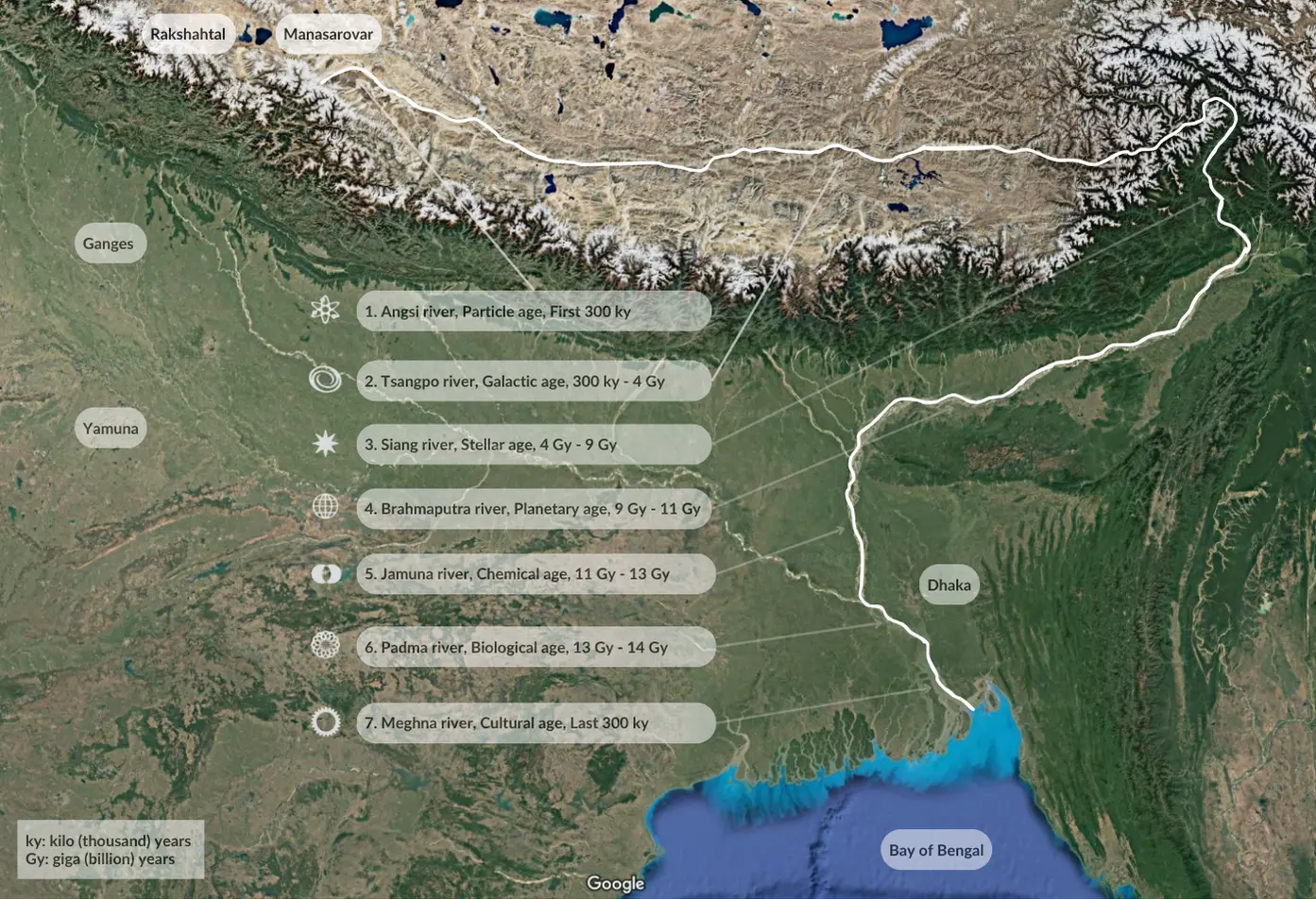
This figure creates a symbolic geography by linking these cosmic milestones to specific segments of the international Brahmaputra river’s flow through China, India, and Bangladesh. The Angsi river at the source represents the primordial Particle age, which transitions into the Tsangpo river across the Tibetan plateau, mirroring the expansive Galactic age. As the river carves through the Himalayas as the Siang river, it corresponds to the high-energy Stellar age. Upon entering the plains of India, it becomes the Brahmaputra river, symbolizing the formation of stable ground in the Planetary age. As it moves toward the Bengal delta, the Jamuna river section represents the Chemical age, while its transformation into the Padma river aligns with the Biological age of life’s complexity. The journey concludes with the Meghna river meeting the Bay of Bengal, representing the Cultural age—the most recent and complex stage of development near the river’s end and the modern human era.
The analogy between time and a river suggests that history is a directional flow that gains complexity and volume as it moves toward its destination. Just as a river begins at a narrow, high-energy mountain source and carves a single path through the landscape, the past is a defined sequence of events that becomes more “solid” as we move away from the origin. However, as the river reaches the delta and meets the Bay of Bengal, it dissolves into a vast, boundless horizon. In this metaphor, the ocean represents the many possibilities of the future; while the past is a singular track we can look back upon, the future is an expansive, unwritten space where all paths merge.
1. Timelines
1.1 Particle age
| Time | Event | Description |
|---|---|---|
| $0$ | The Big Bang | The singularity event marking the origin of space, time, energy and matter (STEM). The universe emerges as an unimaginably hot and dense “primeval fireball”. |
| $10^{-35}$ to $10^{-32}$ seconds | Cosmic Inflation | A brief, exponential expansion where the universe swells in size by a factor of roughly $10^{50}$. This process smoothed out initial irregularities. |
| $10^{-43}$ to $10^{-10}$ seconds | Separation of Forces | As the universe cooled, the single unified “superforce” separated into the four fundamental forces (energies) of nature: gravity, the strong nuclear force, the weak nuclear force, and electromagnetism. |
| $10^{-35}$ to 1 second | Particle Creation & Annihilation | Energy converted into matter via “pair production”. Quarks and leptons (e.g., electrons) emerged. Matter and antimatter collided and annihilated, leaving a slight excess of ordinary matter. |
| 3 minutes to 15 minutes | Primordial Nucleosynthesis | The universe cooled sufficiently (below $10^9$ K) for protons and neutrons to fuse. This “Nuclear Epoch” produced the first atomic nuclei: heavy hydrogen (deuterium), helium, and trace amounts of lithium. |
| 50,000 years | Matter Domination | The “crossover point” where the energy density of matter finally exceeded that of radiation (or energy). This marked the end of the “Radiation Era” and the beginning of the “Matter Era,” setting the stage for structure formation. |
| 300,000 to 380,000 years | Recombination & Decoupling | Electrons combined with nuclei to form neutral atoms (recombination). This neutralized the charged fog, allowing photons to travel freely (decoupling), observable today as the Cosmic Microwave Background (CMB). |