
0.3. Observable universe
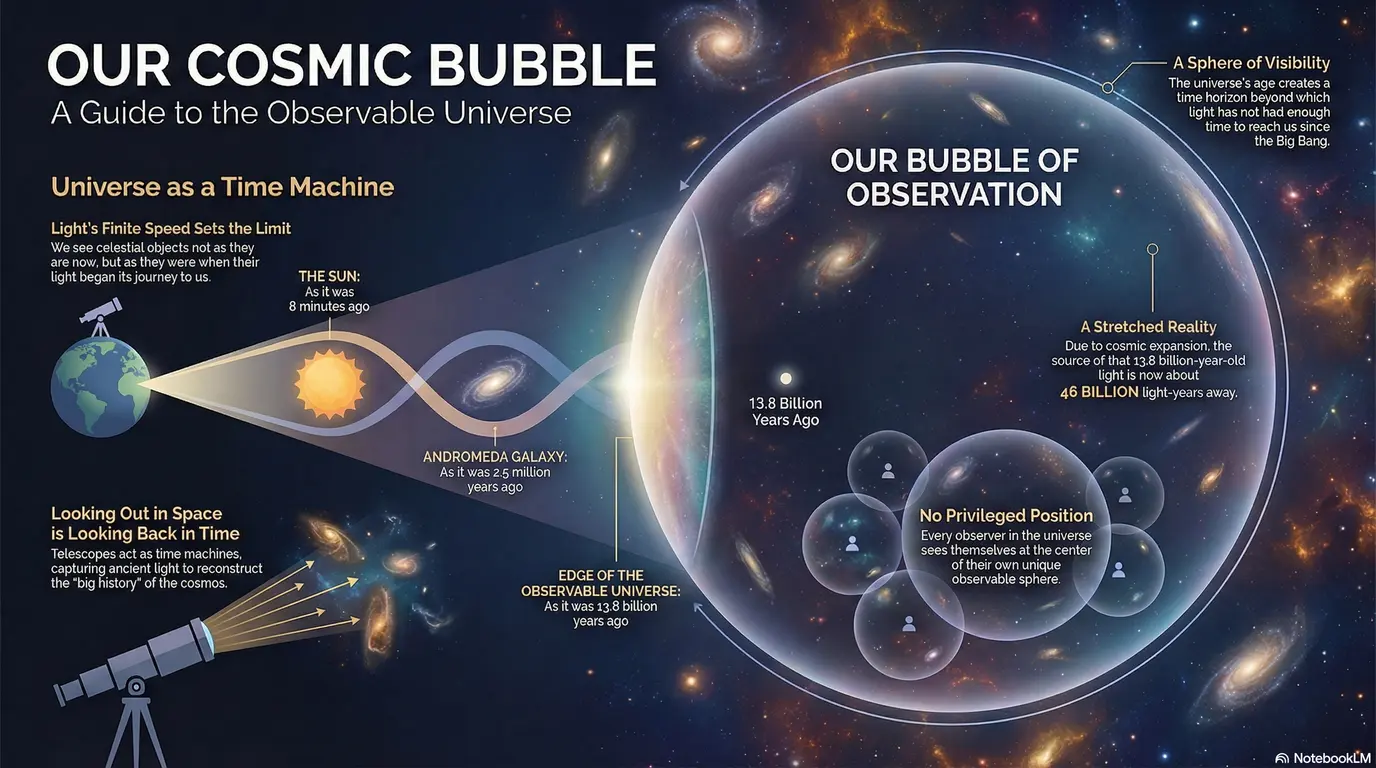
The fundamental limit on what we can perceive in the cosmos is governed by the finite speed of light, which travels at approximately 300,000 kilometers per second, so around 10 trillion km in 1 earth-year. Because this speed is not infinite, light takes time to traverse the vast distances of space; consequently, we never see celestial objects as they exist right now, but rather as they existed when their light was emitted. Looking out into space is equivalent to looking back in time. For instance, we see the Sun as it was 8 minutes ago and the Andromeda Galaxy as it appeared 2.5 million years ago,. Telescopes therefore act as time machines, allowing astronomers to act as historians who reconstruct the “big history” of the cosmos by capturing radiation launched in ages long past.
Since the universe has a finite age (estimated at approximately 13.8 to 14 billion years) we can only see objects whose light has had enough time to reach us since the Big Bang. This limitation creates a “horizon” or a sphere of visibility centered on Earth. This sphere does not represent a physical edge to the universe, but rather a time horizon; beyond it, light has not yet had sufficient time to travel the intervening distance. We are essentially trapped inside a bubble of information, unable to observe events from the earliest moments of the universe because the cosmos was opaque prior to the “decoupling” of matter and radiation about 380,000 years after the Big Bang.
This spherical view relates to a concept known as “Einstein’s curveball,” a three-dimensional analogy used to visualize a four-dimensional closed universe. In this analogy, the universe is imagined as the surface of a sphere (like a balloon), where the radius represents time. Just as a “flatlander” living on the surface of a sphere perceives a horizon in every direction but never finds a physical edge, we perceive our observable universe as a sphere surrounding us. Crucially, this analogy illustrates the cosmological principle: just as every point on a sphere’s surface appears central to an observer located there, every observer in the universe sees themselves at the center of their own observable sphere. Thus, while we appear to be central, we occupy no privileged position in the cosmos.
Although the light from the edge of the observable universe has traveled for nearly 14 billion years, the expansion of space means the source of that light is currently much farther away. Estimates place the “photosphere” of the cosmic microwave background (the effective edge of what we can see) at approximately 46 billion light-years from Earth today. Within this immense volume, astronomers estimate there are more than a trillion galaxies. The scale is so vast that the number of stars in the visible universe is comparable to the number of grains of sand on all the beaches of Earth.
What lies beyond this observable horizon? According to the theory of cosmic inflation, the entire universe is likely much large (perhaps $10^{50}$ times larger) than the patch we can observe. The cosmological principle suggests that the region beyond our horizon is homogeneous, looking much like the region we inhabit, filled with similar galaxies and voids. However, because space is expanding, objects far beyond our horizon may be receding from us faster than the speed of light, meaning we will never be able to communicate with or observe them. We effectively live in one “bubble” of a potentially infinite reality that remains forever unknowable to us.