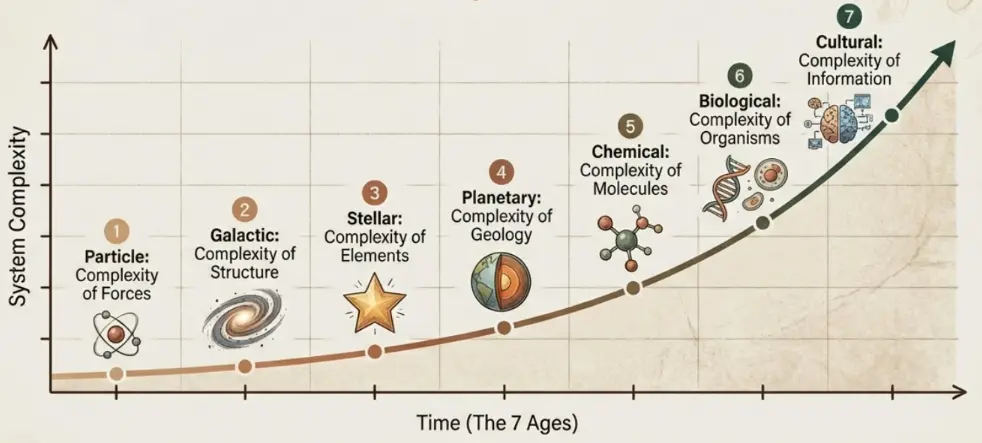
0.2. Cosmic evolution
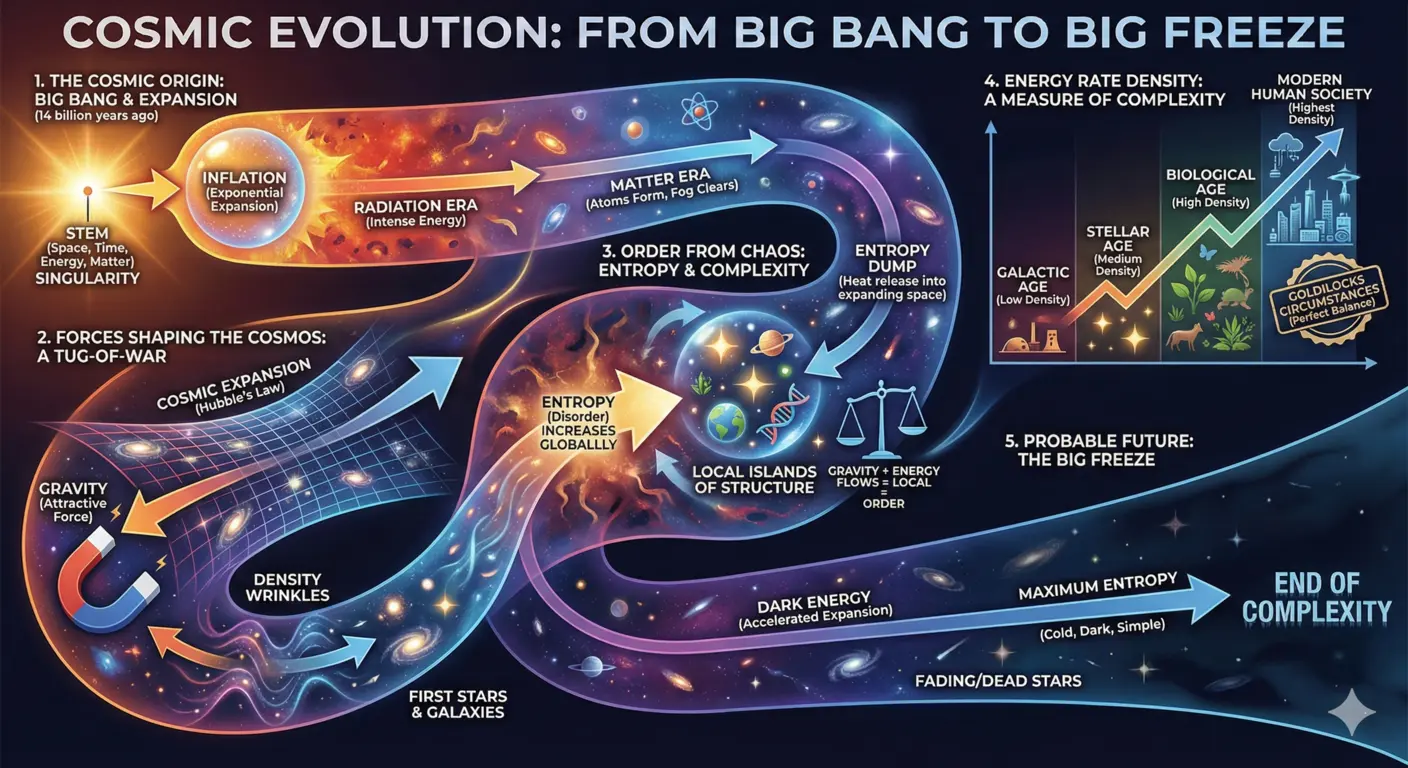
The epic narrative of the cosmos began approximately 14 billion years ago with the Big Bang, a singularity where all space, time, energy and matter (STEM) were compressed into a point of infinite density. This event was not an explosion of matter into pre-existing empty space, but rather a rapid expansion of space itself, carrying matter and energy along with it. In the first fraction of a second, the universe underwent “inflation,” expanding exponentially faster than the speed of light, which smoothed out primordial irregularities and established the vast scale of the cosmos. As the universe expanded and cooled, it transitioned from a chaotic Radiation Era, where intense energy prevented structure, to a Matter Era about 50,000 years later, finally allowing the first atomic nuclei to capture electrons and form neutral atoms.
As this primordial fog cleared, the mechanics of the universe became defined by a cosmic tug-of-war. The ongoing expansion, described by Hubble’s Law, drives galaxies apart at speeds proportional to their distances, stretching the very fabric of space. Simultaneously, gravity works locally to pull matter together, acting on slight variations in the density of the early universe. Gravity magnified these tiny “wrinkles” into massive clouds of hydrogen and helium, which eventually collapsed under their own weight to ignite the first stars and galaxies. This competition between the expansive energy of the Big Bang and the attractive force of mass set the stage for the structure of the observable universe.
However, the evolution of these structures is strictly governed by the laws of thermodynamics, particularly the Second Law, which dictates that entropy, or disorder, must inevitably increase. This creates a profound paradox: how can complex, ordered structures like stars, planets, and life emerge in a universe destined for disorder? The answer lies in the fact that gravity and energy flows allow for the creation of local “islands of structure” at the expense of greater disorder in the surrounding environment. The expanding universe effectively acts as a “trash can” for entropy, allowing local complexity to rise while the total entropy of the cosmos increases globally.
This localized order allows complexity to arise through the flow of energy, a process quantified by “energy rate density“—the amount of energy passing through a system per unit of mass over time. As the universe evolved through the Galactic, Stellar, and Biological Ages, the density of energy flow in complex systems increased dramatically. Surprisingly, while stars possess immense total energy, their energy density is lower than that of living organisms, and modern human society generates the highest energy rate density of all known systems. This rise in complexity is not guaranteed; it occurs only within “Goldilocks circumstances,” where energy flows and environmental conditions are perfectly balanced to sustain intricate structures against the relentless tide of entropy.
Despite this rise in complexity, current observations suggest the universe will likely expand forever rather than recollapse. The discovery of “dark energy,” a mysterious repulsive force that constitutes the majority of the universe’s energy density, indicates that cosmic expansion is accelerating. As galaxies drift farther apart and stars eventually exhaust their nuclear fuel, the universe is expected to become cold, dark, and simple, eventually reaching a state of maximum entropy. In this probable future, known as the “Big Freeze,” energy gradients will flatten out, rendering the formation of any further complexity impossible, bringing the grand narrative to a silent, frozen conclusion.