
Metallicity Scatter Originating from Subkiloparsec Starbursting Clumps in the Core of a Protocluster at z = 7.88
Takahiro Morishita, Massimo Stiavelli, Eros Vanzella, Pietro Bergamini, Kristan Boyett, Marco Chiaberge, Claudio Grillo, Nicha Leethochawalit, Matteo Messa, Guido Roberts-Borsani, Piero Rosati, and Anowar J. Shajib.
The Astrophysical Journal, 985(1), 83, IOP
https://doi.org/10.3847/1538-4357/adc4c3
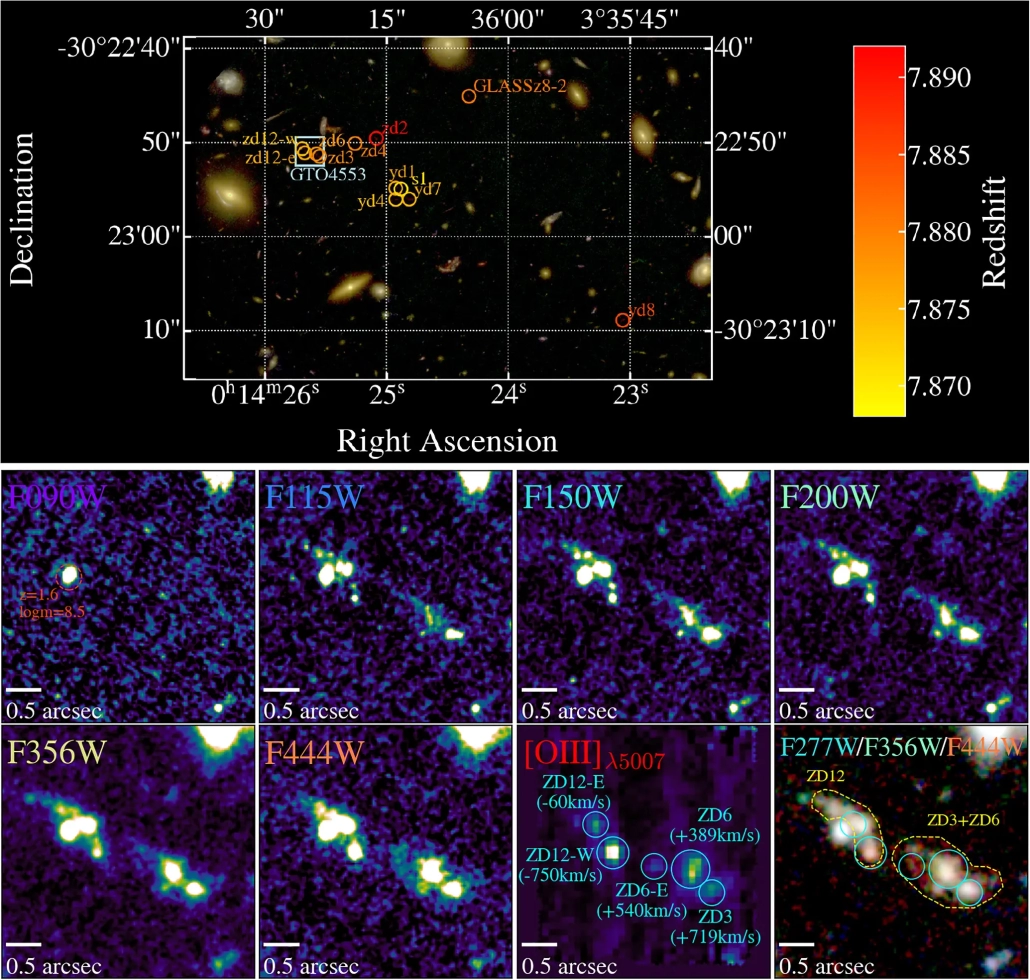
Abstract: We present new JWST NIRSpec integral field unit (IFU) G395H/F290LP observations of a merging galaxy system at $z=7.88$, part of A2744-z7p9OD, the most distant protocluster to date. The IFU cube reveals [O\,\textsc{iii}]$_{\lambda5007}$ emissions in two previously known galaxies, ZD3 and ZD6, and a newly identified galaxy, ZD12, at $z_{\rm spec}=7.8762$. One of the detected [O\,\textsc{iii}]-emitting regions shows the auroral [O\,\textsc{iii}]$_{\lambda4363}$ line, yielding a direct metallicity of $12+\log({\rm O/H})=7.4\pm0.2$, while metallicities elsewhere are measured using strong-line calibrations. We find large internal deviations in metallicity ($\Delta\log({\rm O/H})\sim1$), indicating rapid chemical enrichment driven by intense star formation and mergers, as expected in early galaxies. Our analysis shows that metal-poor regions can easily be outshone by more enriched zones, complicating the identification of metal-free star formation when using integrated spectroscopy (e.g., NIRSpec/MSA). NIRCam imaging reveals seven UV-bright clumps in ZD12 with stellar masses $\log(M_\ast/M_\odot)\sim7.6$–$8.9$, four of which are unresolved ($\lesssim100$ pc) and intensely star-forming ($>30\,M_\odot\,{\rm yr^{-1}\,kpc^{-2}}$), likely contributing to the observed metallicity scatter by fostering rapid chemical cycles. Incorporating newly identified members and literature sources, we estimate a local overdensity of $\delta=44^{+89}{-31}$, a total halo mass of $M_h=5.8^{+0.2}{-0.3}\times10^{11}\,M_\odot$, and a formal velocity dispersion of $1100\pm500~{\rm km\,s^{-1}}$.

