
TDCOSMO: XVIII. Strong lens model and time-delay predictions for J1721+8842, the first Einstein zigzag lens
T. Schmidt, T. Treu, S. Birrer, M. Millon, D. Sluse, A. Galan, A. J. Shajib, C. Lemon, F. Dux and F. Courbin
Astronomy and Astrophysics, 700, A92, EDP
https://doi.org/10.1051/0004-6361/202449984
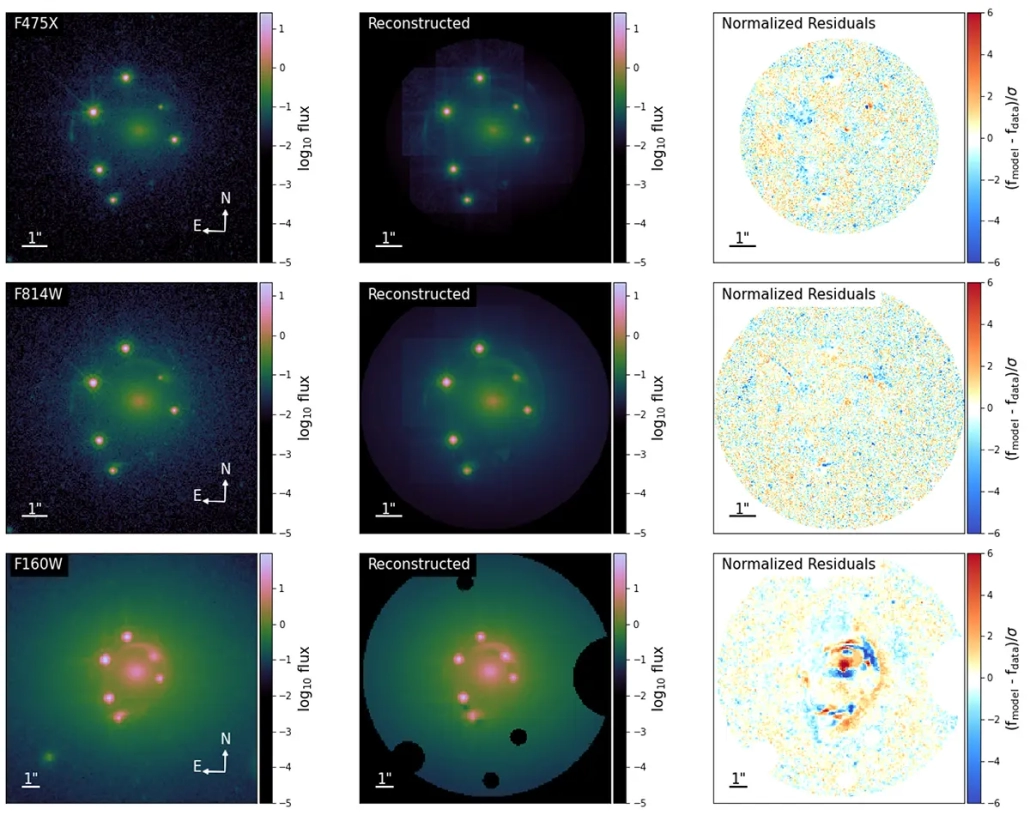
Abstract: We present lens models for J1721+8842, the first-ever discovered galaxy-scale strong lens in an Einstein zigzag configuration. The model consists of four separate lensed galaxies, with the primary source hosting a quasar, lensed into six images by two deflectors at redshifts $z_1 = 0.184$ and $z_2 = 1.885$. The configuration of three lensed sources and the lensed light of the deflector at redshift $z_2 = 1.885$ tightly constrain the mass profile of the primary lensing galaxy. Using two standard descriptions for the main perturber’s mass distribution—a total power-law profile and a composite dark and stellar mass—the inferred convergence around the location of the lensed images is in excellent agreement. While the strong lensing data alone does not significantly favor either of our profile assumptions for the main deflector’s mass distribution, we show that a central stellar velocity dispersion measurement can distinguish or validate them. Using a standard $\Lambda$CDM cosmology with $H_0 = 70~{\rm km~s^{-1}~Mpc^{-1}}$, we present time-delay predictions between the lensed quasar images for both models at the percent level modulo a multiplane mass sheet transform. Our models are the first step toward constraining the time-delay distance ratios for J1721+8842, and thus also $H_0$, independent of other methods. In order to achieve an $H_0$ measurement, our models need to be combined in a multiplane lensing analysis with the stellar velocity dispersion for the deflectors, the line-of-sight convergence, and the observed time delays. Owing to its extraordinary configuration, this is an extremely promising system for a high-precision determination of $H_0$.

