
Investigating the relation between environment and internal structure of massive elliptical galaxies using strong lensing
S M Rafee Adnan, Muhammad Jobair Hasan, Ahmad Al-Imtiaz, Sulyman H. Robin, Fahim R. Shwadhin, Anowar J. Shajib, Mamun Hossain Nahid, Mehedi Hasan Tanver, Tanjela Akter, Nusrath Jahan, Zareef Jafar, Mamunur Rashi, Anik Biswas, Akbar Ahmed Chowdhury, Jannatul Feardous, Ajmi Rahaman, Masuk Ridwan, Rahul D. Sharma, Zannat Chowdhury and Mir Sazzat Hossain
Astronomy and Astrophysics, 699, A259, EDP.
https://doi.org/10.1051/0004-6361/202453239
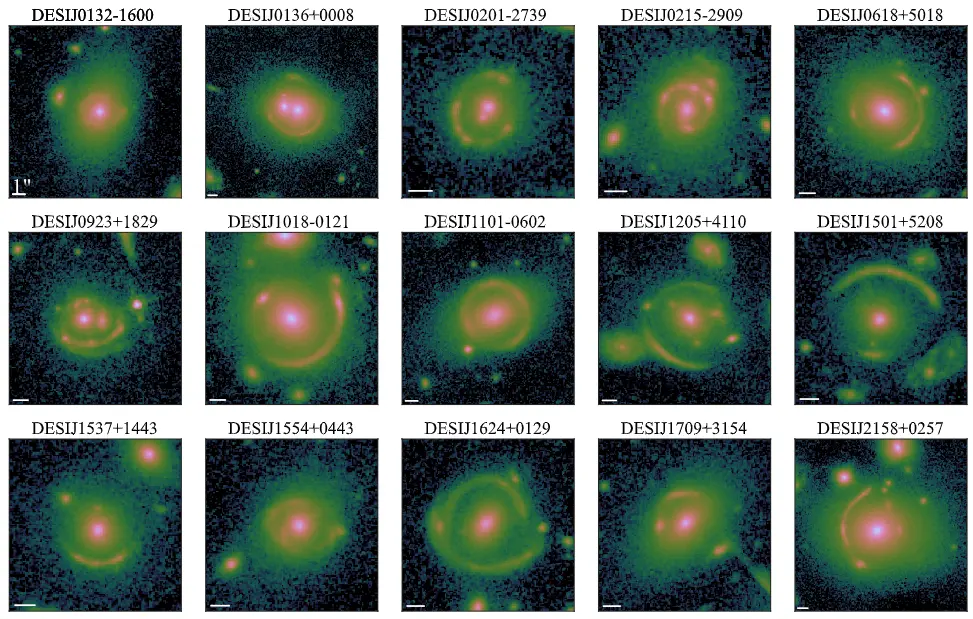
Abstract: Strong lensing by massive galaxies probes their mass distribution, thus providing a window for studying their internal structure, i.e., the distributions of luminous and dark matter. In this paper, we investigate the relation between the internal structure of massive elliptical galaxies and their environment using a sample of 15 strong lensing systems. We performed lens modeling for them using LENSTRONOMY and constrained the mass and light distributions of the deflector galaxies. We adopted the local galaxy density as a metric for the environment and tested our results against several alternative definitions of it. We robustly find that the centroid offset between the mass and light is not correlated with the local galaxy density. This result supports using centroid offsets as a probe of dark-matter theories, since the environment’s impact on these offsets can be treated as negligible. Although we find a moderate to strong correlation between the position angle offset and the standard definition of the local galaxy density, consistent with previous studies, the correlation becomes weaker for alternative definitions of the local galaxy density. This result weakens the support for interpreting the position angle misalignment as having originated from interaction with the environment. Furthermore, we find that the “residual shear” magnitude in the lens model to be uncorrelated with the local galaxy density, supporting the interpretation of the residual shear originating, in part, from the inadequacy in modeling the angular structure of the lensing galaxy and not solely from the structures present in the environment or along the line of sight.

