
The Search for Stable Nickel: Investigating the Origins of Type Ia Supernovae with Late-time Near-infrared Spectroscopy from the Carnegie Supernova Project-II
Sahana Kumar, Eric Y. Hsiao, Chris Ashall, Peter Hoeflich, Eddie Baron, Mark M. Phillips, Maryam Modjaz, Abigail Polin, Nidia Morrell, Christopher R. Burns, Jing Lu, Melissa Shahbandeh, Lindsey A. Kwok, Lluis Galbany, M. D. Stritzinger, Carlos Contreras, James M. DerKacy, T. Hoover, Syed A. Uddin, Saurabh W. Jha, Huangfei Xiao, K. Krisciunas, and N. B. Suntzeff
The Astrophysical Journal, Volume 1000, Issue 2, 178, 23 pp.
https://doi.org/10.3847/1538-4357/ae42bf
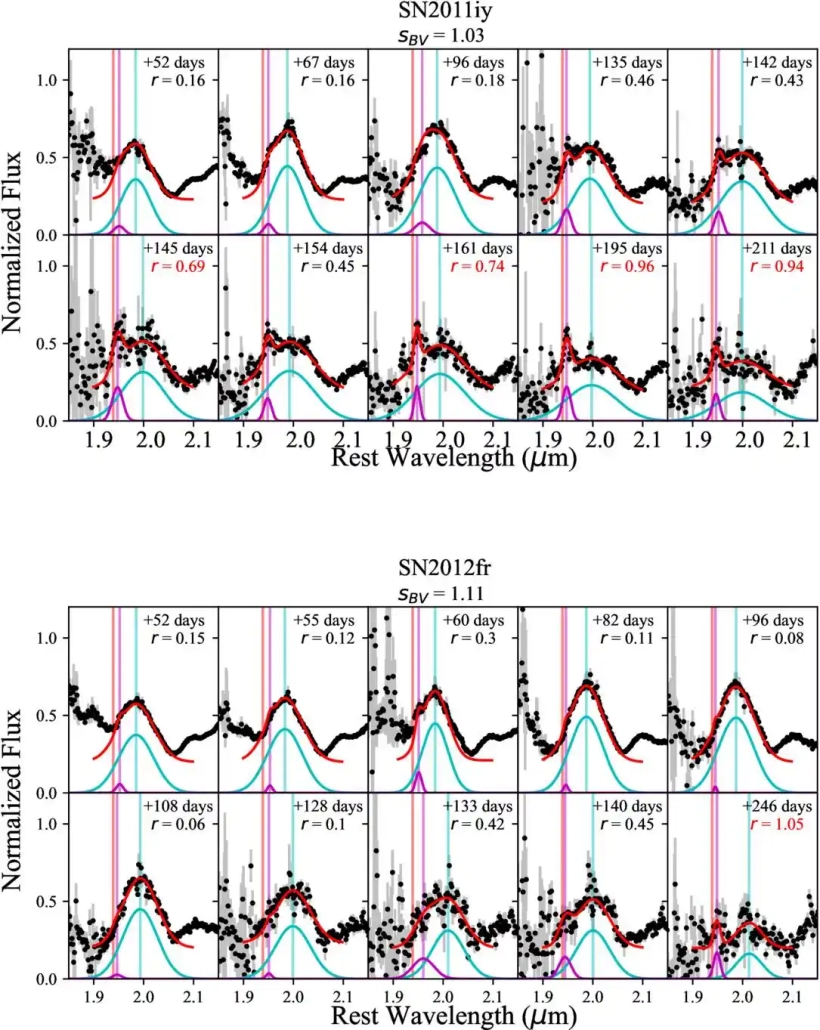
Abstract: Producing stable 58Ni in Type Ia supernovae (SNe Ia) requires sufficiently high-density conditions that are not predicted for all origin scenarios, so examining the distribution of 58Ni using the near-infrared (NIR) [Ni II] 1.939 μm line may observationally distinguish between possible progenitors and explosion mechanisms. We present 79 telluric-corrected NIR spectra of 22 low-redshift SNe Ia from the Carnegie Supernova Project-II, ranging from +50 to +505 days, including 31 previously unpublished spectra. We introduce the Gaussian Peak Ratio, a detection parameter that confirms the presence of the NIR [Ni II] 1.939 μm line in eight SNe in our sample. Nondetections occur at earlier phases (≤+100 days) when the NIR Ni line has not emerged yet or in low signal-to-noise spectra, yielding inconclusive results. Subluminous 86G-like SNe Ia show the earliest NIR Ni features around ∼+50 days, whereas normal-bright SNe Ia do not exhibit NIR Ni until ∼+150 days. NIR Ni features detected in our sample have low peak velocities (v ∼ 1200 km s−1) and narrow line widths (≤3500 km s−1), indicating stable 58Ni is centrally located. This implies high-density burning conditions in the innermost regions of SNe Ia and could be due to higher mass progenitors (i.e., near-Mch). NIR spectra of the nearly two dozen SNe Ia in our sample are compared to various model predictions and paired with early-time properties to identify ideal observation windows for future SNe Ia discovered by upcoming surveys with Rubin-LSST or the Roman Space Telescope.

