
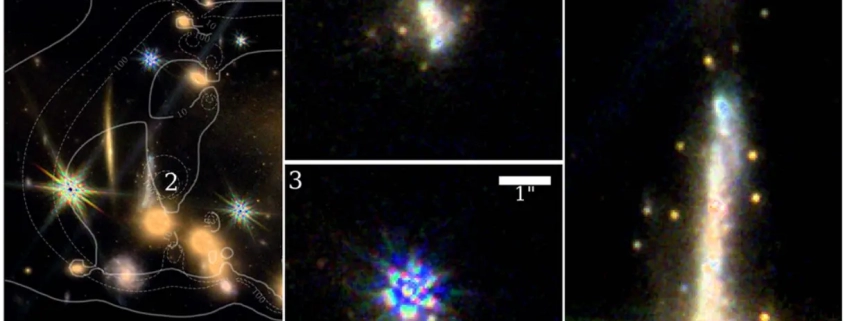
Title: Resolved SED fitting of NIRSpec/IFU data of the Sparkler galaxy (z = 1.4) to trace the detailed star formation history of the galaxy body.
Supervisor: Lamiya Mowla, PhD, Assistant Professor, Wellesley College, USA.
Graduate Research Assistant: Ahmad Al-Imtiaz.
The Sparkler Galaxy (figure above) is a highly magnified, distant system located approximately 9 billion light-years away from us, first reported by Golubchik et al. (2022). Surrounding the galaxy is a set of relatively bright point-like sources (AB ∼ 27 mag), referred to as “sparkles” (Figure 1, right). Previous studies (Mowla & Iyer et al. 2022; Claeyssens et al. 2023) suggest that these sparkles are likely ancient globular clusters (GCs). And star clusters in other lensed galaxies in these cluster none show a population as old as the Sparkler (Claeyssens et al. 2023; Vanzella et al. 2022). However, since the conclusions were drawn primarily from photometric data with significant parameter uncertainties, alternative interpretations—such as younger stellar clusters or even ultra-compact satellites—remain possible.
The Sparkler is observed as three separate lensed images, one of which exhibits a magnification factor exceeding 10–100. To reduce the uncertainties and gain deeper insights into the processes of star cluster and galaxy formation in that epoch, new spectroscopic observations were obtained for the most highly magnified image (Figure 1, right) using the JWST/NIRSpec IFU with PRISM+G140M (GO 2969).
In this project, we aim to: (a) find whether the sparkles are truly old star clusters, (b) accurately constrain their physical properties and place them within the framework of globular cluster scaling relations, and (c) investigate the characteristics of the host galaxy to understand what makes the Sparkler distinct.
The Sparkler has extensive multi-wavelength coverage, including previous JWST/NIRCam imaging (F090W, F150W, F200W, F227W, F356W, F444W), shallow NIRISS wide-field spectroscopy (F115W, F200W), and MIRI imaging (F770W, F1000W, F1500W, F1800W). The newly obtained NIRSpec/IFU PRISM+G140M data provide deeper spectroscopic information, enabling significant improvements in constraining physical properties. In particular, the PRISM data, combined with G140M absorption lines, help break the age-metallicity degeneracy, allowing a more precise characterization of both the sparkles and the host galaxy.
This work will combine the use of Pixedfit (Abdurrouf et al.), DenseBasis (Iyer et al.), and newly developed tools after getting the source place image by modeling the lensing system using Lenstronomy.

