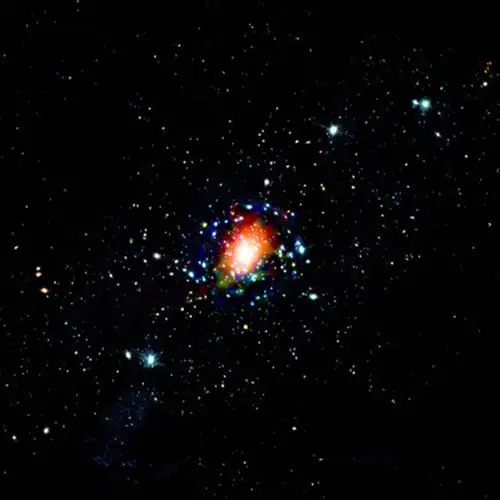

- Yead Muhammad Ivan
Andromeda Galaxy
Our grand, mysterious neighbor, the majestic matriarch of the Local Group.
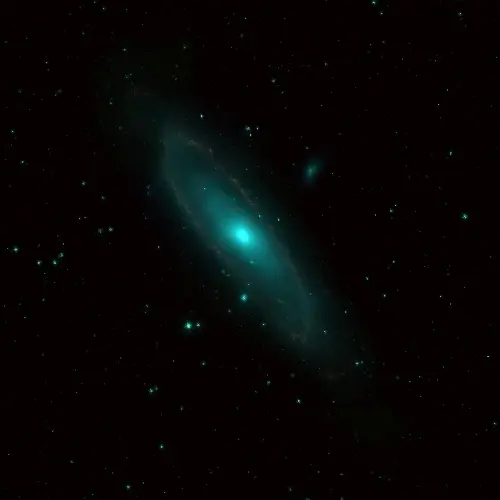
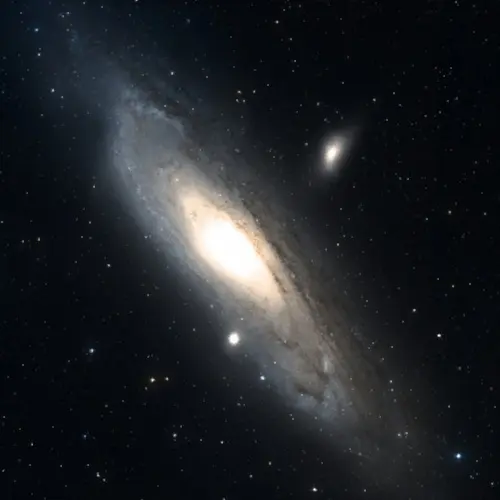
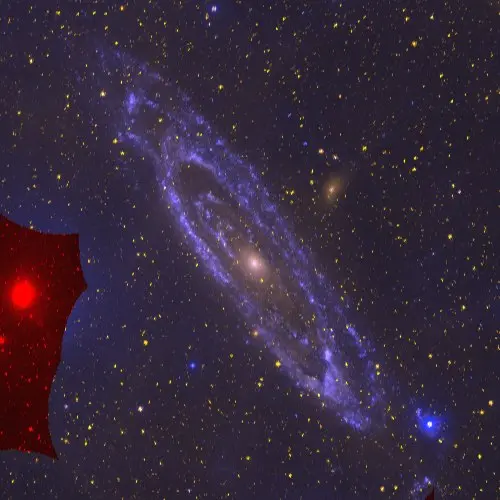
If the Milky Way is our home, then the Andromeda Galaxy (NGC 224) is our grand, mysterious neighbor, the majestic matriarch of the Local Group. Ancient and impossibly vast, this titan is estimated to house a trillion stars within its sprawling disk and prominent rings of fire, making it the most distant object visible to the naked human eye. It shimmers as a steady beacon from approximately 2.5 million light-years (Mly) away, a fixed point in the night sky that has guided human curiosity for over a millennium. But Andromeda is far more than a static portrait. It is a living laboratory for galaxy evolution, composed of complex stellar populations and scarred by a violent history of mergers. From its unique and enigmatic nucleus to its far-reaching, stream-filled halo, M31 stands as a shimmering witness to the slow, grinding assembly of the universe itself.
Nowhere is Andromeda’s violent history more evident than in its sprawling outskirts, where a colossal trail of metal-rich stars known as the Giant Stellar Stream extends some 130 kly through the galactic halo. These luminous filaments function as fossil remnants of smaller satellite galaxies that have fallen victim to a process of galactic cannibalism. As Andromeda’s immense gravitational influence devours these systems, they undergo tidal stripping, leaving behind debris trails that trace the orbital trajectory of their destroyed progenitors. Because the stream’s stars are unusually rich in heavy elements, this interaction likely involved a substantial victim, possibly a precursor to the compact elliptical galaxies M32 and NGC 205. The stream proves, in glowing starlight, that the hierarchical assembly of galaxies is not a relic of the distant past. It persists into the current epoch, unfolding before modern telescopes in slow motion.
This theme of cosmic violence and elegant complexity continues as one travels toward the galaxy’s heart, where Andromeda harbors one of its most famous and confounding secrets: a double nucleus. At first glance, the core appears to host two distinct bright peaks, designated P1 and P2. While this might suggest the presence of two separate galactic centers locked in a death spiral, the reality is both simpler and stranger. Research has revealed that these two peaks are not independent entities but parts of a single, lopsided, eccentric disk of stars orbiting a central supermassive black hole. This black hole, a gravitational monster weighing in at approximately a billion, resides within the fainter of the two peaks, P2. The brighter spot, P1, is an optical illusion of orbital mechanics. It marks the location where stars in their highly eccentric orbits linger and pile up at apoapsis, the point farthest from the black hole. Their slow, collective drift through this region creates a concentrated glow that outshines the true center. To add a final layer of complexity, this heart is technically a triple-component system, as P2 itself contains a tiny, nested disk of young, blue stars, a vibrant counterpoint to the ancient red giants swirling nearby.
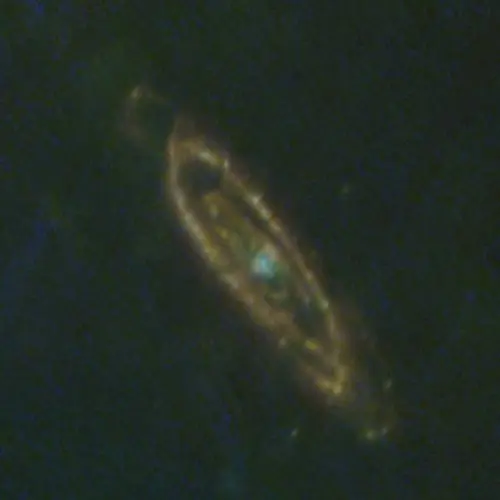
Moving outward from this chaotic core, the galaxy reveals its primary cradle for stellar birth: the magnificent 30-kly ring, often dubbed Andromeda’s Ring of Fire. Here, unlike the relatively quiescent interarm regions, gas and dust are densely concentrated into a dynamic, star-forming cauldron. This structure is a true dynamical enhancement, defined by strong dust emission and high extinction that signals the presence of the cool, dense materials necessary to ignite stars. While infrared observations highlight this glowing torus in stark relief, research shows that star formation within it is not a steady flame but a series of episodic bursts. Activity has declined by roughly fifty percent over the last 250 million years. Despite this slowdown, the ring remains the most active site of stellar assembly in the entire galaxy, a factory floor where new generations of suns are born from the recycled remnants of old.
Andromeda’s creative destruction is not limited to its internal dynamics. Its celestial court is dominated by two primary attendants, the compact elliptical M32 and the dwarf spheroidal NGC 205, which orbit at projected distances of approximately 15 and 30 kly from the nucleus. These companions exist in a perpetual gravitational tug-of-war with the Matriarch. Andromeda’s immense mass aggressively strips their stellar material, feeding features like the Giant Stellar Stream to fuel her own growth, yet their repeated orbital passages exert a reciprocal influence. The gravitational dance of these satellites is likely responsible for twisting the galaxy’s expansive disk into its signature warped geometry, proving that the hierarchical epoch of galaxy building is not a one-way street but a complex negotiation of cosmic forces. Andromeda asserts her dominance, but even she is shaped by those she devours.
Looking forward, this dynamic interplay of forces sets the stage for an even more dramatic finale. Andromeda is currently on a radial trajectory toward the Milky Way at approximately 110 km per second, and the collision is inevitable. Research utilizing precise Hubble Space Telescope proper motion data and simulations confirms that M31’s path is statistically consistent with a direct hit in roughly four billion years. This interaction will eventually merge the Milky Way, Andromeda, and the Triangulum Galaxy (M33) into a single, massive elliptical system, sometimes called Milkomeda. While the elegant spiral structures known today will be fundamentally reshaped by tidal forces, the vastness of interstellar space ensures that individual stars will almost never collide. This probable grand merger could mark the final evolutionary epoch for this corner of the universe, a fitting legacy for the matriarch who has reigned for so long.
Written by Fariba Nehreen Binti using this Google NotebookLM and the papers therein.
Tab Content goes here
Astrophotography information
| Astrophotography | Yead Muhammad Ivan |
| Observing location | Kishoreganj (24.4320, 90.7805) |
| Exposure time | 85 min. |
| Telescope | Askar 71F 71 / 490 mm |
| Camera | Nikon D5300 |
| Field of view (resolution) | 2.75° x 1.83° (1.65 arcsec) |
| Image processing | Yead Muhammad Ivan |
| Image processing method | Stacked in DSS stretched in Siril and edited in Photoshop. |
Astrophysical information
| Object type | Spiral Galaxy |
| Constellation | Andromeda |
| Distance | Approximately 2.5 million light-years or about 770 kiloparsecs |
| Angular size | 3.1° × 1° |
| Physical size | It has a diameter of roughly 220,000 light-years and contains an estimated 1 trillion stars |
| Apparent magnitude | 3.44 |
 Yead Muhammad Ivan