
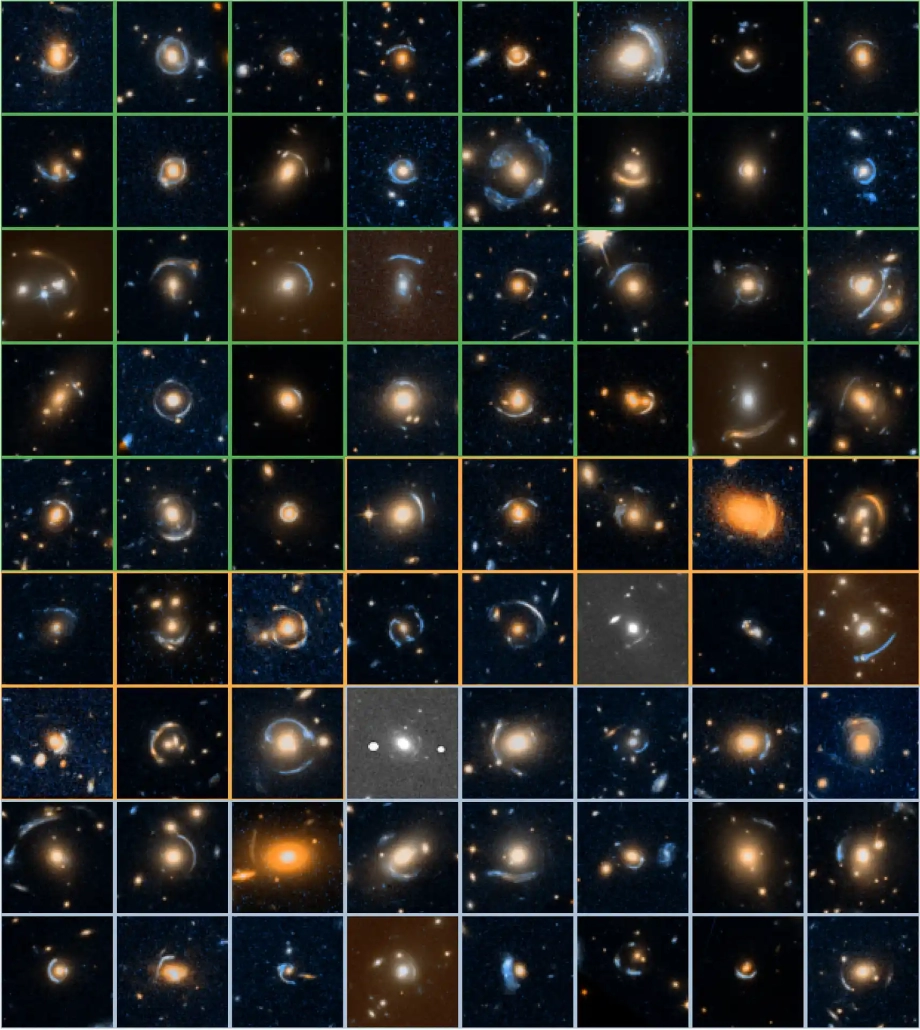
The AGEL Survey Data Release 2: A Gravitational Lens Sample for Galaxy Evolution and Cosmology
Tania M. Barone, Keerthi Vasan G.C., Kim-Vy Tran, Glenn G. Kacprzak, Karl Glazebrook, Tucker Jones, Duncan J. Bowden, Faith Dalessandro, Nandini Sahu, Hannah Skobe, Rebecca J. Allen, A. Makai Baker, Daniel J. Ballard, Yuguang Chen, Thomas E. Collett, Giovanni Ferrami, Jimena González, William Gottemoller, Anishya Harshan, Xiaosheng Huang, Leena Iwamoto, Colin Jacobs, Tesla E. Jeltema, Kaustubh Rajesh Gupta, Geraint F. Lewis, Sebastian Lopez, Themiya Nanayakkara, Nikole M. Nielsen, Jackson O’Donnell, Huimin Qu, Sunny Rhoades, Anowar J. Shajib, Sarah M. Sweet, and Nicolas Tejos
The Astronomical Journal, Volume 171, Issue 1, 57, 23 pp.
https://doi.org/10.3847/1538-3881/ae1f86
Abstract: The ASTRO 3D Galaxy Evolution with Lenses (AGEL) Survey is an ongoing effort to spectroscopically confirm a diverse sample of gravitational lenses with high spatial resolution imaging, to facilitate a broad range of science outcomes. The AGEL systems span single galaxy-scale deflectors to groups and clusters, and include rare targets such as galaxy-scale lenses with multiple sources, lensed quiescent galaxies, and Einstein rings. We build on the 68 systems presented in Tran et al. (AGEL data release 1) to present a total of 139 lenses, and high-resolution Hubble Space Telescope images for 167 lenses from three programs (including one ongoing). Lens candidates were originally identified by convolutional neural networks in the Dark Energy Camera Legacy Survey imaging fields, and of the targets with follow-up spectroscopy, we find a high (96%) success rate. Compared with other spectroscopic lens samples, AGEL lenses tend to have both higher redshift deflectors and sources. We briefly discuss the common causes of false-positive candidates, and suggest strategies for mitigating false-positives in next-generation lens searches. Lastly, we present the newly measured redshifts for six (five confirmed strong lenses, one probable) galaxy-scale double-source plane lenses, targets which are useful for cosmological analyses. With next-generation telescopes and surveys such as Euclid, Vera Rubin’s Legacy Survey of Space and Time, Keck Observatory’s KAPA program, and 4MOST’s 4SLSLS surveys on the horizon, the AGEL survey represents a pathfinder for refining automated candidate search methods and identifying and triaging candidates for follow-up based on scientific potential.

