
CASSA Research Assistants Garner Recognition at the International Conference on Physics 2026
Research assistants from the Center for Astronomy, Space Science and Astrophysics (CASSA) at Independent University, Bangladesh (IUB) recently made a strong impression at the International Conference on Physics 2026. Organized by the Bangladesh Physical Society, the three-day conference was held from April 9 to 11 at the campus of the University of Dhaka. Representing CASSA, research assistants Nafis Sadik Nihal (working with Dr Anowar Jaman Shajib) and Ahmad Al-Imtiaz (working with Dr Lamiya Ashraf Mowla) delivered contributory talks focusing on their latest research in astrophysics. Their presentations successfully captured the attention of participants and experts, highlighting the growing capacity for advanced observational astrophysics research at IUB.
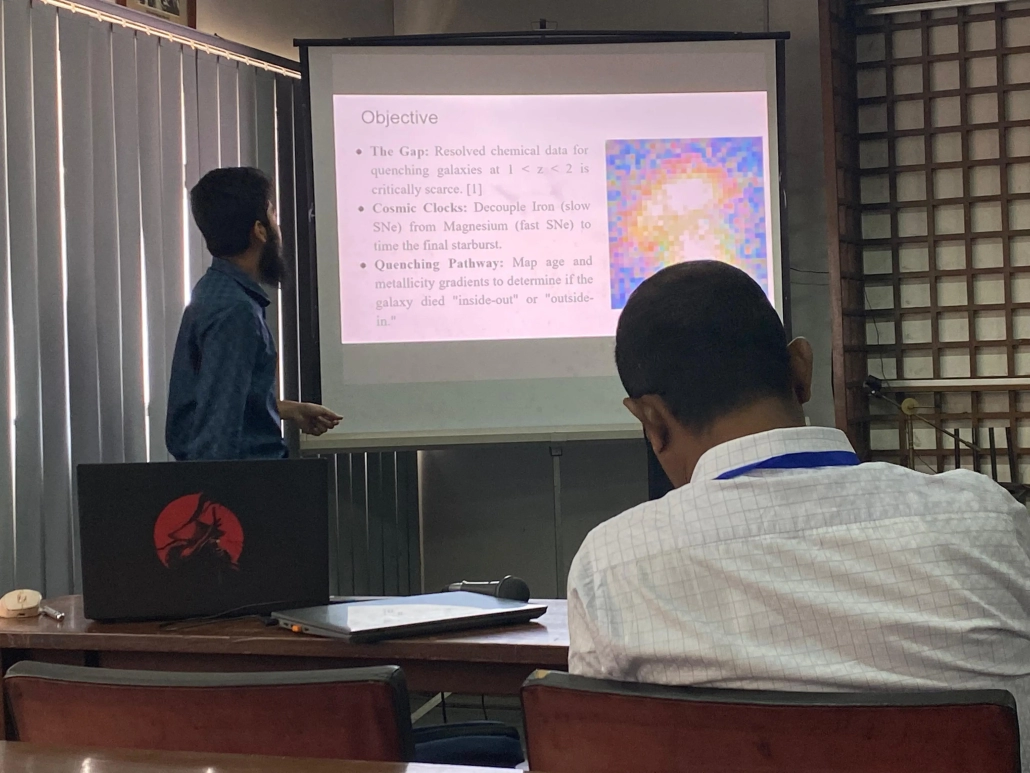
A major highlight of the event was the recognition of Ahmad Al-Imtiaz, who received the award of Best Presenter (Oral) in his respective section. His presentation detailed his research on the evolution of a lensed quiescent galaxy, specifically exploring resolved metallicity and age gradients in the high-redshift system AGEL0014 (known as Red Eyebrow) at a redshift of around 1.4. The work demonstrates significant insights into the early universe and galaxy evolution using strong gravitational lensing. This research was carried out by Imtiaz before he joined CASSA officially.
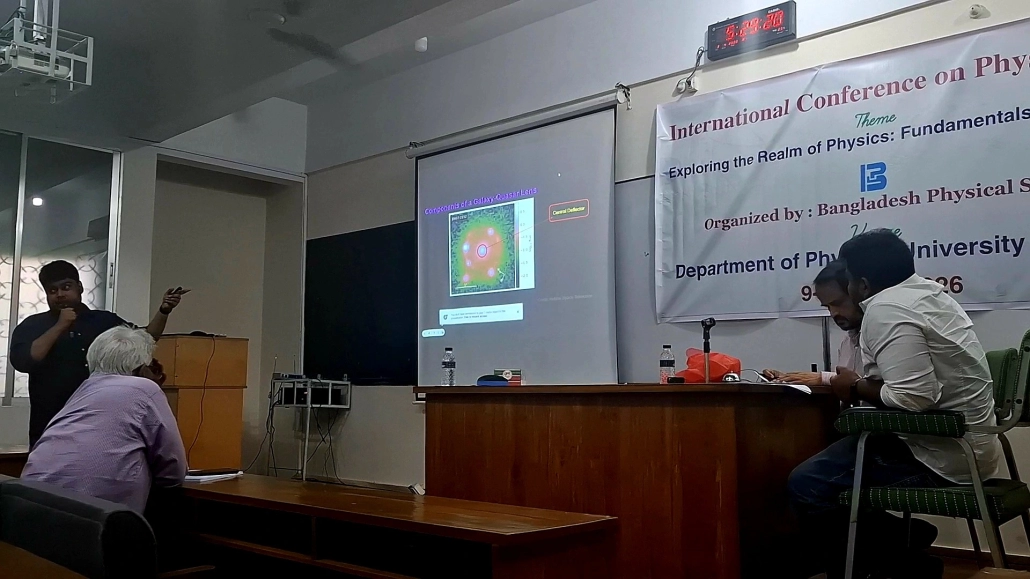
Also presenting innovative work, Nihal introduced “DOLPHIN,” a newly developed automated tool specifically designed to analyze galaxy-scale lensing systems. This research was carried out at CASSA under the supervision of Dr Shajib, a postdoctoral fellow at the University of Chicago, and an Associate Member of CASSA. The research centers on the automated modeling of double and quadruple gravitational lenses using data from the Hubble Space Telescope. By using DOLPHIN, this work promises to significantly streamline complex lens modeling processes, which is a critical component of mapping distant and extended celestial objects efficiently.
The successful participation and the accolades the research assistants receive underscore CASSA’s ongoing commitment to fostering the next generation of astrophysics students and contributing impactful research to the broader astrophysics community.

