
Table of Contents
Ideal gas
In astrophysics, an ideal gas is one whose particles obey the Maxwell–Boltzmann statistics and interact only through elastic collisions, without long-range forces. It provides an excellent approximation for the hot, low-density plasma inside stars, where interactions between particles are rare and short-lived.
The equation of state (EOS) of an ideal gas expresses the pressure \(P\) as a function of density \(\rho\) and temperature \(T\).
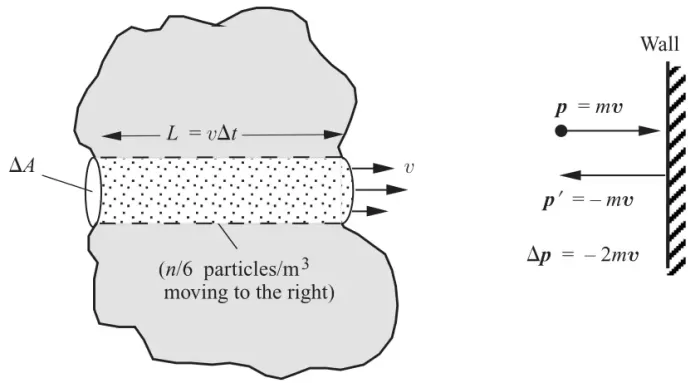
Derivation of pressure
Consider a particle moving toward a wall with velocity \(\mathbf{v}\) and momentum \(\mathbf{p} = m\mathbf{v}\). Upon an elastic collision, it reverses direction, transferring momentum to the wall:
$$ \Delta \mathbf{p} = \mathbf{p}' - \mathbf{p} = -m\mathbf{v} - m\mathbf{v} = -2m\mathbf{v}. $$
Hence, \(+2m\mathbf{v}\) of momentum is imparted to the wall in each collision. Pressure is defined as the momentum transferred per unit area per unit time:
$$ P = N \frac{\Delta p}{\Delta t} \frac{1}{\Delta A}. $$
If the total number density of particles is \(n\), then the number hitting a single wall per unit time is \(N = (nV)/6 = (nv\Delta t \Delta A)/6\). Only one-sixth of all particles move toward a given wall (since there are six directions: ±x, ±y, ±z).
Substituting, we find:
$$ P = \frac{nv}{6} (2mv) = \frac{1}{3} n m v^2 = \frac{2}{3} n \left(\frac{1}{2} m v^2\right). $$
This shows that pressure is directly proportional to the kinetic energy density of the gas:
$$ P = \frac{2}{3} n E, $$
where \(E\) is the average kinetic energy per particle.
If the particles have a distribution of speeds (as in Maxwell–Boltzmann statistics), then
$$ P = \frac{2}{3} n E_{av}. $$
Pressure and kinetic energy density have identical dimensions (energy per volume). Although pressure is formally a tensor (involving both direction and force), it reduces to a scalar in an isotropic gas, where motion is equally probable in all directions.
Average kinetic energy
For a gas following the Maxwell–Boltzmann distribution, the mean kinetic energy per particle can be derived as the expected value:
$$ E_{av} = \left(\frac{p^2}{2m}\right)_{av} = \int_0^\infty \frac{p^2}{2m} P(p)\,dp = \frac{3}{2} kT. $$
Thus, temperature \(T\) is a direct measure of the average kinetic energy of the particles.
This relation allows us to infer the spectral emission of a gas. A monatomic hydrogen gas at \(T = 12\ \text{MK}\) has \(E_{av} = kT = 1.5\ \text{keV}\), corresponding to photons with frequency \(h\nu \approx kT\), or about \(10^{17}\ \text{Hz}\) — in the X-ray range. At \(T = 6000\ \text{K}\), radiation shifts to the visible range, as in the solar photosphere.
Degrees of freedom and molecular gases
For a monatomic gas, motion in the three spatial directions gives three degrees of freedom (DOF). Each contributes \(\tfrac{1}{2}kT\) to the energy, yielding
$$ E_{av} = \frac{3}{2} kT. $$
A diatomic gas has two additional DOFs — rotation and vibration — giving
$$ E_{av} = \frac{5}{2} kT. $$
However, in stellar interiors, molecules dissociate under extreme temperatures, so the gas is almost entirely monatomic and ionized.
Equation of state for stellar gas
In stellar interiors, pressure arises mainly from thermal motion of ions and electrons. Using the ideal gas law, the pressure is
$$ P = n kT = \frac{\rho}{m_{av}} kT, $$
where \(m_{av}\) is the average mass per particle.
For a fully ionized hydrogen plasma, each hydrogen atom contributes two particles (a proton and an electron), so \(m_{av} = m_p/2\). This form of the EOS,
$$ P = \frac{\rho kT}{m_{av}}, $$
is fundamental in stellar structure equations and serves as the foundation for hydrostatic equilibrium, virial balance, and energy transport analyses.
The more familiar form of the ideal gas law, \(PV = \mathsf{n}RT\), follows from \(n = \mathsf{n} N_0 / V\), where \(N_0\) is Avogadro’s number and \(R = k N_0\) is the universal gas constant.
Astrophysical context
- In the solar core, \(T \sim 1.6 \times 10^7\ \text{K}\) and \(\rho \sim 1.5 \times 10^5\ \text{kg/m}^3\), giving pressures of order \(10^{16}\ \text{Pa}\).
- The ideal gas EOS is valid wherever particle collisions dominate over degeneracy or radiation pressure — i.e., in most main-sequence stars.
- At higher densities or lower temperatures, quantum corrections become important, leading to degenerate gases, such as in white dwarfs and neutron stars.
Insights
- Pressure in an ideal gas arises from the transfer of momentum by particle collisions.
- For an isotropic distribution, \(P = \tfrac{2}{3} nE_{av}\).
- The average kinetic energy per particle, \(E_{av} = \tfrac{3}{2}kT\), defines temperature microscopically.
- The stellar equation of state, \(P = \rho kT / m_{av}\), links thermodynamics to hydrostatic equilibrium.
- Deviations from the ideal gas law occur when degeneracy or radiation pressure dominates.
Inquiries
- Derive the expression \(P = \tfrac{1}{3} n m v^2\) from the momentum transfer argument.
- Show how integrating the Maxwell–Boltzmann distribution leads to \(E_{av} = \tfrac{3}{2} kT\).
- Why does a fully ionized hydrogen plasma have \(m_{av} = m_p / 2\)?
- In which astrophysical environments does the ideal gas law fail, and why?
- How does the ideal gas EOS connect to hydrostatic equilibrium in stars?