Table of Contents
Eddington limit
The Eddington limit defines the maximum luminosity a star (or any radiating object) can achieve before radiation pressure overcomes gravity and drives away its outer layers. Beyond this limit, hydrostatic equilibrium can no longer be maintained—the star’s radiation literally blows off its photosphere.
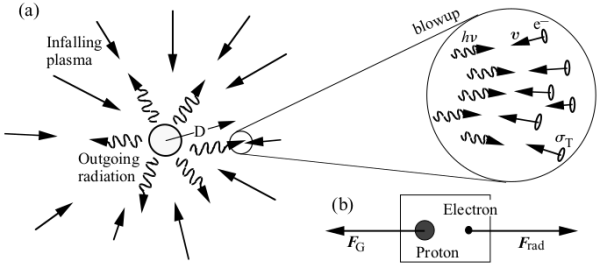
For most main-sequence stars, the luminosity–mass relation follows \( L \propto M^{3} \). However, the maximum possible luminosity, known as the Eddington luminosity, scales only as \( L_E \propto M \). Thus, there exists a critical upper limit to stellar mass, beyond which the radiation pressure becomes dynamically dominant.
Consider a fully ionized hydrogen plasma consisting of free protons and electrons:
- Gravity acts mainly on the protons (which carry most of the mass).
- Radiation pressure acts primarily on the electrons (which scatter photons via Thomson scattering).
The Eddington luminosity is obtained by balancing the outward radiative force with the inward gravitational force on the plasma.
—
Radiative force: Each photon carries energy \( E = h\nu = pc \), so the radiation pressure is
$$ P_{\mathrm{rad}} = \frac{dp}{dt} \frac{1}{A} = \left( \frac{dE}{dt} \frac{1}{A} \right) \frac{1}{c} = \frac{\phi}{c}, $$
where \( \phi \) is the radiative energy flux (W m\(^{-2}\)). The outward force on a single electron is then
$$ F_{\mathrm{rad,e}} = P_{\mathrm{rad}} \sigma_T = \frac{\phi \sigma_T}{c} = \frac{L}{4\pi r^2} \frac{\sigma_T}{c}, $$
where \(L\) is the luminosity, \(r\) is the distance from the center, and \(\sigma_T\) is the Thomson scattering cross-section.
—
Gravitational force: On a proton at the same radius,
$$ F_{\mathrm{G,p}} = -\frac{G M \mu_e m_p}{r^2}, $$
where \(G\) is the gravitational constant, \(M\) the stellar mass, \(m_p\) the proton mass, and \(\mu_e\) the mean molecular weight per electron (nucleons per free electron).
—
Setting the two forces equal at the limit of equilibrium,
$$ F_{\mathrm{G,p}} + F_{\mathrm{rad,e}} = 0, $$
we obtain the Eddington luminosity:
$$ L_E = \frac{4\pi G M_\odot \mu_e m_p c}{\sigma_T} \frac{M}{M_\odot} = 1.26\times 10^{31}\, \mu_e \frac{M}{M_\odot}\ \mathrm{W} = 3.27\times 10^4\, \mu_e \frac{M}{M_\odot}\ L_\odot. $$
—
For a one-solar-mass star (\(\mu_e = 1\)), \(L_E \approx 3.3\times 10^4 L_\odot\). Thus, the Sun’s luminosity (\(L_\odot\)) is well below the limit, ensuring that its plasma remains gravitationally bound—except in the outer corona, where radiation and magnetic pressure drive the solar wind.
Upper stellar mass limit
For hydrogen-burning stars, luminosity scales approximately as \(L \propto M^{3.2}\) (pp-chain dominated). Equating this to the Eddington luminosity yields the maximum mass:
$$ L = L_E \Rightarrow (M/M_\odot)^{3.2} L_\odot = 3.27\times10^4 \mu_e (M/M_\odot) L_\odot, $$
so that
$$ M_{\mathrm{max}} = (3.27\times10^4 \mu_e)^{1/2.2} M_\odot \approx 113\, M_\odot, $$
for pure hydrogen gas (\(\mu_e = 1\)).
The luminosity of such a star is
$$ L = 113^{3.2} L_\odot \approx 3.6\times10^6 L_\odot, $$
or over a million times the Sun’s luminosity. No stable star significantly exceeding 130 M\(_\odot\) has ever been observed.
Stars nearing the Eddington limit exhibit radiation-driven instabilities and are classified as luminous blue variables (LBVs). These massive, hot stars—such as η Carinae and P Cygni—undergo periodic outbursts over months to years, shedding large amounts of mass due to intense radiation pressure.
Eddington limit and mass accretion

The same principle applies to compact objects. For a 1.4 M\(_\odot\) neutron star, the Eddington luminosity is about
$$ L_E \approx 1.8\times10^{31}\ \mathrm{W}, $$
and indeed, the brightest observed neutron stars approach this luminosity. This supports the interpretation that their emission arises from accreting matter falling onto the star from a companion.
If a star accretes mass at a rate \(\dot{m} = dm/dt\), the accretion luminosity is
$$ L_{\mathrm{acc}} = \frac{G M \dot{m}}{R}, $$
where \(R\) is the radius of the accreting object. Setting \(L_{\mathrm{acc}} = L_E\) defines the Eddington accretion rate:
$$ \dot{m}_E \approx 1.26\times10^{31} \frac{R}{G M_\odot}, $$
which is independent of the star’s mass. For a 10 km neutron star,
$$ \dot{m}_E \approx 10^{15}\ \mathrm{kg\,s^{-1}} \approx 10^{-8}\ M_\odot\ \mathrm{yr^{-1}}. $$
Eddington limit and quasars

Quasars are among the most luminous known objects, with \(L \sim 10^{39}\ \mathrm{W}\). Setting \(L = L_E\) gives the mass of the accreting object:
$$ M \approx 10^8 M_\odot. $$
Because quasar brightness varies on timescales of months or years, their emission must arise from a compact region roughly the size of a light-year. Only a supermassive black hole can contain \(10^8 M_\odot\) within such a volume, confirming that quasar radiation originates from accretion onto black holes.
The Schwarzschild radius of a black hole is
$$ R = \frac{2GM}{c^2}, $$
which equals about 2 AU for a \(10^8 M_\odot\) black hole. Substituting into the accretion rate formula gives
$$ \dot{m}_E \approx 0.5\ M_\odot\ \text{per year}, $$
meaning that even such luminous quasars grow modestly by consuming roughly half a solar mass each year.
Insights
- The Eddington limit sets the maximum luminosity that can be radiated without disrupting hydrostatic balance.
- Radiation pressure arises primarily from photon–electron scattering, while gravity acts on protons.
- The limit increases linearly with mass (\(L_E \propto M\)), while stellar luminosity rises faster (\(L \propto M^3\)), imposing a natural mass ceiling.
- Near the limit, stars become unstable and exhibit massive eruptions (e.g., LBVs).
- The same principle constrains the luminosities and accretion rates of compact objects and explains the energy output of quasars.
Inquiries
- Why does the Eddington luminosity depend only linearly on mass while stellar luminosity scales as \(M^3\)?
- What physical processes make LBVs unstable near the Eddington limit?
- Derive the Eddington accretion rate for a 1.4 M\(_\odot\) neutron star and express it in solar masses per year.
- How does the Eddington limit provide evidence for the existence of supermassive black holes in quasars?
- What would happen to a star if its luminosity exceeded the Eddington limit for an extended period?