
Table of Contents
Amateur astronomy
Amateur astronomy remains a unique phenomenon among the exact sciences because non-professionals continue to play an active, and often essential, supporting role in the advancement of the field. While most modern scientific research requires elaborate equipment and rigorous specialized training, astronomy provides a vast landscape where the dedicated amateur comes into their own. The distinction between the professional and the contributing amateur is frequently blurred, as the history of the discipline is a “vine with many grafts” involving observers, mathematicians, and patrons who often pursued the stars out of personal passion rather than financial compensation.
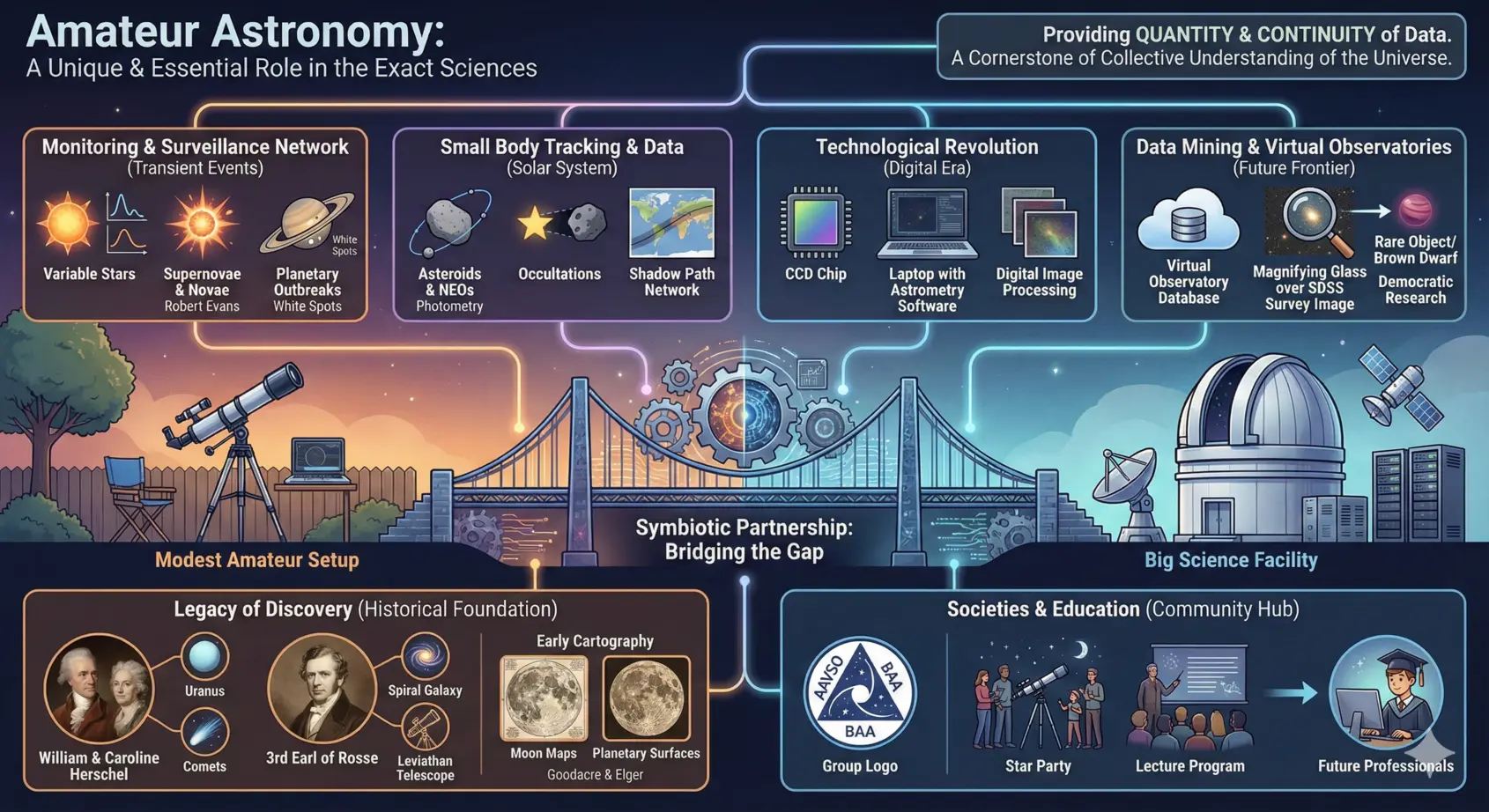
A Legacy of Discovery
The historical foundation of modern astronomy was built largely by individuals who began as amateurs or worked outside official state institutions. William Herschel, arguably the greatest of all observers and the discoverer of Uranus, began his career as an amateur musician before receiving a royal pension. His sister, Caroline Herschel, transformed from a singer into an assistant astronomer, discovering eight comets and providing the first comprehensive index to earlier stellar catalogs. This tradition of independent research continued into the 19th century with figures like the 3rd Earl of Rosse, who built the “Leviathan of Parsonstown,” then the world’s most powerful telescope, to discover the spiral forms of objects now known to be galaxies. Similarly, William Lassell, a successful brewer, used his self-constructed telescopes to discover Triton, a moon of Neptune, and several satellites of Uranus and Saturn.
Before the advent of the Space Age, the amateur community was responsible for the most detailed mappings of the Moon and planetary surfaces. Amateur cartography led the way for many years; for instance, the best lunar maps of the 19th century were produced by dedicated observers like Walter Goodacre and Thomas Elger. These records were so precise that they were used by professionals to correlate the first images of the Moon’s far side obtained by space probes in 1959. In the realm of spectroscopy, pioneers like Sir William Huggins, an amateur, provided the first proof that some nebulae were truly gaseous rather than unresolvable star systems.
Amateur-professional collaboration
In the modern era, the relationship between amateurs and professionals has evolved into a highly collaborative symbiosis. Amateurs undertake work that professionals may lack the time or inclination to pursue, such as long-term monitoring and synoptic coverage. One of the most significant areas of contribution is the study of variable stars. Because there are millions of these objects, professional observatories cannot monitor them all; they rely instead on the diligent estimates provided by amateurs. These observations are vital for understanding stellar life cycles and calibrating the universal distance scale.
Amateurs also function as a global surveillance network for transient and unpredictable phenomena. Discoveries of novae, supernovae, and comets frequently originate with amateur observers who have an encyclopedic knowledge of the sky. For example, the Reverend Robert Evans, using a portable telescope, has visually discovered more than 40 supernovae in external galaxies, providing professionals with the early warnings necessary to redirect major facilities for detailed study. Amateurs are often the first to detect major outbreaks on planets, such as the “white spots” on Saturn discovered by Will Hay in 1933 and again by an amateur in more recent times.
The tracking of small Solar System bodies and asteroids is another field where amateur activity has experienced a resurgence. While professional surveys now detect many near-Earth objects (NEOs), amateurs provide essential follow-up observations to refine orbits and determine rotation periods through photometry. Furthermore, amateurs are uniquely positioned to observe the occultation of stars by asteroids. Because the “shadow paths” of these events are narrow, a network of amateurs can determine the precise dimensions and shapes of asteroids by timing when the starlight is blocked from different geographical locations.
Amateur astronomical societies
Amateur astronomical societies play a crucial role in maintaining the health of the discipline by organizing observational efforts and providing a hub for education. In Britain, the Royal Astronomical Society (RAS) was founded in 1820 to include both full-time and volunteer astronomers. However, as professional requirements became more specialized, exclusively amateur organizations like the British Astronomical Association (BAA) emerged in 1890 to coordinate systematic observations under experienced directors. The BAA established sections for specific targets like Jupiter, the Sun, and variable stars, resulting in some of the most continuous long-term observational records available to science.
In the United States, the American Association of Variable Star Observers (AAVSO), founded in 1911 by William Tyler Olcott, has become the world’s largest organization of its kind. Its international database contains millions of observations used by professional researchers worldwide. These societies act as centers of excellence, with some local clubs maintaining observatories capable of professional-standard work. They fill a vital gap in public education by hosting “star parties” and lecture programs, often serving as the primary inspiration for young people who eventually go on to become professional astronomers.
International coordination remains a goal, although attempts like the International Union of Amateur Astronomers (IUAA) have faced financial constraints. Nevertheless, national societies in countries like Canada, Australia, Japan, and throughout Europe continue to foster a pleasing amount of cooperation with professional bodies. Many of these societies publish their own regular journals and handbooks, which serve as invaluable resources for both the scientific community and the public.
Amateur astronomy in Bangladesh
Bangladesh possesses a vibrant amateur astronomy community characterized by a strong emphasis on education and instrument building. Despite the challenges of high humidity and urban light pollution, the country maintains a rich history of independent observation and a network of active societies that bridge the gap between academic science and the general public.
The tradition of amateur astronomy in the region dates back to the late 19th century, most notably with Radha Gobinda Chandra (1878–1975). Regarded as the founder of amateur astronomy in Bengal, Chandra worked in isolation with a modest 3-inch telescope to record over 49,700 observations of variable stars, earning him international membership in both the AAVSO and the BAA. In the post-independence era, Professor Mohammad Abdul Jabbar played a pivotal role; his seminal book Tara-Porichiti served as the primary guide for sky identification for generations of Bangladeshi amateurs before the internet age.
The modern amateur movement is driven by three key organizations. Anushandhitshu Chokro, founded in 1975, is renowned for its telescope-making workshops where members construct Newtonian reflectors using local materials. The Bangladesh Astronomical Society (BAS), established in 1984 by figures like F. R. Sarker, focuses on seminars and maintaining links with international bodies like the IAU. The Bangladesh Astronomical Association, founded in 1988 by Mashhurul Amin, specializes in public outreach through the long-running magazine Mohakash Barta and the “Dhaka Mahakash Utsab” (Space Festival).
In recent years, youth engagement has surged through the Bangladesh Olympiad on Astronomy and Astrophysics (BDOAA), which trains national teams for international competitions. Concurrently, observatories have gained traction, supported by private individuals like Shahjahan Mridha Benu, who has established private observatories in Gazipur that provide students and enthusiasts with rare access to professional-grade equipment.
Future directions
The “CCD Revolution” of the late 20th century fundamentally changed amateur capabilities. With affordable electronic detectors and specialized software, an amateur using a modest telescope can now produce results that match the quality of major professional observatories from the immediate post-war era. Modern amateurs are often skilled in electronics and digital image processing, allowing them to engage in precise astrometry and photometry.
The advent of the internet and the creation of “virtual observatories” have opened a new frontier: data mining. Amateurs now participate in large-scale projects by sifting through terabytes of data from professional digital sky surveys, such as the Sloan Digital Sky Survey (SDSS), to find rare objects, brown dwarfs, or distant quasars that automated algorithms might miss. This “democratic” approach to research means that anyone with the diligence to analyze large parameter spaces can perform novel science without direct access to a large telescope.
Conclusion
Amateur astronomy provides the “quantity” and “continuity” of data that “Big Science” facilities often cannot maintain. Professional astronomers warmly welcome these contributions, recognizing that the amateur community is as important now as it has been throughout history. As technology continues to bridge the gap between amateur and professional equipment, this symbiotic relationship will remain a cornerstone of our collective effort to understand the universe.