This is an old revision of the document!
3. Stellar Age
1. Event highlights
Formation of the Milky Way's Thin Disk
Following the earlier formation of the galactic halo, the Milky Way flattened into a thin disk. This structural change coincided with the birth of metal-rich Population I stars, which contained heavy elements produced by earlier generations of stars.
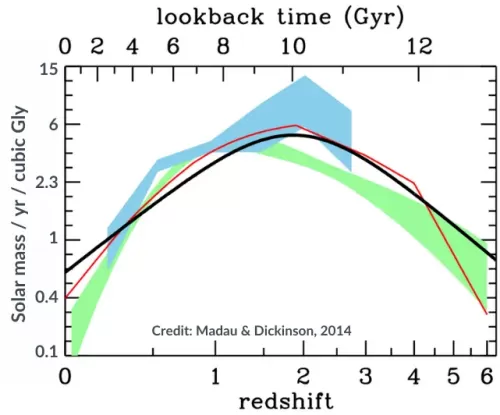
Peak Star Formation Rate
The universe experienced its maximum rate of star formation. Massive stars fused hydrogen and helium into heavier elements like carbon, oxygen, and iron, acting as "nuclear forges" to create the building blocks of future complexity.
Emergence of the Galactic Habitable Zone
A region within the galaxy emerged where conditions favored the development of complex life. By this time, metallicity (heavy element abundance) had spread outward, and the frequency of sterilizing supernovae in the inner galaxy had decreased sufficiently to allow safe orbits for planets.
Stellar Nucleosynthesis
Main-sequence stars fused hydrogen into helium, while massive evolved stars fused helium into carbon, neon, oxygen, silicon, and finally iron in their cores. This process created the chemical complexity required for planetary bodies.
Supernova Enrichment
Massive stars died in core-collapse explosions, scattering chemically enriched material into the interstellar medium. These explosions also synthesized elements heavier than iron (such as gold and uranium) via the r-process (rapid neutron capture).
Acceleration of Cosmic Expansion
The expansion of the universe began to accelerate due to the influence of repulsive "dark energy." This marked the transition from a matter-dominated era to a dark-energy-dominated era, influencing the formation of large-scale structures.
Solar Nebula Collapse
The Stellar Age concluded with the gravitational collapse of a chemically enriched interstellar cloud in our region of the Milky Way. Triggered perhaps by a nearby supernova, this event initiated the formation of the Sun and the Solar System about 4.6 billion years ago.
2. Event details
3. Stars and humans: birth and death