
This is an old revision of the document!
3. Stellar Age
Socrates: In the Galactic Age, we didn’t have time to understand two things. First, how a galaxy transitions from elliptical to lenticular — that is, how a round object becomes flat. Second, how spiral arms are formed within a galaxy’s disk. Since these events occurred during the Stellar Age, I hope the god of war, Mars, will clarify these two matters and grant us peace.
Mars: Peace will come after war. But for now, there’s no way without war. Look ahead — the massive Yarlung Tsangpo Gorge, the deepest and longest canyon on Earth. Its deafening roar will make it impossible for any of us to hear one another.
Hermes: We can hear you clearly. Like the final scene in Crouching Tiger, Hidden Dragon, let’s leap from the summit of Namcha Barwa to the very bottom of the gorge. There, amidst all the sounds, we’ll let our words float.
[Everyone leaps from the mountain summit and, in a moment, lands 7 km below on the banks of the Siang River.]
1. Birth and Death Rates
Socrates: I am confused about how the seven ages of the universe have been divided. I understand that the timeframes of the four ages from the Planetary Age to the Cultural Age are based on Earth and humanity. But why did we decide to begin the Stellar Age exactly ten billion years ago? The first stars were born at the same time as the first galaxies. So, why is the Stellar Age placed after the Galactic Age?
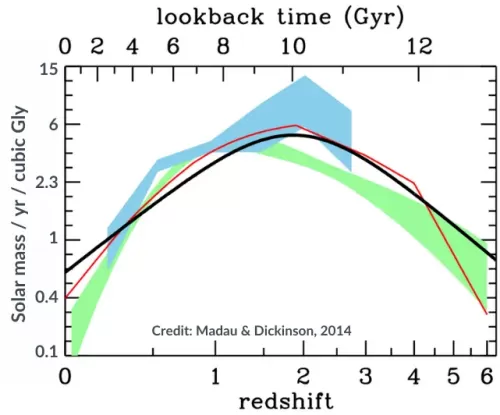
Mars: Knowing this question would arise, I prepared this figure in advance. It shows that the black and red curves have stayed very close to each other over the past twelve billion years. The black curve represents the Star Formation Rate (SFR), and the red curve represents the Black Hole Accretion Rate (BHAR). On the X-axis, time is shown at the top, and redshift is shown at the bottom. We already know from the Galactic Age that redshift serves as a proxy for time. The Y-axis displays the two rates. The formation rate is a type of birth rate, indicating the total mass of stars born per gigaparsec of cubic volume at any point in the universe’s history, measured as a multiple of the Sun’s mass. The accretion rate, on the other hand, is a type of death rate, showing how much mass, in terms of solar masses, is lost into black holes in the same volume during the same time.
Socrates: I see. The figure is now readable, and I understand that both curves peaked ten billion years ago.
Mars: That means ten billion years ago, stars were being formed from gas at the highest rate, while at the same time, the most stars and gas were being lost into black holes. When the birth rate is highest, the death rate is also at its peak—assuming we metaphorically consider falling into a black hole as a form of death.
Socrates: This can be compared to human populations. Just as birth rates are high in Niger, Chad, and Congo, so are death rates. However, since human societies are far more complex than any physical system, the comparison isn’t straightforward.
Mars: True, it isn’t straightforward, but it is quite fascinating. For instance, in this video made using Gapminder, we can see the changes in fertility rates (children per woman) and GDP per capita for all countries over the last two hundred years. Each bubble represents a country, and the size of the bubble is proportional to its population. Currently, countries with lower fertility rates tend to have higher GDPs. Comparing birth and death rates allows us to calculate a country’s population growth rate. Just as the star formation rate peaked ten billion years ago, Bangladesh had an average of more than six children per family until the 1980s. Now, it’s approximately two.
Socrates: Comparing humans to the universe is always fascinating. However, now it’s more important to compare stars to one another. To me, all stars look the same—large, spherical balls of gas. So, how are stars classified?
2. Stellar Classification
Mars: It seems your daemon informs you in advance about the next topic in our discussion. I was just about to talk about stellar classification.
Socrates: My daemon doesn’t have that much free time. Anyway, let’s hear your classification.
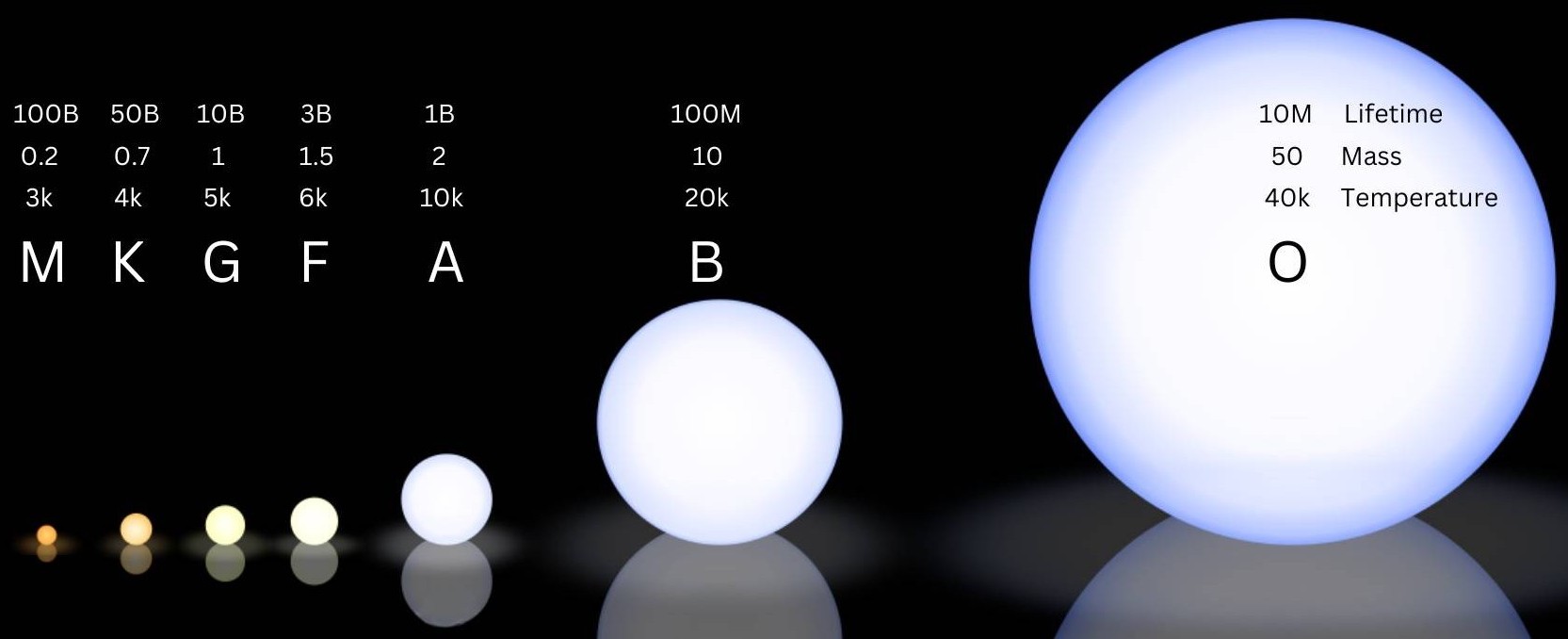
Mars: Galaxies are classified by their shape because there’s a lot of diversity in their forms. Stars, on the other hand, all appear spherical, so they are classified by their size. The larger a star, the greater its mass and temperature. Thus, size, mass, and temperature can all be equally used for classification. In this image, you can see seven types of stars labeled O to M. O-type stars are approximately 50 times more massive than the Sun. Their surface temperature is around 40,000 Kelvin, and their lifespan is only about 10 million years. The Sun is a G-type star with a surface temperature of around 5,000 Kelvin and a lifespan of approximately 10 billion years. M-type stars, on the other hand, have a mass only 20% of the Sun and a lifespan of about 100 billion years.
Socrates: Does that mean none of the M-type or K-type stars born so far have died yet?
Mars: Correct. These smaller stars are the most abundant in the universe, just as the number of poor people in a country is much greater than the number of rich people.
Socrates: That’s a good comparison. So, is our Sun rich or poor?
Mars: You’d call it middle-class. The difference is also reflected in color.
Ishtar: Yes, smaller stars are slightly red, and larger ones are bluish. But while crossing the Milky Way on our way to the Whirlpool Galaxy, all the stars appeared white to us.
Mars: Stars generally look white. The colors in this illustration have been exaggerated to clarify the differences. Stars appear white because they emit light of all colors, and when mixed, all colors form white light. However, this doesn’t mean that all colors are emitted equally. Larger stars produce more blue light than red, smaller stars emit more red light than blue, and medium-sized stars like the Sun emit more green light. The Sun, for instance, sends the most green light to Earth.
Socrates: If a star’s size determines its mass and temperature, how does that relate to its color?
Mars: As we learned during the Particle Era, color corresponds to frequency. Blue light has a higher frequency, green has slightly lower, and red has even lower. Frequency is directly related to energy. A hotter star has more energy because temperature is essentially a measure of the average energy of its gas particles. The more energy a star has, the more it emits higher-frequency light. That’s why O-type stars are so blue, G-type stars are green, and M-type stars are red.
Socrates: If all stars appear white to the naked eye, how can we tell their colors apart?
Mars: It’s not possible with the naked eye. But with spectrographs, like a prism at a telescope’s focal plane, light can be split into its various frequencies or colors. This allows us to identify which color is most prominent in a star’s light. In fact, by analyzing a star’s spectrum, we can determine its temperature.
Juno: Oh, I see! That’s why you’re talking about a star’s surface temperature. The light used to measure temperature comes from the star’s surface, so it’s easier to determine the surface temperature. But is there no way to know the temperature inside a star?
Mars: There is. Using equations of stellar structure, we can simulate stars on computers. These simulations provide information about temperature, density, pressure, and more, from the star’s surface all the way to its core.
Socrates: But now you should explain why a star’s lifespan decreases with greater size, mass, and temperature.
Mars: You’re forcing us to move on to the next topic. The simple answer is that the larger a star, the faster it burns through its fuel, and thus, it dies sooner.
Socrates: What do you mean by fuel?
3. Birth of Stars
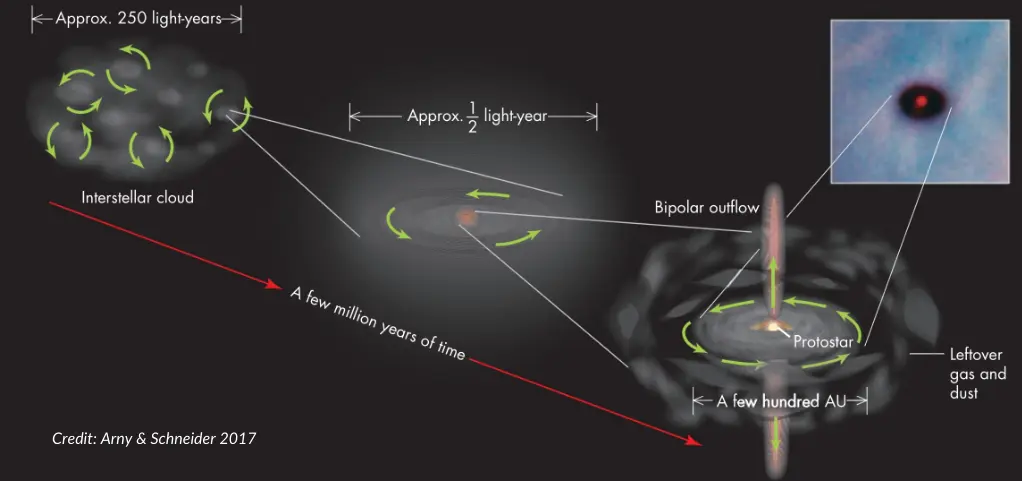
Mars: To understand why stars die quickly, we must first understand how they are born. This image shows the process of their birth. Inside a galaxy, the interstellar medium has many clouds of gas and dust, and stars are born from these clouds. Here you see a giant cloud almost 250 light-years across; remember, the size of a solar system is only about one light-year. When the mass and size of such a rotating cloud exceed a certain threshold (the Jeans mass), it collapses inward due to its own gravity. During collapse, the large cloud fragments into many smaller clouds. The middle panel shows how such a smaller cloud would look after a few million years.
Juno: At first it was a shapeless cloud, now I see a reddish sphere in the middle, surrounded by a flat disk half a light-year wide. How did a formless cloud turn into a spherical core and a flat disk within these few million years?
Mars: To understand this, we must compare gravity and rotation. If I jump from this rock into the fierce current of the Xiang River, I will die, though gravity is pulling me toward Earth’s center. The closer an astronaut comes to Earth, the stronger Earth’s gravity pulls. That means gravity always attracts, and the nearer you are to its center, the stronger it gets.
Juno: Is that why you tie a stone to a rope to explain rotation?
Mars: Yes. If I spin a stone tied to a rope around me, I feel an outward pull on my hand. If I let go of the rope, what happens to the stone?
Juno: It flies off and lands on the bank.
Mars: So, unlike gravity, rotation works as a repelling force. Now imagine a longer rope with the same stone spun at the same angular speed and then released. How far would it go?
Juno: Farther than the first one.
Mars: That means the centrifugal force was stronger this time. The farther from the center, the stronger the effect of rotation, opposing gravity. Strictly speaking, centrifugal force exists only in a rotating reference frame, but let’s skip that complexity. The point is, near the center gravity dominates over rotation, shaping the core into a sphere due to its symmetry—it pulls equally in all directions. Farther out, rotation dominates, producing a flat disk. Since gravity is strongest near the center, most matter falls into the star, leaving only about 1 percent in the disk.
Juno: So gravity has spherical symmetry, and rotation has circular symmetry?
Mars: Exactly. Rotation’s circular symmetry works perpendicular to its axis. Like when you spin a round ball of pizza dough on your hand, it flattens into a disk. Your hand is the axis, the disk forms perpendicular to it.
Socrates: I see. So how does a protostar form out of this half light-year spherical core and flat disk?
Mars: This video shows it even better. These are real images of many stars forming inside the giant Orion Molecular Cloud Complex. Here’s the process: when the central gas sphere grows massive enough, it begins accreting gas and dust from the disk. Some of this infalling material shoots out along the rotation axis, forming twin jets. These are called bipolar outflows. Don’t they remind you of active galaxies from the galactic age?
Socrates: Not only the outflows, the entire process of star formation feels like the birth of a lenticular or spiral galaxy.
Mars: Indeed, stellar systems and such galaxies are both flat. Galactic disks also form from rotating interstellar clouds, but on a much larger scale. If a cloud forming stars is hundreds of light-years wide, a galaxy-forming cloud spans hundreds of thousands or even millions of light-years.
Socrates: Just as black holes at the centers of active galaxies eventually become inactive when they run out of gas, will these bipolar outflows of protostars also fade?
Mars: Yes, and that’s when the gas sphere grows out of its “teenage years” into an adult star.
Socrates: So when do we stop calling a gas sphere a protostar and start calling it an adult star?
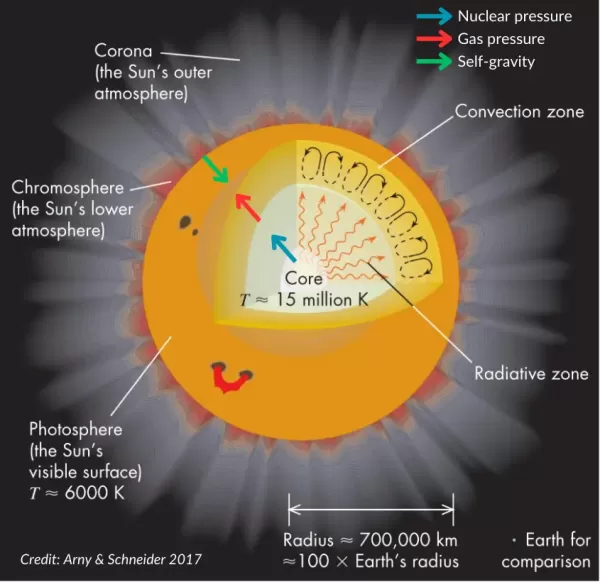
Mars: To answer that, look at this diagram of the Sun’s internal structure. At the core lies the nucleus, around it the radiative zone, then the convective zone, and outside that the photosphere—the star’s visible surface. Beyond the photosphere are the chromosphere and corona, seen only during a total eclipse. We call a human an adult when growth in height stops and the body reaches stability, usually after age eighteen. Similarly, a star becomes an adult when its size stabilizes and no longer changes much.
Socrates: So the red, blue, and green arrows in this diagram show how that stability is achieved?
Mars: Yes. The green arrows represent inward self-gravity. Gravity tries to contract the star. But as the star contracts, its gas heats up, and hot gas pushes outward. This gas pressure is shown with red arrows. If gravity and gas pressure balance, the star neither shrinks nor expands. But gas pressure alone is weaker than gravity, so stars need an extra outward force. This comes from nuclear pressure, shown by the blue arrows at the center.
Socrates: Is it called nuclear pressure because it originates from nuclear reactions?
Mars: Exactly. As the protostar contracts, the gas heats further. The hottest gas is in the core. When the core reaches 15 million degrees, nuclear fusion begins.
Socrates: Fusion between what?
Mars: Since 76 percent of the universe is hydrogen, stars also contain about 75 percent hydrogen gas. At 15 million degrees, hydrogen nuclei fuse together to form helium nuclei. At these temperatures, electrons cannot remain bound, so nuclei exist “naked.”
Socrates: I see how hydrogen fuses into helium. We studied this in more detail, with diagrams, during the particle age. But how does this fusion create outward nuclear pressure in the core?
Mars: Nuclear fusion releases tremendous energy in the form of light. As this light travels from the core toward the surface, it exerts radiation pressure. That’s what we call nuclear pressure. Once fusion starts, nuclear pressure joins gas pressure to balance gravity, and the star stabilizes—neither shrinking nor swelling. That is when we call it an adult star.
4. Life of Stars
Hermes: Now that we’re on the border between India and China, let’s sit in the famous Buddhist monastery of Bisheng village and hear the story of stellar life. Watching the dramatic performances of Indian and Chinese border guards during the storytelling wouldn’t be a bad addition either.
[Everyone leaves the shores of Aungsui and sits in the Bisheng monastery, facing the snowy peaks.]
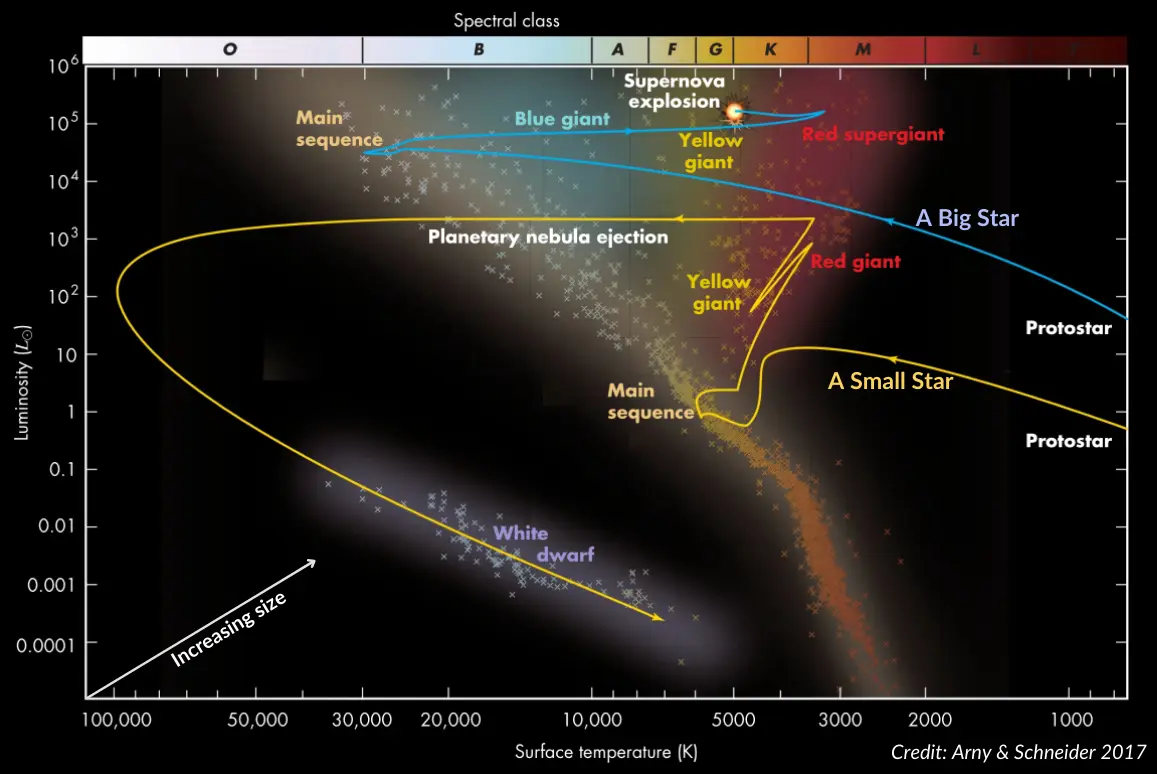
Mars: To understand the life of a star, we need to understand this famous plot known as the H-R Diagram. This is literally the story of a star’s life. On the X-axis (horizontal), we have the surface temperature of stars, ranging from just 1,000 Kelvin on the right to 100,000 degrees on the left. On the Y-axis (vertical), we have luminosity, i.e., the power of a star in watts, which we’ve compared to the power or brightness of light bulbs during the Galactic Age. Although the temperature is given in Kelvin, luminosity is given relative to the Sun: 1 means equal to the Sun’s brightness, above that up to a million times brighter, and below that up to 10,000 times dimmer. Each cross mark represents the position of a star. By tracing a cross mark downward, you can find the temperature of that star, and by moving left, you can determine its luminosity. The top horizontal axis also shows the spectral classification of stars. Previously, we discussed up to M-type stars, but here cooler L-type and T-type stars have been added. Since temperature is measured by analyzing light spectra, these classifications are known as spectral classes. A diagonal arrow at the bottom-left corner shows that as you move upward along the arrow, the size of the stars increases, while moving downward decreases it.
Socrates: It seems most stars (the crosses) lie within a diagonal band where a yellow and a blue line enter and exit. The arrow between these two lines suggests movement. What do this diagonal band and these two colored lines represent?
Mars: The band is called the Main Sequence, where all adult stars reside. The two colored lines represent the life tracks of two types of stars, showing changes in their temperature and luminosity from birth to death. The blue line is for massive stars that are 10–20 times heavier than the Sun, while the yellow line is for smaller stars like the Sun.
Socrates: Are there no adult stars to the right or left of the Main Sequence?
Mars: No. As the temperature (X) of a star increases, its luminosity (Y) also increases. That’s why the Main Sequence is diagonal. Being to the right would mean low temperature but high luminosity, and being to the left would mean high temperature but low luminosity—both cases indicate instability, where stars grow or shrink. Stability is only found within the Main Sequence. When I mentioned a star’s lifespan during classification, I was referring to how long it can stay on the Main Sequence. The Sun, for example, can remain in the Main Sequence for about 10 billion years. It has already spent 5 billion years there and has another 5 billion years left.
Socrates: Explain the life track of smaller stars, i.e., the yellow line in this H-R Diagram.
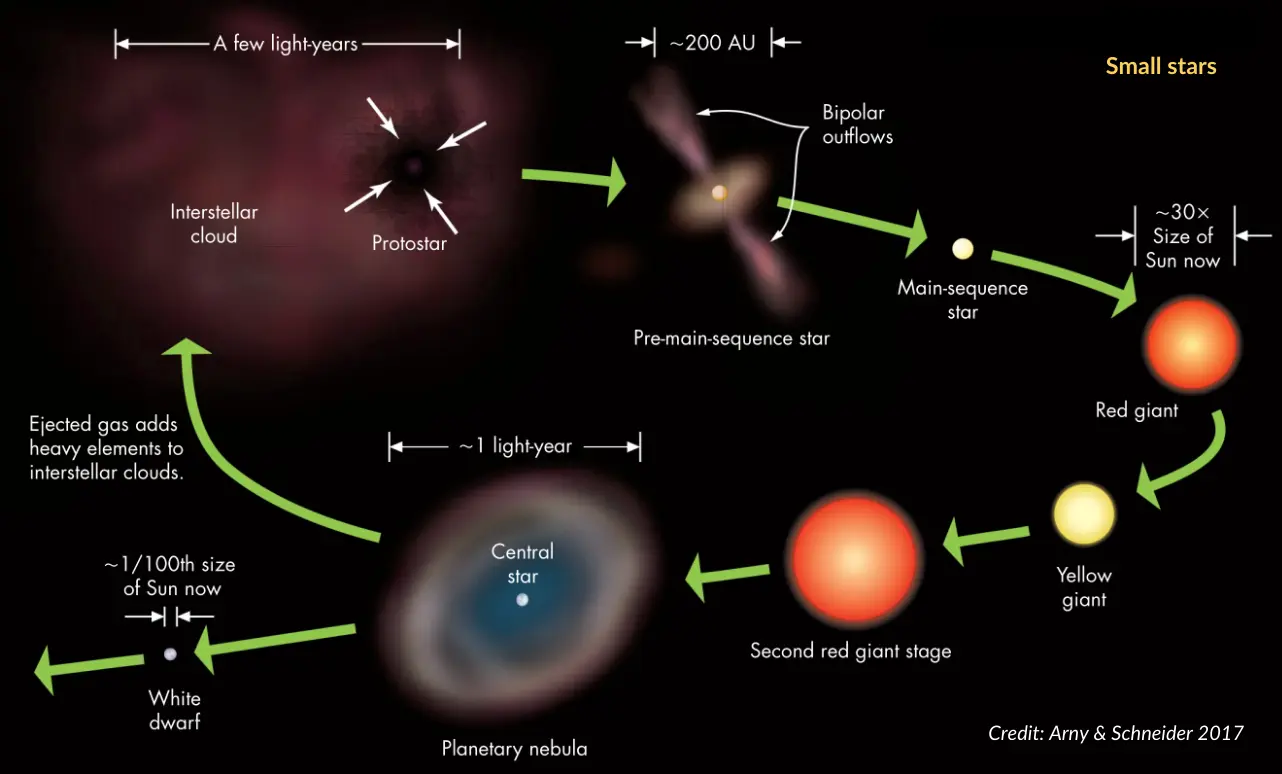
Mars: The yellow line on the H-R Diagram aligns with this image, making it easier to understand. This image shows every stage in the life of a small star like the Sun, from birth to death, while the yellow line gives an idea of the star’s temperature and luminosity at each stage. I’ll explain by comparing the two side-by-side. The yellow line shows that the cloud from which the protostar forms is initially cold. As the temperature of the cloud increases from 1,000 to 4,000 Kelvin (moving left), the line suddenly drops, indicating that the cloud is shrinking. Remember, moving downward means brightness (and size) is decreasing. After passing through the protostar and bipolar outflow phases, when the star shrinks further and nuclear fusion begins in its core, the yellow line reaches the Main Sequence, signifying the star’s stable, adult phase. A star like the Sun remains here for 10 billion years, as it takes that long to convert all the hydrogen in its core into helium. What happens after the hydrogen is exhausted?
Socrates: Ah, now I understand my earlier question about fuel. Hydrogen is the fuel for nuclear reactions in a star. When it runs out, there will be no outward nuclear pressure, and gravity will compress the star again.
Mars: And what happens when the star shrinks?
Socrates: The gas will become even hotter. But my question is, if the star shrinks, shouldn’t the yellow line move downward from the Main Sequence? Why does it move upward instead?
Mars: Because, Socrates, as the gas becomes hotter, hydrogen fusion begins in a shell around the core. Since the shell is closer to the surface compared to the core, the nuclear pressure in the shell causes the star to expand, turning it into a Red Giant. It’s red because its temperature is lower. After reaching a peak on the yellow line, the core becomes so hot that helium fusion starts in the core, where two helium nuclei fuse to form carbon. At this point, the yellow line drops again, stabilizing at a point where we call the star a Yellow Giant. What happens when the helium fuel is exhausted, i.e., when all helium is converted into carbon?
Socrates: The star will expand again due to shell fusion, leading to what the image calls the Second Red Giant phase.
Mars: The carbon core doesn’t expand, but the surrounding gas does, spreading outward. At this stage, a colorful ring of gas surrounding the dense core becomes visible, known as a Planetary Nebula. Our smart telescopes can capture beautiful images of planetary nebulae, like the Helix and Dumbbell Nebulae. Eventually, the gas in the nebula mixes back into the interstellar cloud, while the core continues shrinking and heating. The yellow line moves left, and after the nebula fully dissipates, the core cools further, transforming into a White Dwarf—the dead remnant of a small star like the Sun.
Socrates: Fascinating. So, stars come from clouds and return to clouds. The emphasis in the Bible on returning to where we came from feels newly significant now.

Mars: Exactly. Stellar life, like human life, is a cyclical process. Humans come from the Earth and return to it; stars come from gas and return to gas. By comparing this image of massive stars’ lives with the blue line in the H-R Diagram above, you’ll see the same cyclical process for larger stars as well.
Socrates: Yesterday, you said massive stars are at least 8 times heavier than the Sun. Now tell me their story.
Mars: Look at the blue line on the H-R Diagram. It starts from the bottom, rising to meet the Main Sequence. This means the gas gradually heats and expands, eventually forming an adult Main Sequence star through the same protostar and outflow phases. When the star nears the end of its life, the blue line exits the Main Sequence almost straight to the right, indicating a decrease in temperature and a slight increase in size. This phase is called the Blue Giant. It is followed by the Pulsating Yellow Giant phase, where the star’s size alternately increases and decreases. When it expands further, it becomes a Red Supergiant, where elements heavier than carbon, such as oxygen and even iron, form in its core. Once the core is entirely made of iron (with 26 protons in its nucleus), fusion can no longer occur. The core collapses violently under gravity in less than a second. When the collapsing material bounces off the iron core, it explodes outward in a massive event called a supernova.
Socrates: I suppose this explosion also scatters the surrounding gas, which mixes back into the interstellar cloud, like smaller stars’ gas. But what happens to the iron core?
Mars: The iron core collapses further, becoming either a neutron star or a black hole. The core of a star that is 10–20 times more massive than the Sun typically becomes a neutron star, while heavier stars end their lives as black holes.
Socrates: So, we’ve heard of three types of stellar remnants: White Dwarfs for small stars, and Neutron Stars or Black Holes for massive stars. While it may be sorrowful to unearth graves, I’m sure we’re all curious to know what these three “corpses” are really like.
5. Death of Stars
Mars: The remains of a star are no less fascinating than its life. To understand white dwarfs, we need to go back to 1604 and meet Kepler in Prague. That year, Kepler observed a supernova, now known as Kepler’s Supernova, whose remnants are about 20,000 light-years away from us. The Chandra X-ray Observatory captured images showing that even 400 years after the explosion, the gas is still expanding outward at a speed of about 30 million kilometers per hour. However, this isn’t the same kind of supernova I mentioned earlier. This one wasn’t formed from a massive star but from a smaller one.
Socrates: Didn’t you say smaller stars only form white dwarfs, not supernovae?
Hermes: Patience! First, let’s travel to Prague in 1604.
[With Hermes’ help, everyone travels to a night in 1604 Prague and finds Kepler in a marketplace, engaged in a mild debate with three others.]
Mars: Stay invisible, everyone. Let me talk to Kepler.
[Mars approaches the group Kepler was debating with, while the others remain invisible, observing and listening.]
Kepler: I won’t believe it until I see it with my own eyes—a new star in the sky. I want to believe, though, because it would deliver another significant blow to Aristotle’s theories.
Mars: I saw it myself just last night.
Kepler: Where?
Mars: Look in that direction. It’s still visible. Check your charts to see if that star was supposed to be there.
Kepler: Incredible. It truly is a new star. It wasn’t supposed to be there. It’s been visible since last night. Aristotle said that nothing new happens in the heavens. He’s been proven wrong. My job now is to properly bury Aristotle’s theories by proving Copernicus’ heliocentric model.
Mars: Did you know that this new star is also a kind of burial?
Kepler: What do you mean? Who are you? A philosopher?
Mars: Who I am doesn’t matter. First, tell me—if, like Plato’s Timaeus, I tell you a plausible story about this “new” star, will you listen?
Kepler: I’m considering writing a story myself, called Somnium. I’m not averse to stories.
5.1 White Dwarf
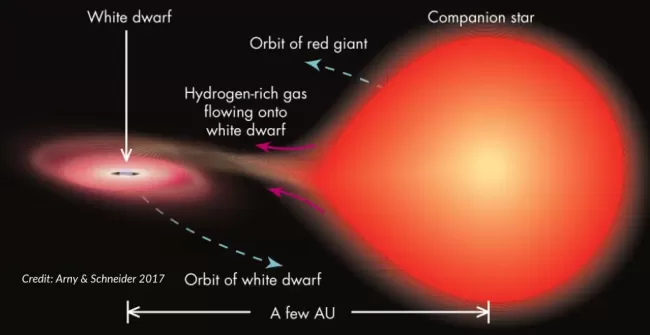
Mars: Listen, then. This so-called “new star” was actually part of a binary system, meaning it had a companion star. Let’s call the new star B and its companion C. For about 10 billion years, B and C orbited each other. However, since B was slightly larger and heavier than C, it died a million years ago, leaving behind a white dwarf—a very small but extremely hot remnant that appears white. After orbiting B’s corpse for a million years, C also neared the end of its life, swelling into a red giant, becoming enormous but cooler, thus appearing red. C grew so large that B (the white dwarf) began pulling gas from C’s outer layers. As a result, B’s mass gradually increased until, yesterday, it exceeded 1.4 times the Sun’s mass. This caused B to collapse inward. However, since B’s core was extremely dense, the infalling gas couldn’t reach the center, bouncing off the solid core and exploding outward in a massive supernova. That’s why B is visible now. B isn’t a “new” star—it’s the fresh explosion of an old star’s corpse.
Kepler: Perhaps companion C was trying to revive B.
Mars: And it backfired. That’s why I always say: never attempt to revive the dead. If Orpheus couldn’t bring back Eurydice, how could C revive B? In reality, B’s massive explosion permanently flung C out of their mutual orbit. C is now a runaway star, a solitary wanderer. They’ll never again be gravitationally bound to each other.
Kepler: It’s not true that the dead can’t be revived. Plato revived Socrates. As much as I dislike Tycho Brahe, I must unearth the meaning of his observations, even if it means digging up his legacy.
[Kepler turns back to find Mars gone, vanishing in an instant. Hermes takes everyone back to the confluence of the Siang and Brahmaputra rivers in India.]
Socrates: Was that really the right thing to do? Poor Kepler—if he can’t calculate Mars’ orbit now, it’ll be all your fault.
Mars: Do you think I’d let Kepler catch me that easily?
Socrates: Well, we’ve now understood white dwarf supernovae quite thoroughly, thanks to this story-like explanation. Now, tell us—what is this white dwarf made of?
Mars: A white dwarf is the highly compressed core of a star, so its density is incredibly high. So high, in fact, that the electrons within it can no longer maintain their usual positions and speeds. Under immense pressure, they are forced much closer together, and their speeds increase far beyond normal. These are known as degenerate electrons. Because they resist being forced closer, they collectively create an outward pressure called degeneracy pressure. This pressure counteracts gravity, allowing a white dwarf to remain stable for billions of years.
Socrates: Fascinating. Now, let’s hear about the other two stellar remnants.
5.2 Neutron Stars
Mars: If the core mass of a star is less than 1.4 times the Sun’s mass, it becomes a white dwarf upon death. However, if it exceeds 1.4 times, it becomes a neutron star. For a core to reach this critical mass during a star’s death, the star’s total mass must be at least 8 times the Sun’s mass. This is why only stars at least 8 times heavier than the Sun can leave behind a neutron star as their remnant.
Socrates: You’ve mentioned this “1.4 times” limit before. Why is it precisely 1.4 times the Sun’s mass?
Mars: Subrahmanyan Chandrasekhar (after whom the Chandra X-ray Observatory is named) discovered this famous limit in 1930 while traveling on a ship from Mumbai to Venice. Let me explain the Chandrasekhar Limit in simple terms, without math. Stars are primarily made of hydrogen (74%) and helium (24%). Inside stars, the temperature is so high that electrons are stripped from atoms, leaving ions and free electrons. This creates a plasma—a gas of free protons (from hydrogen nuclei) and electrons. After passing through the red giant phase, the core of the star becomes small and dense. The electrons resist further compression by generating electron degeneracy pressure, stabilizing the star as a white dwarf. However, Chandrasekhar calculated that if the core’s mass exceeds 1.4 times the Sun’s mass, gravity becomes so strong that electron degeneracy pressure can no longer counteract it. The core continues to collapse, breaking apart atomic nuclei, and converting protons into neutrons. These neutrons are packed extremely closely, and their motion generates a new type of pressure called neutron degeneracy pressure, which halts further collapse. Stars stabilized by neutron degeneracy pressure are called neutron stars.
Socrates: How small is a neutron star? It must be incredibly compact.
Mars: Yes. If you compress a Sun-sized star (diameter ~1 million km) to the size of Earth (~10,000 km), you get a white dwarf. Compress it further to the size of Dhaka city (~10 km), and you get a neutron star. With no reduction in mass, the density increases drastically: inside the Sun, it is approximately 1 g/cm³; inside a white dwarf, it reaches around 1 million g/cm³; and inside a neutron star, it skyrockets to about 1 trillion g/cm³.
This means a teaspoon of neutron star material would weigh about 1 trillion kilograms.
Socrates: And you said earlier that neutron stars are the roundest objects in the universe. Why? The Sun is also round.
Mars: The Sun and the Earth are both round, but how round are they? Due to rotation, no object can be perfectly spherical. The Earth, which rotates once every 24 hours, is slightly flattened at the poles. The difference between Earth’s equatorial and polar diameters is 0.3%, while for the Sun, it’s only 0.0009%, making the Sun 99.999% perfectly spherical. Neutron stars are just as spherical as the Sun.
Socrates: But it seems to me that neutron stars should be even more spherical than the Sun. Their higher density means stronger self-gravity, right?
Here’s the response without bullet points:
Mars: You’re absolutely correct, Socrates. The gravity on a neutron star is immensely strong. Let me explain using weight as an analogy. A person weighing 100 kg on Earth would weigh 1,000 Newtons on Earth’s surface, 30,000 Newtons on the Sun’s surface, and 1 trillion Newtons on a neutron star’s surface. Despite this immense gravity, neutron stars remain as spherical as the Sun because they also spin very rapidly. Some neutron stars rotate up to 1,000 times per second. When a neutron star has a companion star or nearby gas, it can form an accretion disk, similar to protostars or active galaxies. As matter spirals into the neutron star, some of it is ejected along the poles as jets. These jets give rise to a type of neutron star called a pulsar.
Despite this immense gravity, neutron stars remain as spherical as the Sun because they also spin very rapidly. Some neutron stars rotate up to 1,000 times per second. When a neutron star has a companion star or nearby gas, it can form an accretion disk, similar to protostars or active galaxies. As matter spirals into the neutron star, some of it is ejected along the poles as jets. These jets give rise to a type of neutron star called a pulsar.
Socrates: Does it have any connection to the word “pulse”?

Mars: Yes, exactly like this image. The jet of a pulsar emits through a narrow beam, and we can only detect it when the beam is pointed directly at us. Each time the beam sweeps past Earth, telescopes detect a burst of high-energy radiation, creating a “pulse.” For pulsars that rotate 1,000 times per second, we detect 1,000 pulses per second. The first pulsar was discovered in 1967 by Jocelyn Bell Burnell at Cambridge University. Its regular pulses were so precise that some initially mistook them for signals from an alien civilization.
Socrates: Humanity might never fully understand if aliens actually exist. But for now, tell me about black holes. How much larger and denser does a star’s core need to be to form a black hole?
5.3 Black Hole
Mars: By now, you understand how a black hole forms. The fundamental challenge of a star’s life is resisting the relentless inward pull of gravity. The Sun does this through nuclear pressure and the pressure of hot gases, white dwarfs resist through electron degeneracy pressure, and neutron stars through neutron degeneracy pressure. However, if a star’s initial mass is 20 times or more that of the Sun, its core will have a mass of at least three times the Sun’s mass at the time of its death. In such cases, even the degeneracy pressure of neutrons cannot counteract gravity. As the outer layers of the core collapse and bounce off the dense inner core, they cause a powerful supernova explosion, called a hypernova. After this explosion, the innermost core collapses under gravity into a near-point of infinite density—a singularity.
Socrates: But a black hole isn’t just a point. It has size, doesn’t it?
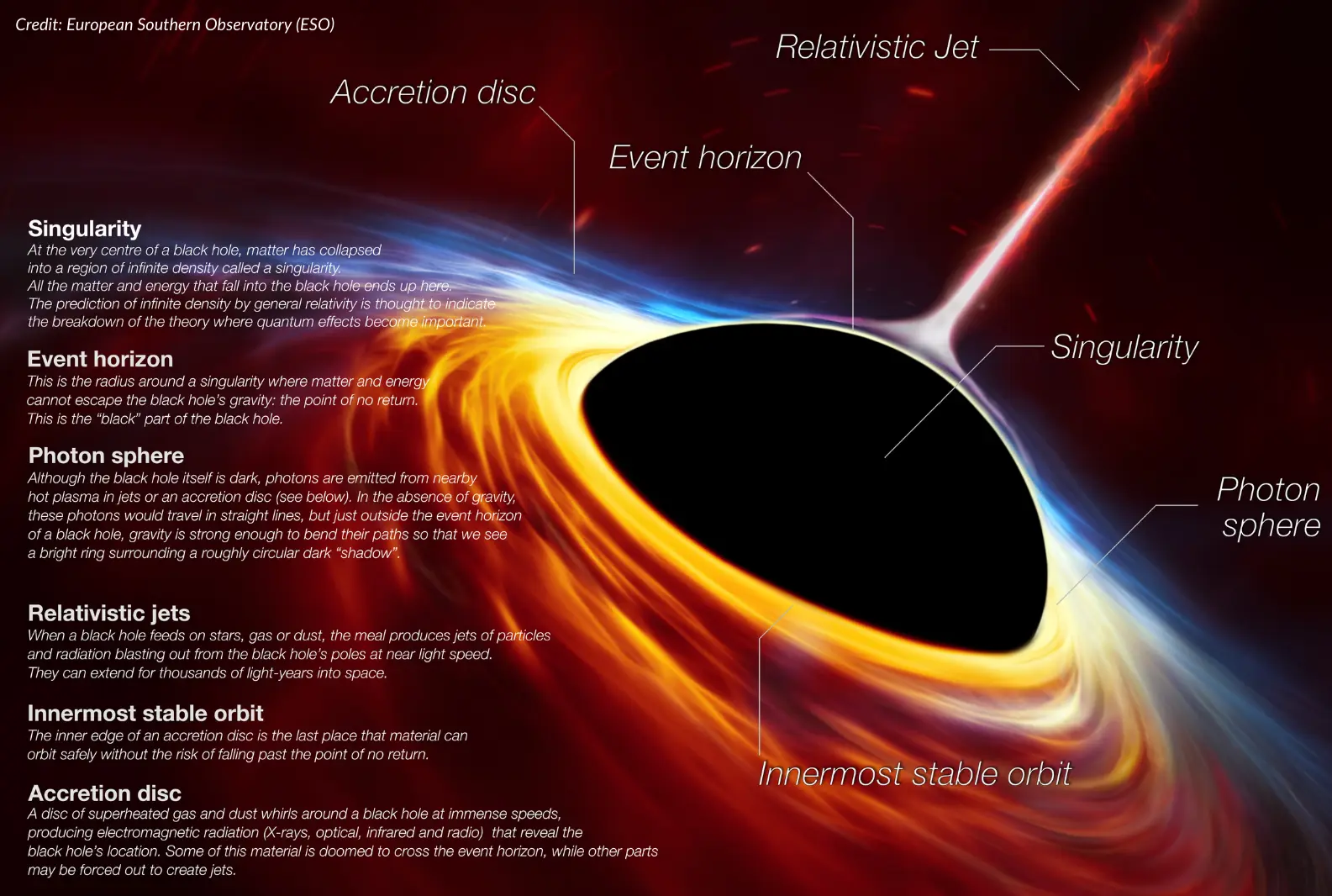
Mars: Yes, it does. This image shows the structure surrounding a black hole, or at least its surroundings. The interior can’t be depicted, as nothing, not even light, can escape from within.
Socrates: Is it gravity that prevents light from escaping?
Mars: Exactly. The stronger the surface gravity, the harder it is to escape. To escape Earth’s gravity, an object must travel at 11 km/s. For the Sun, the escape velocity is 600 km/s; for a white dwarf, it’s 5,000 km/s; and for a neutron star, it’s about 100,000 km/s. Since light travels at 300,000 km/s, even it struggles to escape from a neutron star, getting stretched and redshifted by gravity. A black hole is an object where the escape velocity exceeds the speed of light. Since even light cannot escape, we call it a black hole. While all the energy and matter are concentrated in the singularity, the black hole’s gravitational influence extends up to the event horizon. Beyond this boundary, nothing can escape—not even light. If something crosses the event horizon, there’s no return. Even approaching the innermost stable orbit is dangerous—anything moving closer is destined to cross the event horizon. Just outside this, light bends so much due to gravity that it orbits the black hole like a satellite, forming a spherical photon sphere. Like protostars and pulsars, gas falling into a black hole forms a flat accretion disk around it. Some of this material is lost forever, but due to the black hole’s rotation, some of it is ejected in jets along the poles at nearly the speed of light.
Socrates: So, what we saw during the Galactic Age as supermassive black holes are essentially combination of many such black holes. But let’s not get lost in the singularity. The Brahmaputra is calling. We must now journey back to Earth, five billion years ago.