Table of Contents
This is an old revision of the document!
3.3 Formation and evolution of stars
1. Birth of Stars
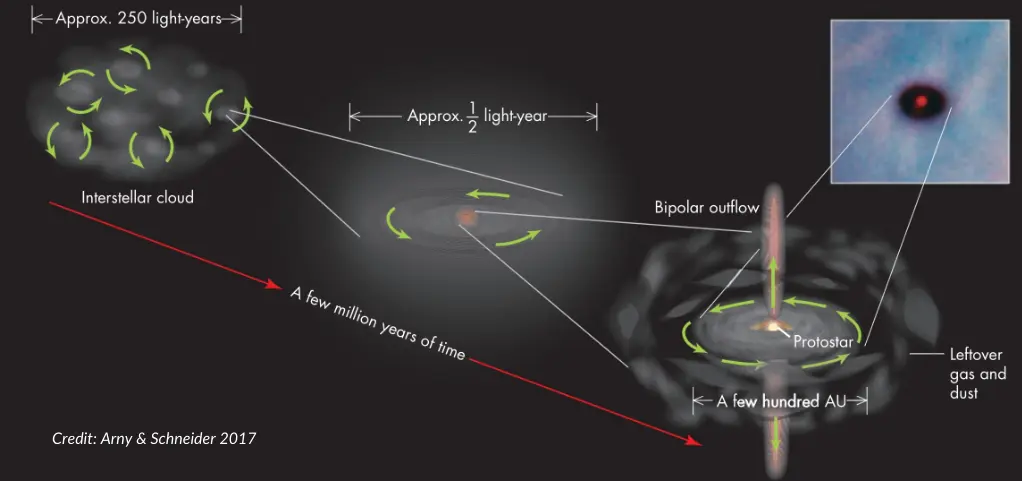
The birth of a star begins within a vast, swirling interstellar cloud, which can span approximately 250 light-years across. Triggered by gravitational instability, these colossal clouds begin to collapse and fragment into smaller, denser clumps. Within one of these contracting fragments—now shrunk to roughly half a light-year in diameter—gravity pulls the material ever tighter. As the fragment collapses, it begins to rotate, funneling material inward. The core of this shrinking gas pocket heats up significantly, converting gravitational potential energy into thermal energy, and eventually forms a dense, warm central structure called a protostar.
Over a few million years, the newly formed protostar continues to shrink and accumulate mass. The surrounding material flattens into a swirling disk spanning a few hundred astronomical units (AU), enveloped by a larger envelope of leftover gas and dust. During this highly active phase, the system channels powerful jets of material outward from its poles, creating distinct bipolar outflows. Meanwhile, deep within the core, temperature and pressure continue to rise dramatically. Once the core becomes hot and dense enough to ignite nuclear fusion, the tremendous outward pressure finally balances the relentless inward pull of gravity, and a stable star is officially born.
However, the journey of a newborn star is often perilous, unfolding in crowded galactic nurseries like the Orion Nebula. The young star’s protective cocoon and surrounding disk face intense radiation from powerful, nearby stars, which can burn away this material and potentially leave the new star stripped of its planetary building blocks. If the disk does survive, it becomes the birthplace of planets. Initially driven by electrical forces that cause dust grains to collide and stick together, and later by gravity, these clumps grow larger over time. As these baby planets form, they scour their orbital paths of dust, carving out distinct, dark gaps in the disk—a remarkable process astronomers have even been able to observe around young stars, like HL Tauri, using advanced radio telescopes.
2. Life of Stars