
This is an old revision of the document!
Hubble's law
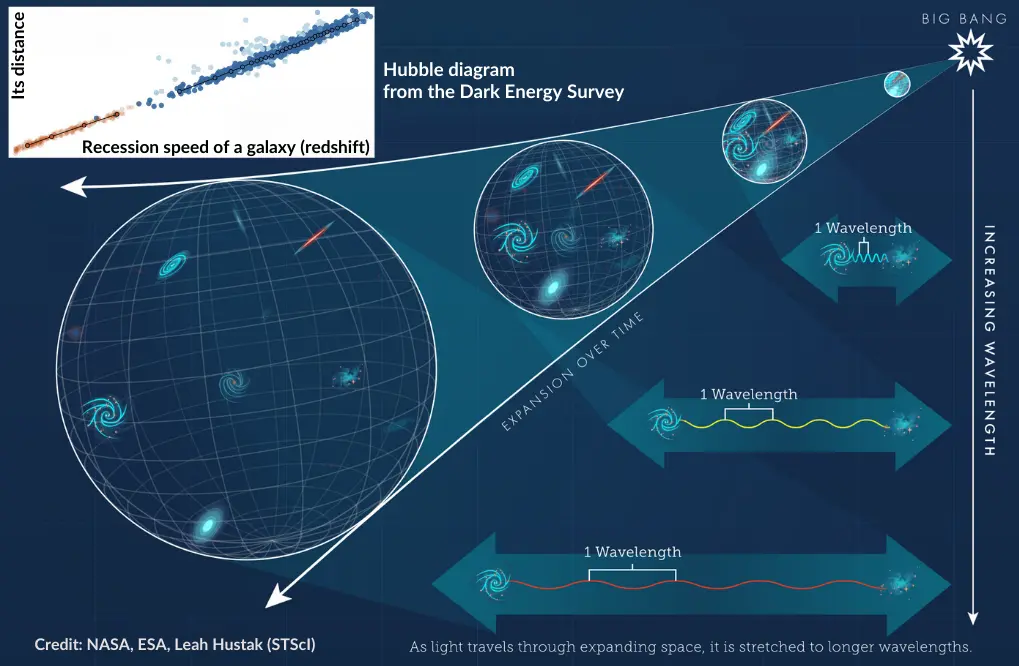
In the late 1920s, Edwin Hubble revolutionized our understanding of the cosmos by demonstrating a direct, linear relationship between the distances of galaxies and their recessional velocities (speeds). As illustrated in the inset Hubble diagram featuring modern data, plotting a galaxy’s distance against its recession speed reveals that the farther away a galaxy is located, the faster it is moving away from us. This foundational principle is now known as Hubble’s law. The slope of this linear trend is the Hubble constant, which mathematically represents the universe’s overall rate of expansion. Specifically, it quantifies the exact amount by which a galaxy’s speed increases for every additional million light-years (Mly) of distance. Modern estimates indicate this constant is roughly 21 km/s/Mly; meaning for every additional Mly a galaxy is from Earth, its recession speed increases by about 21 km/s. The inverse of this expansion rate directly points to the age of the universe, estimated at around 14 billion years.
To construct his groundbreaking initial diagrams, Hubble relied on two distinct methods to determine the distances and speeds of many galaxies. To measure distance, he utilized Cepheid variable stars, building on Henrietta Leavitt’s discovery that a Cepheid’s regular pulsation period directly indicates its intrinsic, “true” brightness. Because a star’s “apparent” brightness diminishes predictably as its light travels through space, comparing this measured apparent brightness to its calculated true brightness yields the exact distance to the star. Using this precise method, Hubble measured the distance to the Andromeda Nebula (2.5 Mly), proving it was a completely separate galaxy far beyond the 100-kly diameter of our own Milky Way.
To determine recession speed, Hubble analyzed the galaxies’ optical spectra, i. e. the intensity of light at different wavelengths or colors. As clearly illustrated in the overarching diagram, as light travels through expanding space over time, its waves are physically stretched to longer, redder wavelengths. By measuring the extent of this cosmological redshift, Hubble could accurately calculate a galaxy’s outward velocity. This universal, proportional expansion provides the most direct implication for the Big Bang; tracing these outward trajectories backward dictates that all cosmic matter was once compressed into a single, intensely hot and dense point before rapidly expanding. To visualize this cosmic mechanism, imagine coins taped to the surface of an inflating balloon. As the fabric of the balloon stretches, every coin recedes from the others, with more distant coins separating at faster speeds. This perfectly mirrors how the fabric of space itself expands, carrying galaxies apart without a single central explosion point.