This is an old revision of the document!
2.2. Types of galaxies
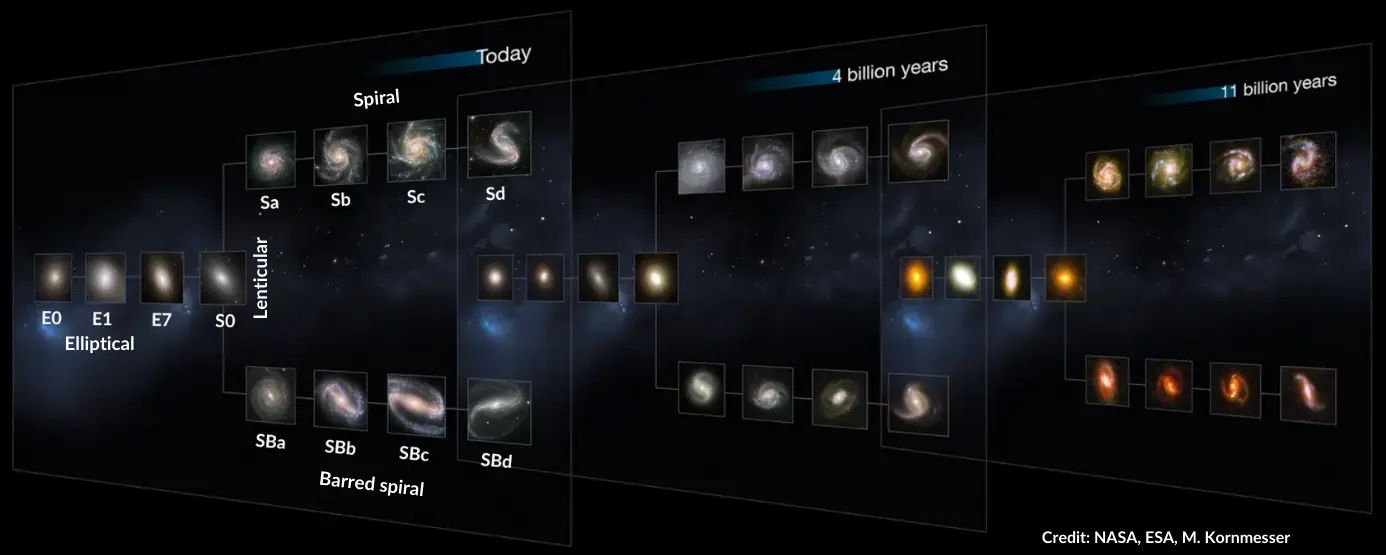
Edwin Hubble’s “tuning fork” diagram remains the definitive framework for classifying the diverse morphologies of the local universe. At the base of this sequence—forming the handle of the fork—reside the Elliptical galaxies (E). These systems are characterized by smooth, featureless profiles and are populated primarily by ancient, reddish stars. Lacking the cool reservoirs of gas and dust required for active star formation, they are subdivided based on their degree of elongation: ranging from the perfectly spherical $E0$ to the highly flattened, cigar-shaped $E7$. At the pivotal junction where the fork bifurcates sit the Lenticular galaxies, designated $S0$ (or $SB0$ if a central bar is present). These are transitional “hybrid” systems; they possess the central bulge and thin stellar disk of a spiral, yet remain as quiescent and devoid of vibrant spiral arms as the ellipticals.
The two diverging prongs of the tuning fork represent the Normal and Barred Spiral galaxies. Normal spirals consist of a dense central bulge surrounded by a flattened disk containing distinct, pinwheeling arms. They are subclassified from $Sa$ to $Sd$: $Sa$ galaxies possess the largest central bulges and the most tightly wound arms, while $Sd$ systems exhibit minimal bulges, loosely wrapped arms, and abundant quantities of gas and dust. Paralleling this prong are the Barred Spirals ($SBa$ through $SBd$), which are fundamentally similar but feature a linear “bar” of stellar material passing through the core. In these systems, the spiral arms trail outward from the ends of this bar rather than emerging directly from the central nucleus.
While this taxonomy provides an elegant snapshot of the modern universe, these structured shapes are the hard-won result of 11 billion years of cosmic upheaval. During the “Quasar Epoch,” the early universe was dominated by chaotic, irregular fragments rather than the distinct spirals we see today. Through “major mergers”—violent collisions between comparably sized systems—delicate gas disks were shattered and reorganized into the first elliptical galaxies. Conversely, “minor mergers” allowed larger galaxies to consume smaller companions while preserving their overall disk structure, seeding the growth of modern spirals. As the expansion of the universe spread galaxy clusters farther apart, the rate of destructive collisions subsided. The brilliant, high-energy quasars of the early cosmos eventually exhausted their fuel, fading into the dormant supermassive black holes that now lurk quietly at the hearts of the quiescent, “in-shape” galaxies we observe today.
Active galaxies