
Table of Contents
This is an old revision of the document!
0.4. Light and Telescopes
Astronomers utilize telescopes as powerful time machines to investigate the seven ages of cosmic evolution, relying on the finite speed of light to view distant objects not as they are today, but as they existed many years ago when their radiation was first emitted. To probe the initial Particle Age, scientists employ radio telescopes to detect the Cosmic Microwave Background, the fossilized afterglow of the Big Bang. As the cosmos cooled into the Galactic Age, deep-field observations in visible and infrared light have revealed the chaotic assembly of the first galaxies, while multi-wavelength instruments allow astronomers to peer into the Stellar Age, penetrating dusty interstellar clouds to witness the birth of stars and the forging of heavy elements. This elemental enrichment sets the stage for the Planetary and Chemical Ages, where spectroscopes analyze starlight to identify complex molecules and planetary systems, providing the chemical foundation for the Biological Age. Finally, in the current Cultural Age, humanity turns these instruments outward to search for radio signals or laser pulses from other technological civilizations, to contextualize our own place in the extraordinary hierarchy of nature.
What is Light?

As shown in the animation above, light is a form of electromagnetic radiation (or waves) composed of rapidly fluctuating electric (E) and magnetic (B) fields that vibrate perpendicular to one another and to their direction of travel, moving through the vacuum of space at a constant, finite speed, $c$. This radiation arises whenever electrically charged particles, such as electrons, undergo acceleration or a change in motion; for instance, in a lightning bolt, accelerated charged particles release energy as visible light.
We characterize these waves by their wavelength—the distance between two consecutive wave crests—and their frequency, which is the number of crests that pass a specific point every second. These two properties share an inverse relationship, meaning that if you double the frequency, the wavelength is cut in half, because their combination must always equal the constant speed of light. Additionally, light behaves as discrete packets of energy known as photons, where the amount of energy carried is directly proportional to the frequency; consequently, radiation with a high frequency and short wavelength carries significantly more energy than radiation with a low frequency and long wavelength. The wavelength is measured in meters, frequency in hertz (Hz, cycles per second), and energy in joules.
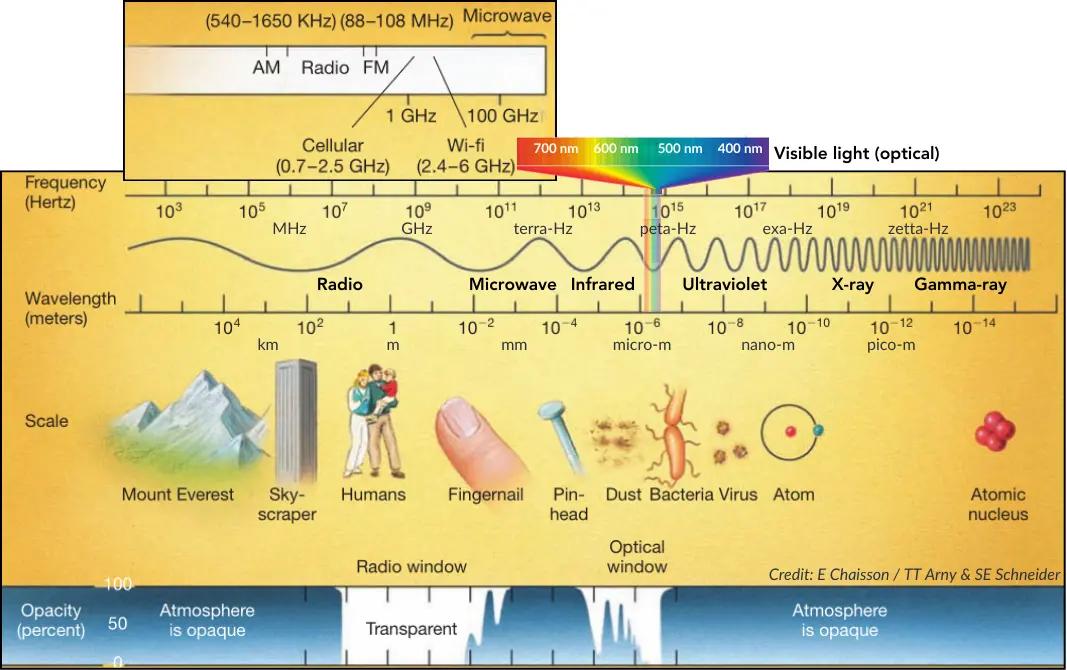
The electromagnetic spectrum begins with low-frequency radio waves, which possess the longest wavelengths—comparable to the scale of mountains—and the lowest energy, qualities that allow AM radio broadcasts to bounce off the atmosphere and travel over the horizon. As the frequency increases and wavelengths shorten, we encounter high-frequency radio waves, which carry slightly more energy and are utilized for FM radio and television signals that pass through the ionosphere rather than reflecting off it. Moving up the scale, microwaves feature even shorter wavelengths and higher frequencies, carrying sufficient energy to power our radar systems, Wi-Fi networks, and cellular communications. As energy intensifies further, we reach infrared radiation, which we physically experience as heat and utilize in technologies like remote controls and night-vision sensors that see through dark or dusty conditions.
This transitions into the narrow band of visible light, the only radiation possessing the specific frequency and energy required to trigger chemical reactions in human eyes, allowing us to perceive the colors of our world. Just beyond the violet end lies ultraviolet radiation, which has shorter wavelengths and carries enough energy to penetrate and damage living cells, a process we experience in daily life as suntans or sunburns. At even higher energies are X-rays, which have such high frequency and penetrating power that they can pass through soft tissue to reveal the shadows of our bones in medical imaging. Finally, the spectrum culminates with gamma rays, which possess the shortest wavelengths and the highest energy—billions of times that of visible light—and are associated with the intense nuclear reactions of radioactivity and nuclear explosions.
Earth’s atmosphere functions as a selective shield, effectively opaque to most electromagnetic radiation but permeable through specific “spectral windows” where the air is transparent,. The most significant openings are the optical window, allowing visible light to reach the surface, and the radio window, which permits the passage of radio waves with wavelengths ranging from approximately one centimeter to ten meters. Conversely, atmospheric gases absorb the majority of other wavelengths; the ozone layer completely blocks lethal ultraviolet, X-rays, and gamma rays, rendering these energetic bands observable only from space. Infrared radiation encounters a “partially transparent” atmosphere, where water vapor and carbon dioxide absorb many wavelengths, though some infrared light can still reach high, dry mountain observatories. Finally, the electrically conductive ionosphere reflects radio waves longer than about 10 meters, preventing them from penetrating to the ground.
How Telescopes Work
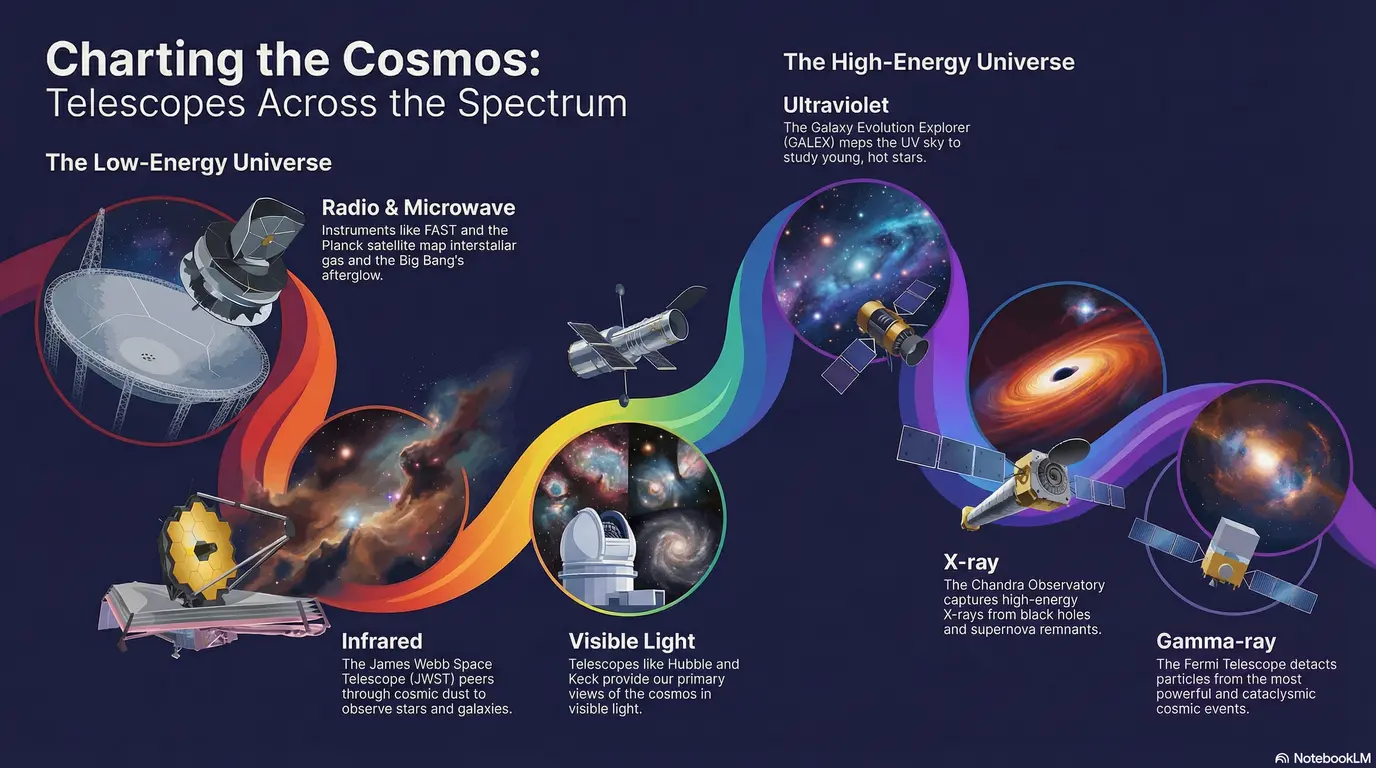
To study the universe, astronomers use specialized tools tuned to different wavelengths of the electromagnetic spectrum. This begins with radio waves, captured by instruments like LOFAR and the Five-hundred-meter Aperture Spherical Telescope (FAST) to map interstellar gas and pulsars. For microwaves, the South Pole Telescope (SPT-3G) and the Planck satellite map the afterglow of the Big Bang. To capture infrared light, the James Webb Space Telescope (JWST) observes stars and galaxies through cosmic dust. Visible light is monitored, for example, by the ground-based Keck Observatory and the Hubble Space Telescope, with the Vera C. Rubin Observatory leading wide-field surveys. In higher energies, the Galaxy Evolution Explorer (GALEX) remains an important example for mapping the ultraviolet sky to study young stars, while the Chandra X-ray Observatory captures X-rays from black holes and supernova remnants. Finally, the extremely high-energy universe is observed through the Fermi Gamma-ray Space Telescope, and the Cherenkov Telescope Array Observatory (CTAO) that detects particles from cataclysmic cosmic events.
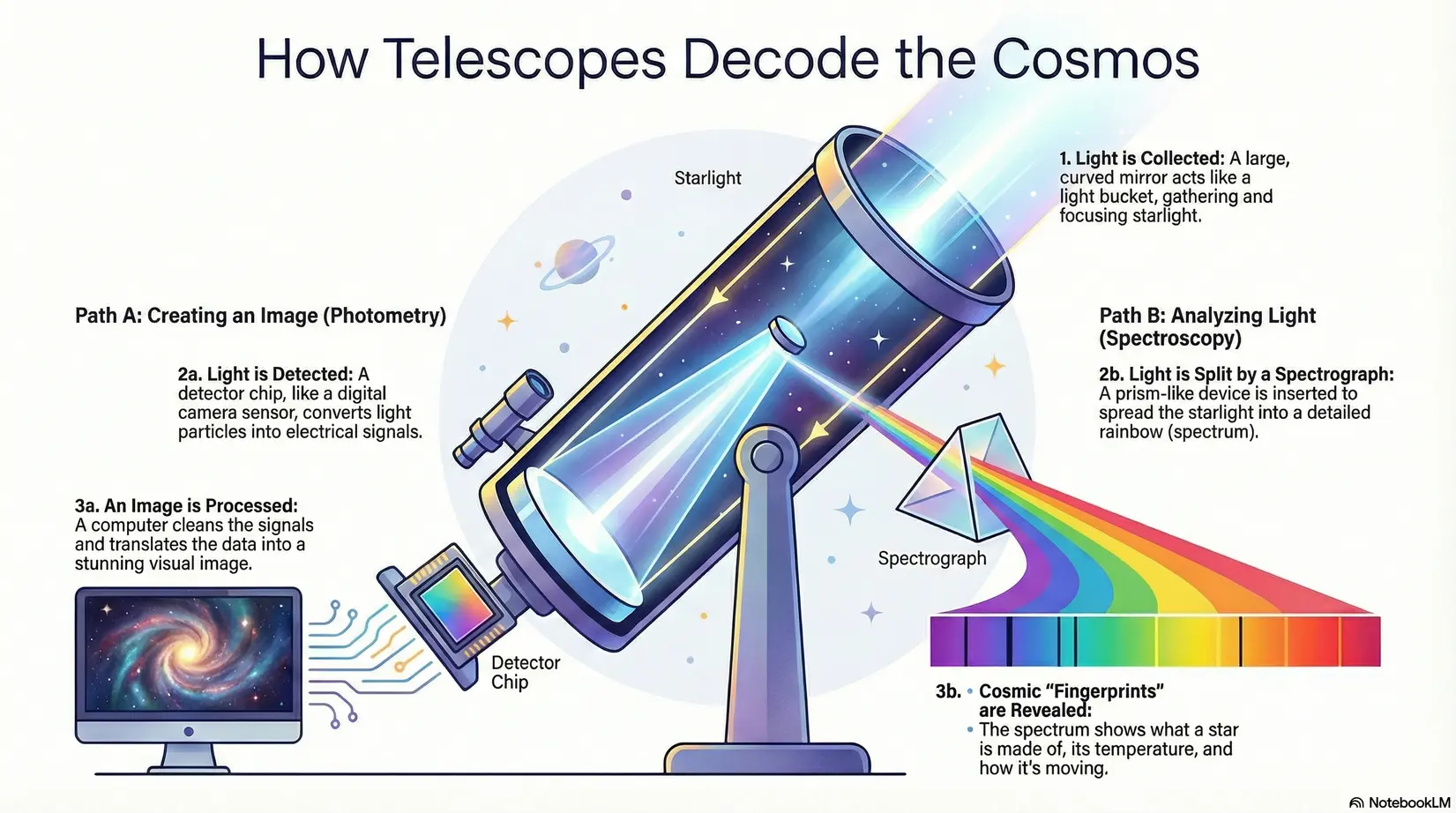
Every modern telescope system works as a three-part team to transform faint cosmic whispers into clear, viewable data. The process begins with a “collector”—usually a large, curved mirror—which acts like a giant light bucket, catching incoming rays and concentrating them onto the focal plane in front of the collector. At this focus plane sits the “detector,” typically a high-tech chip similar to the sensors found in digital cameras. This chip counts the individual particles of light (photons) and converts them into electrical signals, electrons, much like how a solar panel turns sunlight into power. Finally, these signals are sent to a “processor,” where computers clean up digital noise and translate the data into the stunning, detailed images we see on our screens. This process of measuring the intensity of light to create images is known as photometry. This technology isn’t just for advanced science; the digital cameras in our smartphones and home video recorders operate on these same basic principles, using light-sensitive chips to capture our everyday moments electronically. However, professional telescopes perform far better than consumer electronics because they possess significantly more advanced versions of these three components. Unlike a smartphone that takes an instantaneous snapshot, a telescope can keep its “eye” open for hours or even days, allowing it to collect and store vast amounts of light until even the dimmest cosmic objects become visible.
Beyond just taking beautiful pictures, telescopes can also serve as long-distance laboratories through spectroscopy by using a device called a spectrograph. By placing a high-tech prism between the collector and the detector, astronomers can spread light out into its component colors, creating a “spectrum” that looks like a detailed rainbow. Instead of a simple 2D photograph, the computer reconstructs this data into a graph that shows the intensity of each color. This spectral analysis is vital because it reveals the unique “fingerprints” of matter; by studying these specific patterns of light, scientists can identify exactly what a distant star is made of, how hot it is, and how fast it is moving. This effectively allows us to decode the physical secrets of the universe from billions of light-years away without ever leaving Earth.
The true power of a telescope is defined by two main qualities: resolution and sensitivity. Resolution is the ability to see fine details, such as distinguishing two separate car headlights in the distance rather than seeing one blurry glow, or being able to read the date on a coin from across a field. Sensitivity, on the other hand, is the “light-gathering” power of the instrument. Much like a wide bucket catches more rainwater than a tiny thimble, a larger telescope mirror intercepts more light, allowing us to see objects billions of times fainter than anything the human eye could spot on its own. These capabilities rely entirely on the mirror’s design: a larger surface area makes the telescope more sensitive to dim light, while a wider diameter determines how sharp and clear the final image will be.