Table of Contents
This is an old revision of the document!
0.4. Light and Telescopes
Astronomers utilize telescopes as powerful time machines to investigate the seven ages of cosmic evolution, relying on the finite speed of light to view distant objects not as they are today, but as they existed many years ago when their radiation was first emitted. To probe the initial Particle Age, scientists employ radio telescopes to detect the Cosmic Microwave Background, the fossilized afterglow of the Big Bang. As the cosmos cooled into the Galactic Age, deep-field observations in visible and infrared light have revealed the chaotic assembly of the first galaxies, while multi-wavelength instruments allow astronomers to peer into the Stellar Age, penetrating dusty interstellar clouds to witness the birth of stars and the forging of heavy elements. This elemental enrichment sets the stage for the Planetary and Chemical Ages, where spectroscopes analyze starlight to identify complex molecules and planetary systems, providing the chemical foundation for the Biological Age. Finally, in the current Cultural Age, humanity turns these instruments outward to search for radio signals or laser pulses from other technological civilizations, to contextualize our own place in the extraordinary hierarchy of nature.
What is Light?
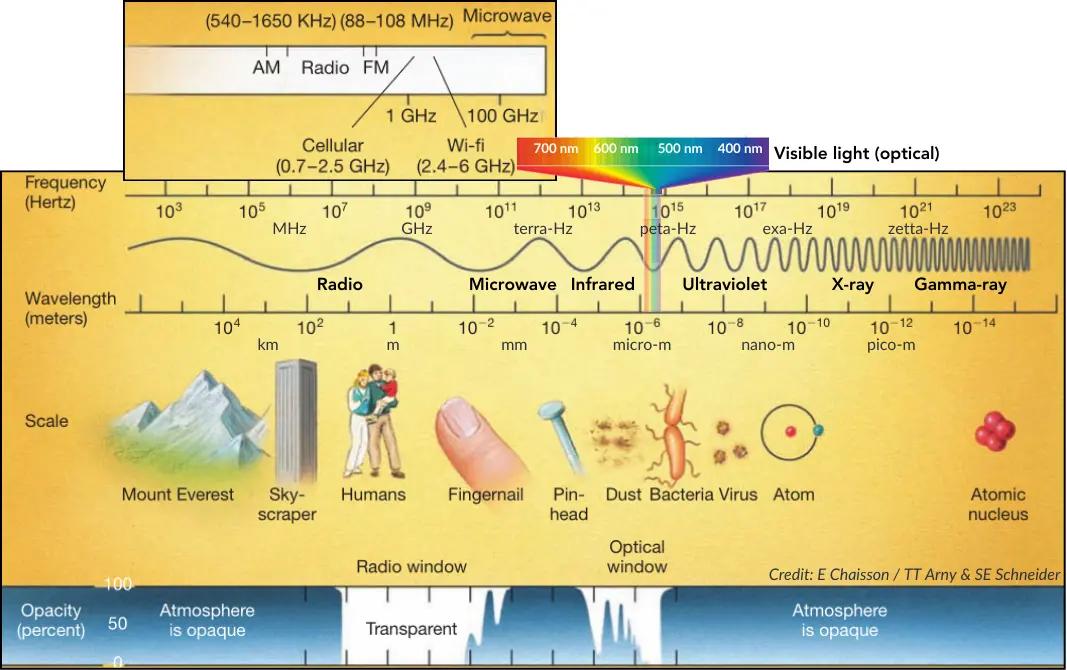
Light is a form of electromagnetic radiation composed of rapidly fluctuating electric and magnetic fields that vibrate perpendicular to one another and to their direction of travel, moving through the vacuum of space at a constant, finite speed. This radiation arises whenever electrically charged particles, such as electrons, undergo acceleration or a change in motion; for instance, in a lightning bolt, accelerated charged particles release energy as visible light.
We characterize these waves by their wavelength—the distance between two consecutive wave crests—and their frequency, which is the number of crests that pass a specific point every second. These two properties share an inverse relationship, meaning that if you double the frequency, the wavelength is cut in half, because their combination must always equal the constant speed of light. Additionally, light behaves as discrete packets of energy known as photons, where the amount of energy carried is directly proportional to the frequency; consequently, radiation with a high frequency and short wavelength carries significantly more energy than radiation with a low frequency and long wavelength. The wavelength is measured in meters, frequency in hertz (Hz, cycles per second), and energy in joules.
How Telescopes Work