
Table of Contents
This is an old revision of the document!
Three worlds of existence
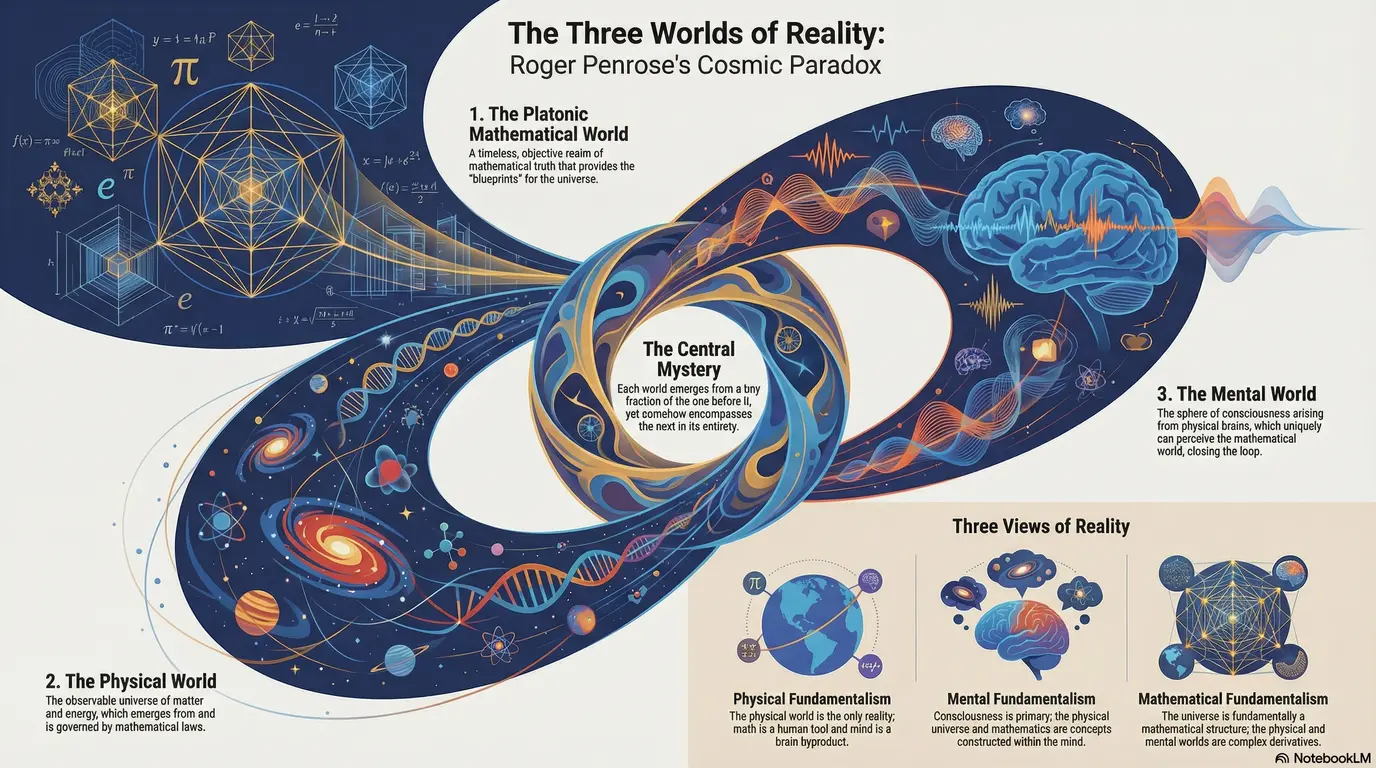
Roger Penrose’s framework of the “Three Worlds” offers a profound way to visualize reality as a triangle composed of three distinct forms of existence: the Platonic mathematical world, the physical world, and the mental world. In this model, the three spheres are connected in a closed loop where each world appears to generate the next, creating a deep paradox known as the three-world mystery. The diagram illustrates that while each world seems to emerge from only a tiny fraction of the one preceding it (for example, the physical universe is governed by only a small part of all mathematics) that new world somehow manages to comprehend or encompass the next one in its entirety. This cycle suggests that numbers, matter, and mind are not separate entities but are locked in a continuous relationship of becoming.
At the conceptual peak of this cycle lies the Platonic mathematical world, a timeless and spaceless realm of objective truth. This view, known as mathematical Platonism, posits that mathematical forms (such as the natural numbers or the intricate infinite patterns of the Mandelbrot set) exist independently of us. These structures are not merely inventions of the human imagination but are discoveries waiting to be found, possessing an objective reality that transcends human existence. In this framework, the mathematical world serves as the absolute foundation, providing the precise blueprints and rigid laws that govern the behavior of the universe, existing whether or not there are humans to perceive them.
Emerging from these abstract blueprints is the physical world, the observable universe consisting of space, time, energy, and matter (STEM). This is the reality we touch and see, governed strictly by the mathematical laws derived from the Platonic sphere, such as the equations of general relativity or quantum mechanics. The diagram suggests that the physical world is a projection of these mathematical truths, where energy and matter behave according to precise calculations. However, this physical reality serves as more than just a stage for atoms and stars; it acts as the necessary substrate for the next phase of existence, providing the complex biological structures required for life.
This biological complexity gives rise to the mental world, the sphere of conscious perception and awareness. While mentality is rooted in the operation of physical brains, it represents a distinct realm of experience where matter “wakes up” to become a thinking entity. The existence of the mental world introduces a profound mystery: how material objects like neurons can conjure up subjective feelings and consciousness. Furthermore, the mental world possesses the unique capacity to close the loop of the triangle. Through reason, insight, and understanding, the human mind can access the Platonic world, allowing us to perceive and comprehend the very mathematical truths that govern the physical reality we inhabit.
The implications of this system depend entirely on which of the three worlds one views as fundamental, as each perspective radically shifts our understanding of reality. If one adopts “Physical Fundamentalism,” the physical world is the only true reality; mathematics becomes merely a descriptive tool invented by humans, and the mind is just a byproduct of brain chemistry. Conversely, “Mental Fundamentalism” suggests that consciousness is primary; in this view, the physical universe and mathematics are simply concepts constructed within the mind, having no existence outside our perception. Finally, “Mathematical Fundamentalism” argues that the universe is, at its core, a mathematical structure, meaning physical objects and minds are just complex derivatives of equations. The diagram ultimately leaves these possibilities open, presenting a unified loop where reality might require the interplay of all three.