
Table of Contents
This is an old revision of the document!
SpaceTime and Energy-Matter (STEM)
1. Relativity: Special Theory
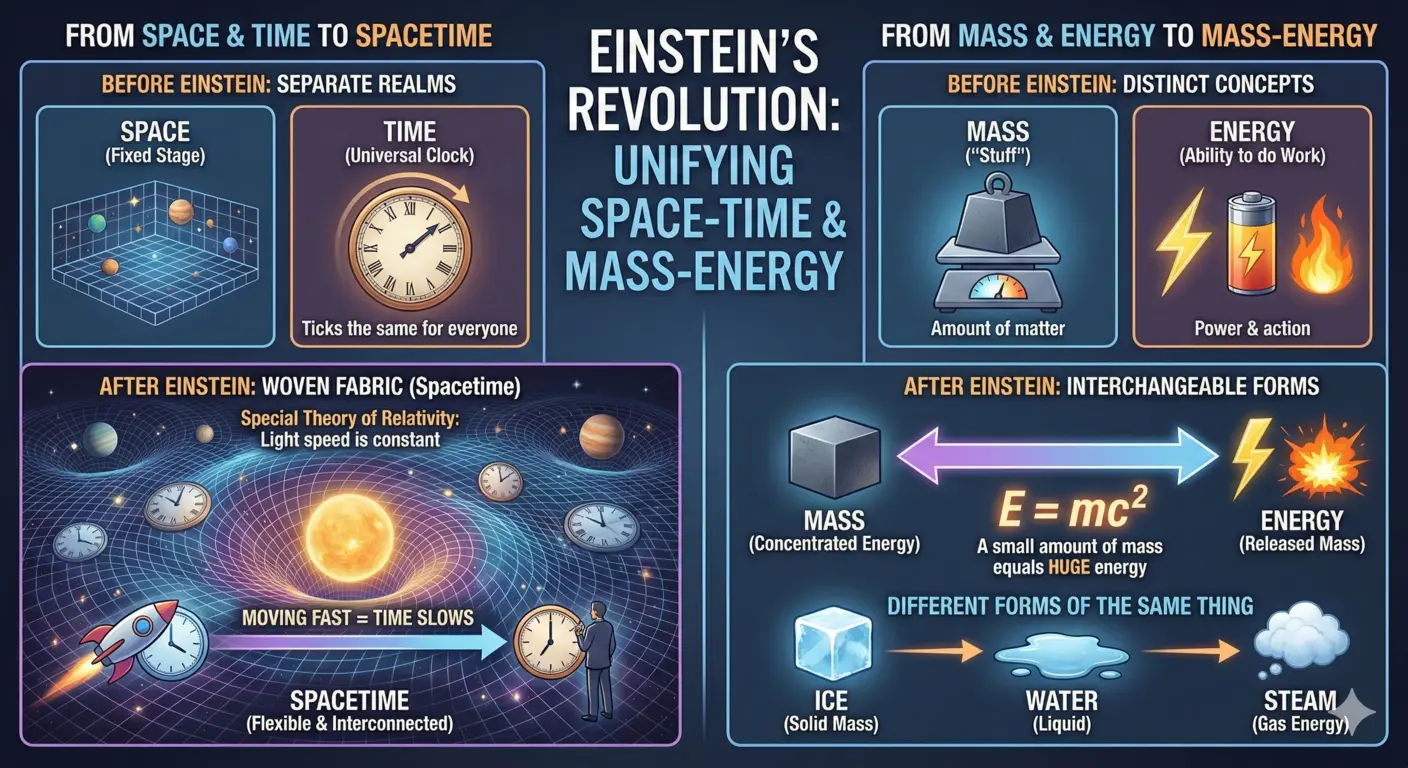
Before Einstein, scientists believed that space and time were completely separate things. Space was viewed as a fixed stage where events happened, and time was like a universal clock that ticked at the same rate for everyone, everywhere. Einstein changed this view forever with his Special Theory of Relativity (1905, Bern). He realized that because the speed of light is always the same, space and time must be connected. He showed that if you move very fast through space, time actually slows down for you compared to someone standing still. This meant that space and time are not independent; instead, they are woven together into a single, flexible fabric known as “spacetime.”
This new way of thinking also connected matter and energy. Previously, people thought mass (how much “stuff” is in an object) and energy (the ability to do work) were totally different and could not change into each other. Einstein discovered that mass is really just a super-concentrated form of energy. His famous equation, $E=mc^2$, explains this relationship. It shows that a very small amount of mass is equal to a huge amount of energy. This proved that matter and energy are essentially the same thing in different forms, similar to how ice and steam are both just different forms of water.
2. Relativity: General Theory
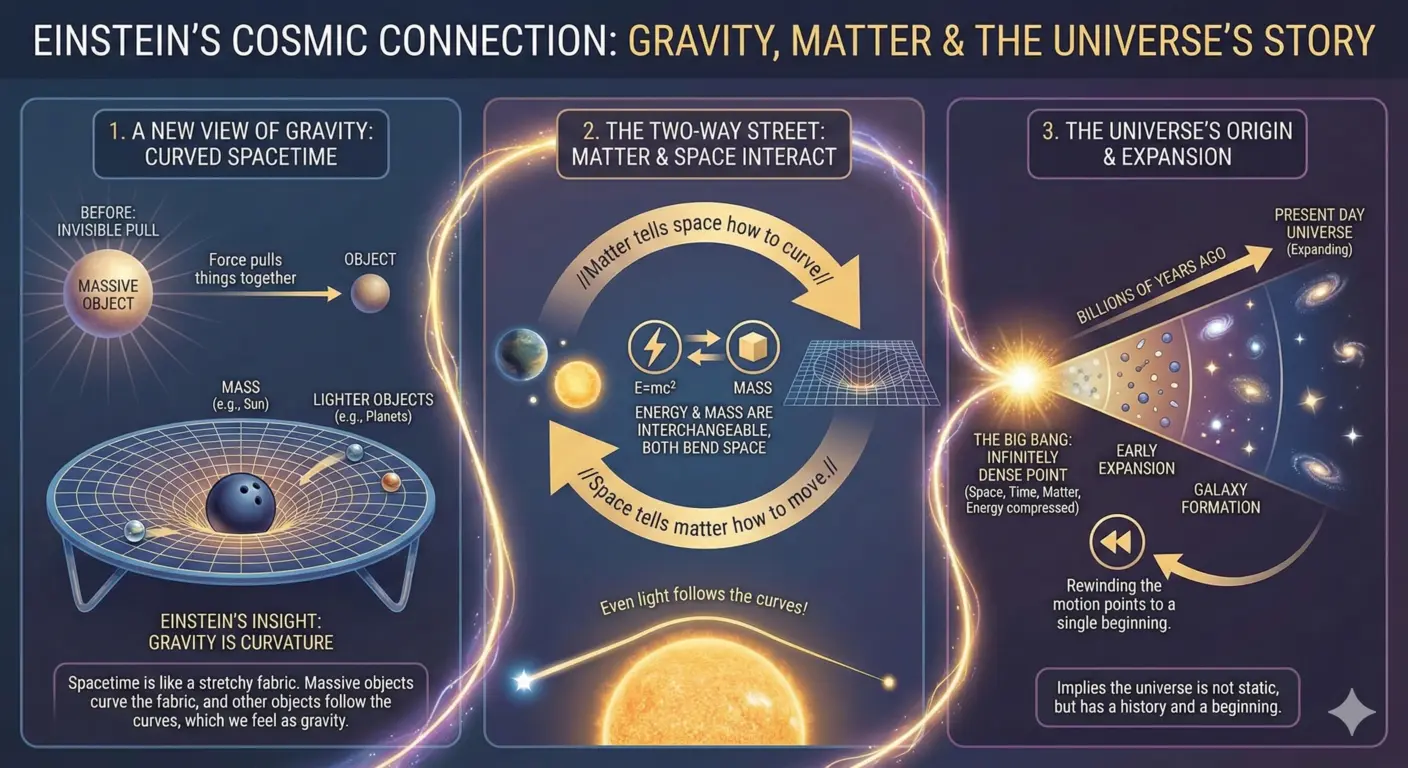
Einstein took his earlier ideas a giant step further with the General Theory of Relativity (1915, Berlin), which explained gravity in a completely new way. Before this, gravity was thought of as an invisible force pulling things together. Einstein instead proposed that spacetime is like a stretchy fabric, similar to a trampoline. If you place a heavy object like a bowling ball in the center, the fabric curves downward. Lighter marbles rolled nearby will follow this curve and spiral inward. Einstein showed that massive objects like the Sun curve the fabric of spacetime around them, and this curvature is what we feel as gravity. It wasn’t a “pull” anymore; it was objects just following the natural slopes in space.
This theory created a direct two-way street between the “stage” (spacetime) and the “actors” (matter and energy). A famous physicist summed it up by saying, “Matter tells space how to curve; space tells matter how to move.” Because energy and mass are interchangeable, any form of energy acts just like mass to bend space. This means that everything in the universe is connected: a planet isn’t just floating in empty nothingness; its mass is actively shaping the geometry of the space around it. Even light, which has no mass, follows these curves, bending as it passes massive stars, proving that space itself is warped by the energy within it.
The most profound implication of this theory was for the history of the universe itself. If matter curves spacetime, then the shape and destiny of the entire universe depend on how much “stuff” is in it. Einstein’s equations suggested the universe could not just be sitting still; it had to be either expanding or contracting. This realization allowed scientists to “rewind” the motion of the expanding universe we see today. It pointed back to a single moment billions of years ago when all space, time, matter, and energy were compressed into a single, infinitely dense point, leading to the Big Bang theory—the idea that the universe, and time itself, had a beginning.