
TDCOSMO: XXIII. Measurement of the Hubble constant from the doubly lensed quasar HE 1104−1805
Eric Paic, Frédéric Courbin, Christopher D. Fassnacht, Aymeric Galan, Martin Millon, Dominique Sluse, Devon M. Williams, Simon Birrer, Elizabeth J. Buckley-Geer, Michele Cappellari, Frédéric Dux, Xiang-Yu Huang, Shawn Knabel, Cameron Lemon, Anowar J. Shajib, Sherry H. Suyu, Tommaso Treu, Kenneth C. Wong, Lise Christensen, Veronica Motta and Alessandro Sonnenfeld
Astronomy & Astrophysics, Volume 706, A270, 21 pp.
https://doi.org/10.1051/0004-6361/202556411
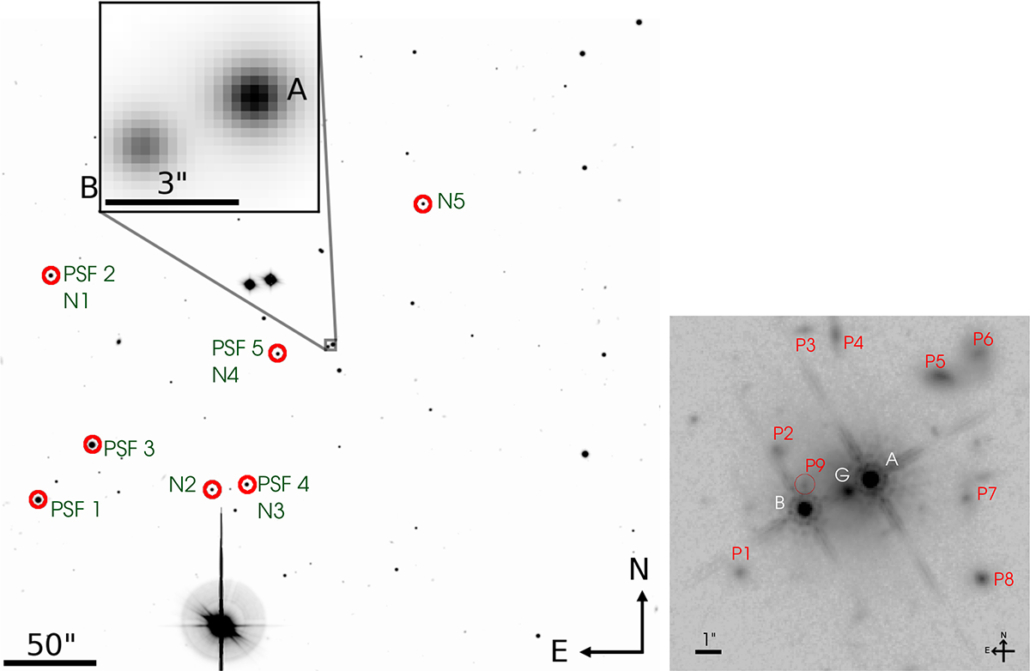
Abstract: Time-delay cosmography leverages strongly lensed quasars to measure the Universe’s current expansion rate, H0, independently from other methods. The latest TDCOSMO milestone measurement primarily used quadruply lensed quasars for their mass profile constraints. However, doubly lensed quasars, being more abundant and offering precise time delays, could expand the sample by a factor of 5, significantly advancing towards a 1% precision measurement of H0. We present the first TDCOSMO analysis of a doubly imaged source, HE 1104−1805, including the measurement of the four necessary ingredients. First, by combining 17 years of data from the SMARTS, Euler, and WFI telescopes, we measured a time delay of 176.3 +11.4−10.3 − 10.3 + 11.4 days. Second, using MUSE data, we extracted stellar velocity dispersion measurements in three radial bins with 5% to 13% precision. Third, employing F160W HST imaging for lens modelling and marginalising over various modelling choices, we measured the Fermat potential difference between the images. Fourth, using wide-field imaging, we measured the convergence added by objects not included in the lens modelling. By combining these four ingredients, we measured the time delay distance and the angular diameter distance to the deflector, favouring a power-law mass model over a baryonic and dark matter composite model. The measurement was performed blindly to prevent experimenter bias and resulted in a Hubble constant of H0 = +5.8−5.0 H 0 = 64 . 2 − 5.0 + 5.8 × λint km s−1Mpc−1, where λint is the internal mass sheet degeneracy parameter. This is in agreement with the TDCOSMO-2025 milestone and its precision for λint = 1 is comparable to that obtained with the best-observed quadruply lensed quasars (4─6%). This work is a stepping stone towards a precise measurement of H0 using a large sample of doubly lensed quasars, supplementing the current sample. The next TDCOSMO milestone paper will include this system in its hierarchical analysis, constraining λint and H0 jointly with multiple lenses.

