
IUB launches Bangladesh’s first Transient Array Radio Telescope
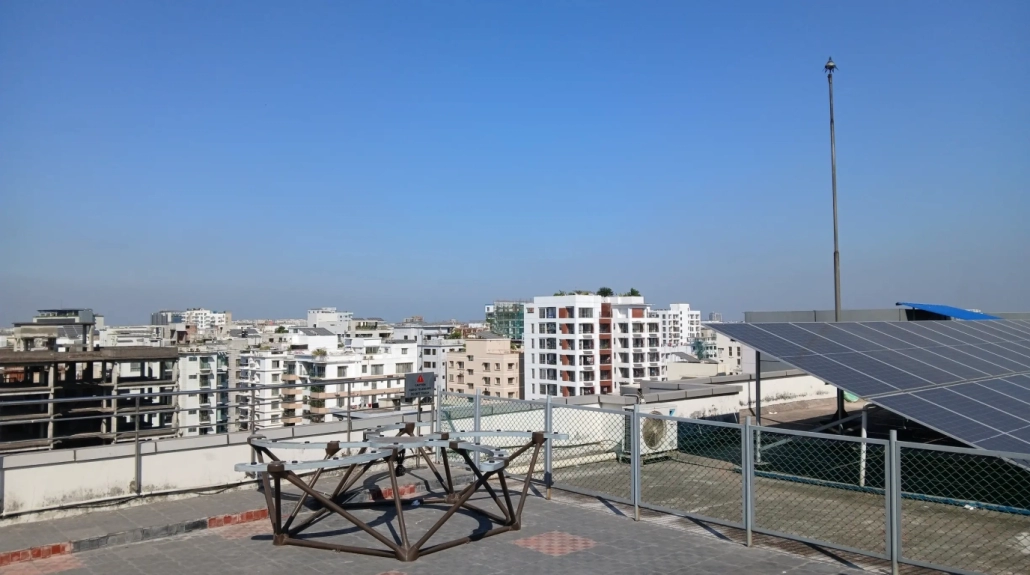
Independent University, Bangladesh (IUB) has launched the country’s first Transient Array Radio Telescope (TART), marking a milestone in the nation’s entry into radio astronomy instrumentation. Installed on the roof of IUB’s 10-storey academic building, the telescope successfully detected radio signals from space for the first time on November 18, 2025. This is not only Bangladesh’s first TART but also the only such telescope in the entire Northern Hemisphere. Its commissioning marks the beginning of local capacity in building radio astronomy instruments. To signify this “start,” the telescope has been named START – a “small TART.”
Through an initiative of IUB’s Center for Astronomy, Space Science and Astrophysics (CASSA), the array structure of the telescope was fully designed and fabricated at IUB’s own Fabrication Laboratory (Fab Lab IUB). The project received financial support from IUB’s Department of Physical Sciences. The antennas and electronic components were imported from New Zealand. The telescope was first brought online on November 18 under the supervision of Dr. Tim Molteno, Senior Lecturer at the University of Otago, New Zealand. Images of the entire sky, captured by TART telescopes in Bangladesh and in seven Southern Hemisphere countries, can be viewed live at: https://map.elec.ac.nz
Dr. Khan Muhammad Bin Asad, Director of CASSA and Assistant Professor at IUB’s Department of Physical Sciences, said, “Installing this telescope marks the beginning of astronomical instrumentation in Bangladesh. It took us more than six months to build it. Due to some electronic complications, we were unable to activate it earlier. Dr. Molteno brought several new electronic components with him, and under his supervision, once those were integrated, we were finally able to activate the telescope.”
Dr. Asad, who holds a PhD in Radio Astronomy and Astrophysics from the University of Groningen in the Netherlands, added: “START is different from the telescopes we usually know. Telescopes like James Webb or Hubble rely on mirrors to create images from visible light. START, on the other hand, detects invisible radio waves using multiple GPS antennas. Its primary scientific goals are to measure the electron content of Earth’s ionosphere and detect electrons and other fermionic particles – commonly called cosmic rays – that strike our atmosphere from space. For imaging research, our main source will be the many GPS satellites orbiting Earth, which will allow us to determine START’s properties with high precision.”
To provide students from IUB and 10 other universities from across Bangladesh with hands-on experience in building and activating a radio telescope, CASSA organized a five-day workshop. On November 18, the first day of the workshop, Dr. Molteno – one of the global leaders of TART technology – briefed participants on different types of radio telescopes installed around the world.
Dr. Molteno said, “The key advantage of TART is that it is a modern array telescope that can be built at low cost. Anyone who can construct this 24-antenna mini-array and produce images from its observations will be capable of working with much larger telescopes. The telescope’s more than 250 antenna pairs capture an image of the entire sky every minute. These observations are automatically combined to generate full-sky images. Researchers worldwide are working to advance this technology, and Bangladesh’s participation has opened new possibilities. The array designed and built in IUB’s Fabrication Lab has proven more efficient and stable than those in other countries.”
Installed beside the CASSA office on IUB’s academic building rooftop, the telescope has a diameter – the distance between its two farthest antennas – of about 10 feet. Similar telescopes currently exist in Ghana, Kenya, Zambia, Namibia, Mauritius, South Africa, and New Zealand. Several more are being built in different countries. These projects are connected through shared data and knowledge exchange, collectively forming what is known as the Global TART Network.
Dr. Molteno further explained, “Another major advantage of TART is its ability to detect many transient events that optical telescopes cannot. Transients are short-lived cosmic phenomena that appear suddenly and disappear quickly – sometimes within seconds, minutes, or days – such as stellar explosions, radio flashes, or bursts of high-energy emissions. Detecting these fleeting events requires specialized instruments. TART is specifically designed to detect the transient events known as cosmic rays.”
He noted that several large radio telescopes worldwide span sizes from hundreds of meters to several kilometers. These include the Square Kilometre Array (SKA) under construction in South Africa and Australia – set to become the world’s largest and most powerful radio telescope, with greatly enhanced sensitivity and data capacity. South Africa also hosts the mid-sized, high-performance MeerKAT telescope, used for deep-space observations. The United States is home to the Very Large Array (VLA) in New Mexico, which produces high-resolution images of the sky from multiple configurations. While SKA, MeerKAT, and VLA serve major global research projects, TART provides an accessible, low-cost alternative for instrumentation and imaging research.
Dr. Asad said, “Building the telescope is not the biggest achievement. The real accomplishment will be using the data from this telescope for advanced research and enabling scientists worldwide to benefit from it. If that happens, Bangladesh will find a place on the global map of astronomy. Apart from IUB, no other university in Bangladesh teaches astronomy. We currently offer several undergraduate courses as part of a minor, and our long-term goal is to launch a full master’s program in this field.”
At the inauguration ceremony of the workshop on November 18, IUB Vice Chancellor Prof. M. Tamim said, “With our START telescope, Bangladesh has taken its first step into constructing astronomical instruments. This is a proud moment for IUB. One of CASSA’s goals is to develop a new generation of space scientists and engineers in Bangladesh. Today marks the beginning of that journey.”
Other speakers at the inauguration ceremony of the workshop included IUB Pro-Vice Chancellor Prof. Dr. Daniel W. Lund; Director of Graduate Studies Prof. Dr. M. Arshad Momen; Dean of the School of Engineering, Technology and Sciences Dr. Habib Bin Muzaffar; Head of the Department of Physical Sciences Dr. Farhad Alam; and Head of the Department of Electrical and Electronic Engineering Dr. Mustafa Habib Chowdhury.

