
Analyzing Type Ia supernovae near-infrared light curves with principal component analysis
T. E. Müller-Bravo, L. Galbany, M. D. Stritzinger, C. Ashall, E. Baron, C. R. Burns, P. Höflich, N. Morrell, M. Phillips, N. B. Suntzeff and S. A. Uddin
Astronomy and Astrophysics, 702, A134, EDP
https://doi.org/10.1051/0004-6361/202555078
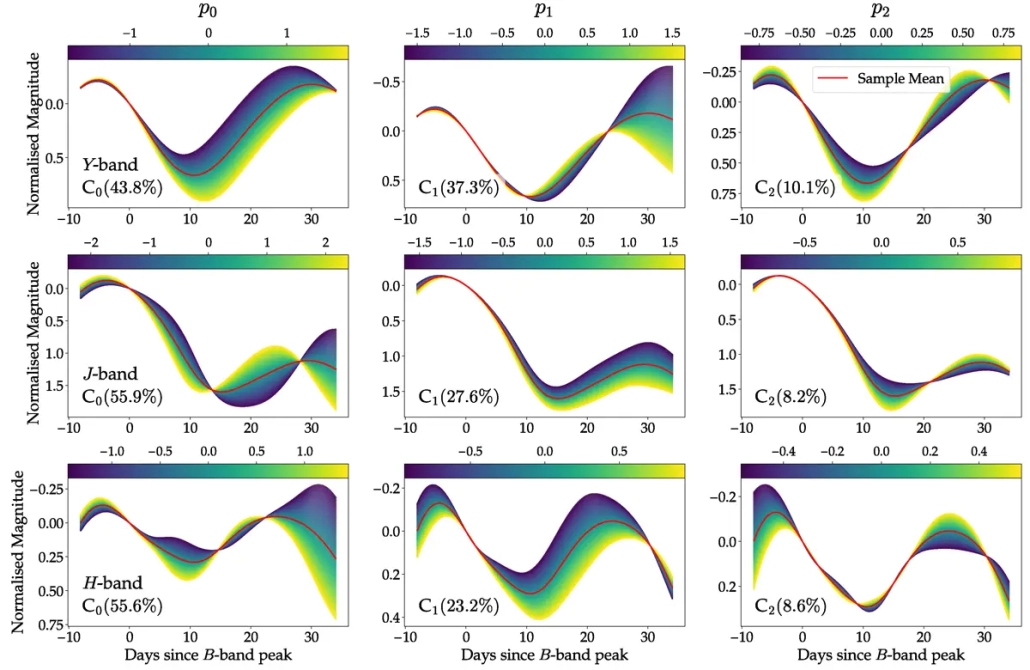
Abstract: Thermonuclear explosions of C/O white dwarf stars in binary systems known as Type Ia supernovae (SNe Ia) remain poorly understood. The complexity of their progenitor systems, explosion physics, and intrinsic diversity poses challenges in understanding these phenomena as astrophysical objects, as well as their standardization and use as cosmological probes. Near-infrared (NIR) observations offer a promising avenue for studying the physics of SNe Ia and for reducing systematic uncertainties in distance estimations, as they exhibit lower dust extinction and smaller dispersion in peak luminosity than optical bands. In this work, we applied a principal component analysis (PCA) to a sample of SNe Ia with well-sampled NIR ($YJH$-band) light curves to identify the dominant components of their variability and constrain physical underlying properties. The theoretical models are used for the physical interpretation of the PCA components, where we found that the $^{56}\mathrm{Ni}$ mass best describes the dominant variability. Other factors, such as mixing and metallicity, were found to contribute significantly as well. However, some differences are seen among the components of the NIR bands, which could be attributed to differences in the explosion aspects they each trace. Additionally, we compared the PCA components to various light curve parameters, identifying strong correlations between the first component in $J$ and $H$ bands (second component in $Y$) and peak brightness in both the NIR and optical bands, particularly in the $Y$ band. When applying a PCA to NIR color curves, we found interesting correlations with the host-galaxy mass, where SNe Ia with redder NIR colors are predominantly found in less massive (potentially more metal-poor) galaxies. We also investigated the potential for improved standardization in the $Y$ band by incorporating PCA coefficients as correction parameters, leading to a reduction in the scatter of the intrinsic luminosity of SNe Ia. As new NIR observations become available, our findings can be further tested, ultimately refining our understanding of SNe Ia physics and enhancing their reliability as cosmological distance indicators.

