
GPU-Accelerated Gravitational Lensing and Dynamical (GLaD) modeling for cosmology and galaxies
Han Wang, Sherry H. Suyu, Aymeric Galan, Aleksi Halkola, Michele Cappellari, Anowar J. Shajib and Miha Cernetic
Astronomy and Astrophysics, 701, A280, EDP
https://doi.org/10.1051/0004-6361/202554861
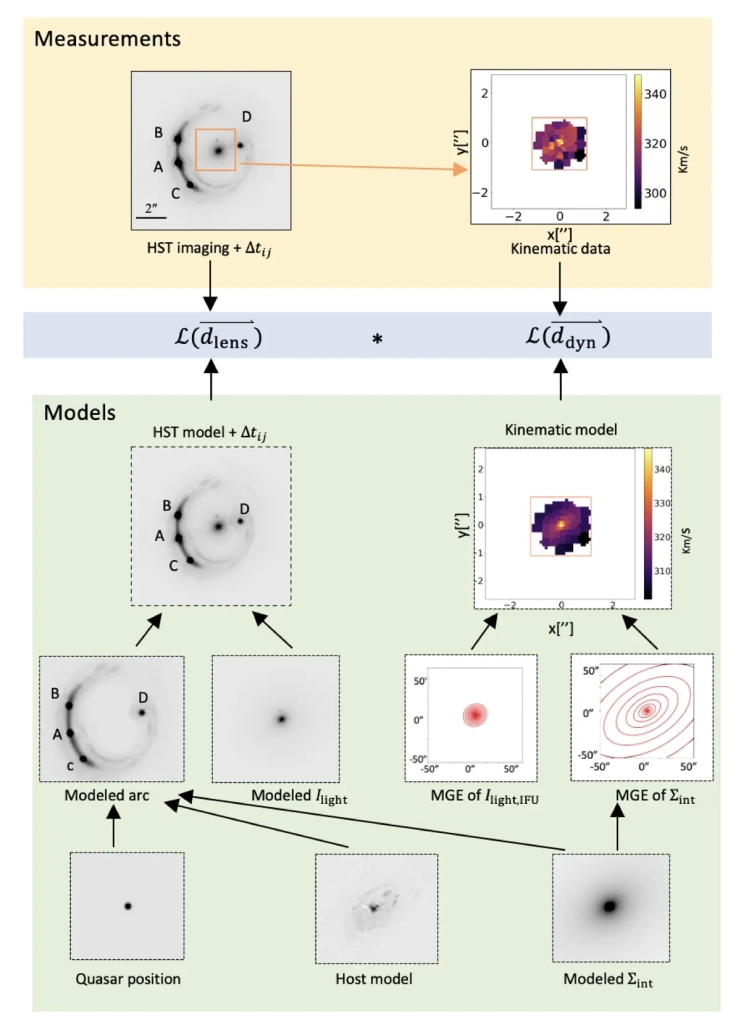
Abstract: Time-delay distance measurements from strongly lensed quasars provide a robust and independent method for determining the Hubble constant ($H_0$). This approach offers a crucial cross-check against $H_0$ measurements obtained from the standard distance ladder in the late Universe and the cosmic microwave background in the early Universe. The mass-sheet degeneracy in strong-lensing models may introduce a significant systematic uncertainty, however, that limits the precision of $H_0$ estimates. Dynamical modeling complements strong lensing very well to break the mass-sheet degeneracy because both methods model the mass distribution of galaxies, but rely on different sets of observational constraints. We developed a method and software framework for an efficient joint modeling of stellar kinematic and lensing data. Using simulated lensing and kinematic data of the lensed quasar system RXJ1131–1131 as a test case, we demonstrate that a precision of approximately 4\% on $H_0$ can be achieved with high-quality data that have a high signal-to-noise ratio. Through extensive modeling, we examined the impact of a supermassive black hole in the lens galaxy and potential systematic biases in kinematic data on the $H_0$ measurements. Our results demonstrate that either using a prior range for the black hole mass and orbital anisotropy, as motivated by studies of nearby galaxies, or excluding the central bins in the kinematic data can effectively mitigate potential biases on $H_0$ induced by the black hole. By testing the model on mock kinematic data with values that were systematically biased, we emphasize that it is important to use kinematic data with systematic errors below the subpercent level, which can currently be achieved. Additionally, we leveraged GPU parallelization to accelerate the Bayesian inference. This reduced a previously month-long process by an order of magnitude. This pipeline offers significant potential for advancing cosmological and galaxy evolution studies with large datasets.

