
Resolved Stellar and Nebular Kinematics of a Star-forming Galaxy at z ∼ 2
Sunny Rhoades, Tucker Jones, Keerthi Vasan G. C., Yuguang Chen, Nicha Leethochawalit, Richard Ellis, Anowar J. Shajib, Karl Glazebrook, Kris Mortensen, and Ryan L. Sanders
The Astrophysical Journal, 991(1), 86, IOP
https://doi.org/10.3847/1538-4357/adfa22
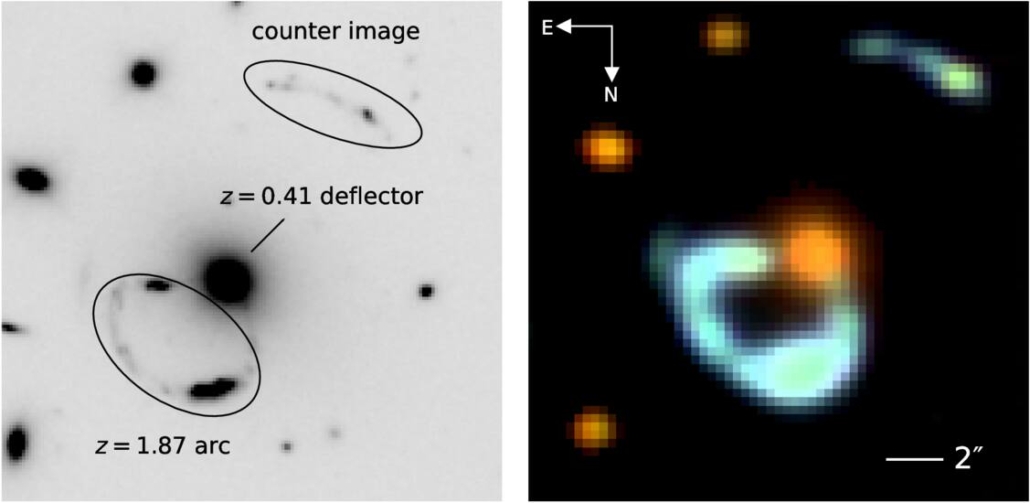
Abstract: The kinematics of star-forming galaxy populations at high redshifts are integral to our understanding of disk properties, merger rates, and other defining characteristics. Nebular gas emission is a common tracer of galaxies’ gravitational potential and angular momenta, but is sensitive to nongravitational forces as well as galactic outflows, and thus might not accurately trace the host galaxy dynamics. We present kinematic maps of young stars from rest-ultraviolet photospheric absorption in the star-forming galaxy CASSOWARY 13 (a.k.a. SDSS J1237+5533) at $z=1.87$ using the Keck Cosmic Web Imager, alongside nebular emission measurements from the same observations. Gravitational lensing magnification of the galaxy enables good spatial sampling of multiple independent lensed images. We find close agreement between the stellar and nebular velocity fields. We measure a mean local velocity dispersion of $\sigma = 64 \pm 12~{\rm km~s^{-1}}$ for the young stars, consistent with that of the H\,\textsc{ii} regions traced by nebular C\,\textsc{iii}] emission ($52 \pm 9~{\rm km~s^{-1}}$). The $\sim 20~{\rm km~s^{-1}}$ average difference in line-of-sight velocity is much smaller than the local velocity width and the velocity gradient ($\gtrsim 100~{\rm km~s^{-1}}$). We find no evidence of asymmetric drift nor evidence that outflows bias the nebular kinematics, and thus we conclude that nebular emission appears to be a reasonable dynamical tracer of young stars in the galaxy. These results support the picture of star formation in thick disks with high velocity dispersion at $z \sim 2$, and they represent an important step toward establishing robust kinematics of early galaxies using collisionless tracers.

