
Cosmography with the Double-source-plane Strong Gravitational Lens AGEL150745+052256
Nandini Sahu, Anowar J. Shajib, Kim-Vy Tran, Hannah Skobe, Sunny Rhoades, Tucker Jones, Karl Glazebrook, Thomas E. Collett, Sherry H. Suyu, Keerthi Vasan G. C., Tania M. Barone, Duncan J. Bowden, Daniel Ballard, Glenn G. Kacprzak, Sarah M. Sweet, Geraint F. Lewis, and Themiya Nanayakkara
The Astrophysical Journal, 991(1), 72, IOP
https://doi.org/10.3847/1538-4357/adf442
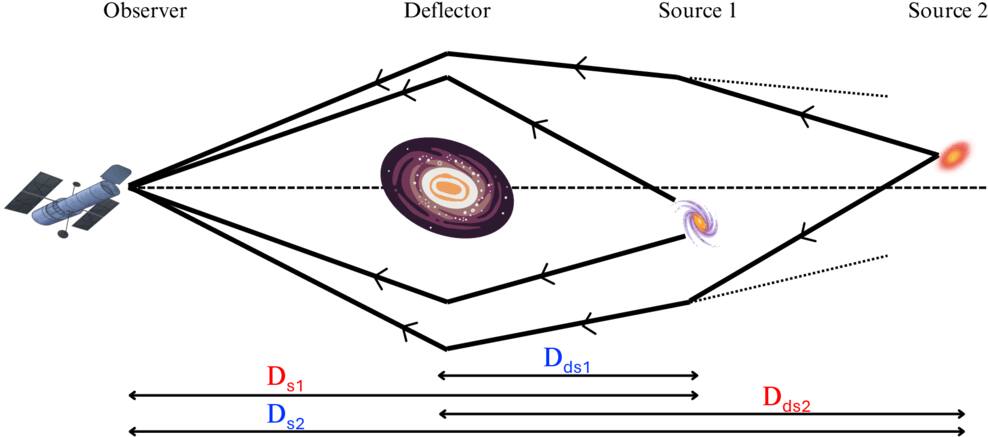
Abstract: Strong gravitational lenses with two background sources at widely separated redshifts are a promising independent probe of cosmological parameters. We can use these systems, known as double-source-plane lenses (DSPLs), to measure the ratio ($\beta$) of angular-diameter distances of the sources, which is sensitive to the matter density ($\Omega_m$) and the equation-of-state parameter for dark energy ($w$). However, DSPLs are rare and require high-resolution imaging and spectroscopy for detection, lens modeling, and measuring $\beta$. Here, we report only the second DSPL ever used to measure cosmological parameters. We model the DSPL AGEL150745+052256 from the ASTRO 3D Galaxy Evolution with Lenses (AGEL) survey using Hubble Space Telescope/Wide-Field Camera 3 imaging and Keck Cosmic Web Imager spectroscopy. The spectroscopic redshifts for the deflector and two sources in AGEL1507 are $z_{\rm defl}=0.594$, $z_{s1}=2.163$, and $z_{s2}=2.591$. We measure a stellar velocity dispersion of $\sigma_{\rm obs}=109\pm27~{\rm km\,s^{-1}}$ for the nearer source (S1). Using $\sigma_{\rm obs}$ for the main deflector (from literature) and S1, we test the robustness of our DSPL model. We measure $\beta = 0.953^{+0.008}{-0.010}$ for AGEL1507 and infer $\Omega_m = 0.33^{+0.38}{-0.23}$ for $\Lambda$CDM cosmology. Combining AGEL1507 with the published model of the Jackpot lens improves the precision on $\Omega_m$ ($\Lambda$CDM) and $w$ ($w$CDM) by $\sim10\%$. The inclusion of DSPLs significantly improves the constraints when combined with Planck’s cosmic microwave background observations, enhancing the precision on $w$ by 30%. This paper demonstrates the potential constraining power of DSPLs and their complementarity to other standard cosmological probes. Tighter future constraints from larger DSPL samples discovered from ongoing and forthcoming large-area sky surveys would provide insights into the nature of dark energy.

