
Scalar-field dark energy models: Current and forecast constraints
Anowar J. Shajib and Joshua A. Frieman
Physical Review D, 112(6), 063508, APS
https://doi.org/10.1103/kjpb-r698
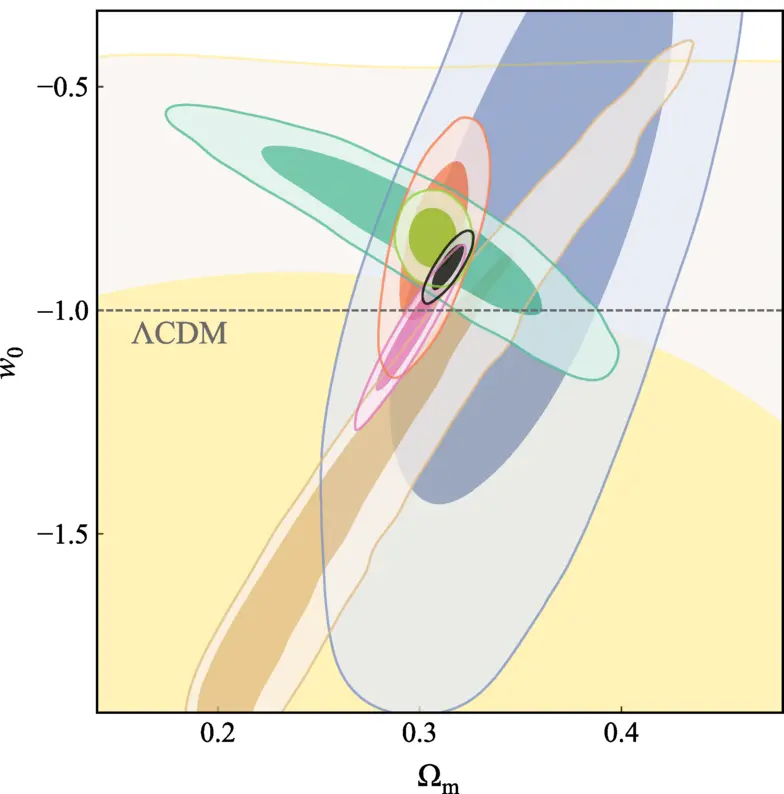
Abstract: Recent results from type Ia supernovae (SNe Ia) and baryon acoustic oscillations (BAO), in combination with cosmic microwave background (CMB) measurements, have focused renewed attention on dark energy models with a time-varying equation-of-state parameter, $w(z)$. In this paper, we describe the simplest, physically motivated models of evolving dark energy that are consistent with the recent data, a broad subclass of the so-called thawing scalar-field models that we dub $w_\phi$CDM. We provide a quasiuniversal, quasi-one-parameter functional fit to the scalar-field $w_\phi(z)$ that captures the behavior of these models more informatively than the standard $w_0 w_a$ phenomenological parametrization; their behavior is completely described by the current value of the equation-of-state parameter, $w_0 = w(z=0)$. Combining current data from BAO (DESI data release 2), the CMB (Planck and ACT), large-scale structure (DES year-3 $3\times2$pt), SNe Ia (DES-SN5YR), and strong lensing (TDCOSMO + SLACS), for $w_\phi$CDM we obtain $w_0 = -0.904^{+0.034}_{-0.033}$, $2.9\sigma$ discrepant from the $\Lambda$ cold dark matter ($\Lambda$CDM) model. The Bayesian evidence ratio substantially favors this $w\phi$CDM model over $\Lambda$CDM. The data combination that yields the strongest discrepancy with $\Lambda$CDM is BAO + SNe Ia, for which $w_0 = -0.837^{+0.044}_{-0.045}$, $3.6\sigma$ discrepant from $\Lambda$CDM and with a Bayesian evidence ratio strongly in favor. We find that the so-called $S_8$ tension between the CMB and large-scale structure is slightly reduced in these models, while the Hubble tension is slightly increased. We forecast constraints on these models from near-future surveys (DESI-extension and the Vera C. Rubin Observatory LSST), showing that the current best-fit $w\phi$CDM model will be distinguishable from $\Lambda$CDM at over $9\sigma$.

