
Table of Contents
This is an old revision of the document!
Maxwell–Boltzmann statistics
Maxwell–Boltzmann statistics (MBS) describes how particles in a gas distribute themselves in momentum or velocity when the gas is in thermal equilibrium. The distribution arises from three fundamental constraints:
- All directions in velocity space are equally probable (isotropy).
- The total energy of the system is finite.
- The total number of particles is fixed.
Condition (1) ensures a wide range of possible particle speeds, while (2) and (3) constrain the total spread of those speeds.
One-dimensional distribution
Consider a gas of identical particles of mass \(m\) in equilibrium at temperature \(T\). The probability \(\mathsf{P}(v_x)\,dv_x\) of finding a particle with velocity between \(v_x\) and \(v_x+dv_x\) is given by the Maxwell–Boltzmann distribution:
$$ \mathsf{P}(v_x)\,dv_x = \left(\frac{m}{2\pi kT}\right)^{1/2} e^{-mv_x^2/(2kT)}\,dv_x, $$
where \(k\) is Boltzmann’s constant. This Gaussian form shows that most particles have moderate velocities, while both very slow and very fast particles are less common.
—
Momentum space
Because \(p_x = m v_x\), the same distribution can be expressed in terms of momentum:
$$ \mathsf{P}(p_x)\,dp_x = \left(\frac{1}{2\pi m kT}\right)^{1/2} e^{-p_x^2/(2mkT)}\,dp_x. $$
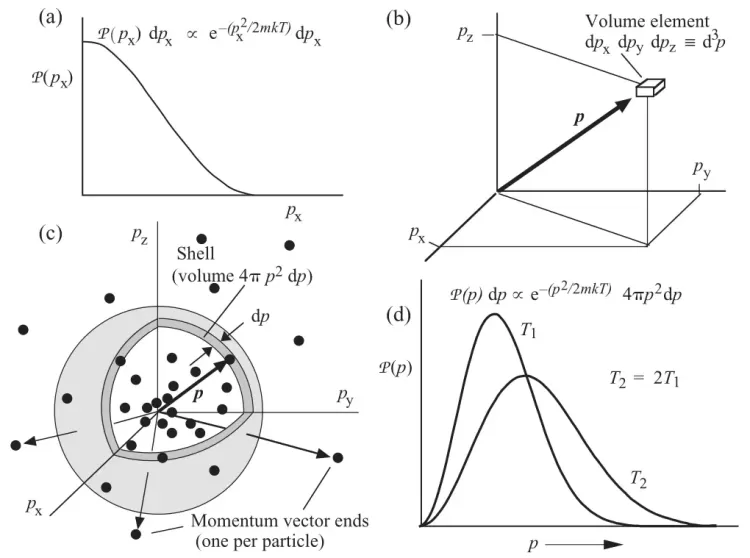
Extending to three dimensions:
$$ \mathsf{P}(p)\,d^3p = \left(\frac{1}{2\pi m kT}\right)^{3/2} \exp\!\left(-\frac{p^2}{2mkT}\right)\,d^3p, $$
where \(p^2 = p_x^2 + p_y^2 + p_z^2\). The quantity \(\mathsf{P}(p)\) is dimensionless — the units of \(d^3p\) cancel those of \(\mathsf{P}(p)\). Thus, \(\mathsf{P}(p)\,d^3p\) gives the probability of finding a particle in a small volume of momentum space.
The distribution may also be written in terms of energy using \(E = p^2 / (2m)\):
$$ \mathsf{P}(p)\,d^3p = \left(\frac{1}{2\pi m kT}\right)^{3/2} e^{-E/(kT)}\,d^3p. $$
Hence, \(\mathsf{P}(p) \propto e^{-E/(kT)}\), showing that the probability of finding particles with energy greater than \(kT\) falls exponentially — this is the hallmark of Maxwell–Boltzmann statistics.
—
Spherical representation in momentum space
For an isotropic distribution, the probability of finding a particle in a spherical shell of radius \(p\) and thickness \(dp\) is
$$ \mathsf{P}(p)\,dp = 4\pi p^2 \left(\frac{1}{2\pi m kT}\right)^{3/2} e^{-p^2/(2mkT)}\,dp. $$
This 1D form represents a 3D gas compactly. The function peaks at a finite momentum \(p_{\text{max}} > 0\) because:
- at \(p = 0\), the \(p^2\) term drives the probability to zero;
- at large \(p\), the exponential suppression dominates.
The temperature dependence (\(T^{-3/2}\)) ensures that the curve flattens and broadens with increasing temperature, reflecting faster-moving particles.
—
Phase space
The phase space of a system combines position space \((x, y, z)\) and momentum space \((p_x, p_y, p_z)\) into a 6D continuum. Each point in this space corresponds to one possible microstate of a particle.
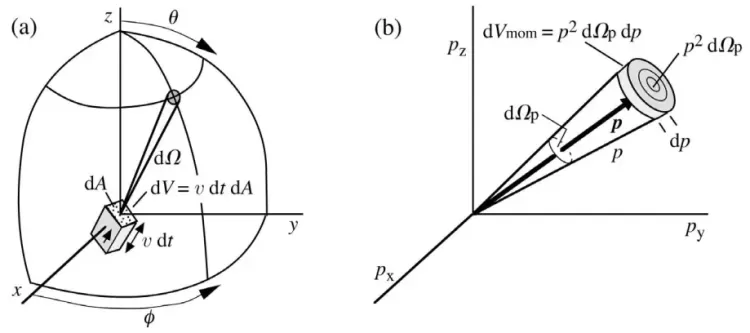
If \(N\) particles occupy a total volume \(V\), their number density is \(n = N/V\). The phase-space distribution function for Maxwell–Boltzmann statistics is then
$$ f_{MB} = n\,\mathsf{P}(p) = \frac{N}{V} \left(\frac{1}{2\pi m kT}\right)^{3/2} \exp\!\left(-\frac{p^2}{2mkT}\right), $$
where \(f_{MB}\) has units of m\(^{-3}\)(Ns)\(^{-3}\) or equivalently (Js)\(^{-3}\). This quantity represents the number of particles per unit phase-space volume — often called the phase-space density or simply the distribution function.
—
Observable quantities can be derived by integrating \(f\) over momentum space:
- Number density:
$$ n(x,y,z) = \int f(x,y,z,p)\,d^3p $$
(particles per cubic meter)
- Particle flux density:
$$ \phi_p(x,y,z,t) = \int v\,f\,d^3p $$
(particles per square meter per second)
—
Specific intensity
A closely related quantity in radiative processes is the specific intensity, \(J\), which measures the directional flux of particles or photons:
$$ J = \frac{dN}{dA\,d\Omega\,dE\,dt}, $$
the number of particles passing through area \(dA\) with energy between \(E\) and \(E+dE\) within solid angle \(d\Omega\) per unit time.
From the definition of \(f\):
- volume element in physical space: \(dV = v\,dt\,dA\),
- volume element in momentum space: \(dV_{mom} = p^2\,d\Omega_p\,dp\).
Hence the number of particles in phase space:
$$ dN = f\,p^2\,d\Omega_p\,dp\,v\,dt\,dA. $$
Comparing this with the definition of \(J\):
$$ J\,dA\,d\Omega\,dE\,dt = f\,p^2\,d\Omega_p\,dp\,v\,dt\,dA, $$
and assuming \(d\Omega = d\Omega_p\), we find
$$ J\,dE = f\,v\,p^2\,dp. $$
From special relativity, \(E^2 = (pc)^2 + (mc^2)^2\), so
$$ E\,dE = c^2 p\,dp, $$ and since \(v = p c^2 / E\), substituting gives
$$ J = p^2 f. $$
Thus, specific intensity is simply the distribution function multiplied by \(p^2\):
\begin{equation}\label{J} J = p^2 f. \end{equation}
—
The units of particle-specific intensity are m\(^{-2}\) s\(^{-1}\) J\(^{-1}\) sr\(^{-1}\), representing particle flux per unit energy per steradian.
For energy-specific intensity \(I(\nu)\):
$$ I(\nu) = \frac{E J(E)\,dE}{d\nu}. $$
Using \(E = h\nu\) and \(dE = h\,d\nu\):
$$ I = J\,h^2\nu. $$
Since \(J = p^2 f\) and \(p = h\nu / c\):
\begin{equation}\label{I} I(\nu) = \frac{h^4 \nu^3}{c^2} f. \end{equation}
This equation links the energy-specific intensity directly to the distribution function.
—
Liouville’s theorem and surface brightness
Liouville’s theorem states that for an observer moving with a stream of particles, the distribution function \(f\) — and hence \(J\) and \(I\) — remains constant along the trajectory:
$$ \frac{df}{dt} = 0. $$
This implies that the specific intensity is conserved along a ray in free space. Therefore, the surface brightness of an astronomical object seen by an observer is equal to its intrinsic brightness at the source:
\begin{equation}\label{B} B(\nu,\theta_s,\phi_s) = I(\nu,\theta_o,\phi_o), \end{equation}
where \((\theta_s,\phi_s)\) and \((\theta_o,\phi_o)\) denote angular coordinates at the source and at the observer, respectively.
—
Insights
- The Maxwell–Boltzmann distribution arises from the most probable energy partition among many identical, distinguishable particles.
- It predicts that few particles have very low or very high momenta; most lie near the peak at \(E \approx kT\).
- In three dimensions, \(P(p)\,dp \propto p^2 e^{-p^2/(2mkT)}\).
- The distribution function \(f_{MB}\) serves as the foundation for computing observable macroscopic quantities.
- Specific intensity and surface brightness are conserved along a ray path, illustrating the connection between thermodynamics and radiative transfer.
Inquiries
- Derive the expression for the Maxwell–Boltzmann distribution in momentum space from the 1D velocity distribution.
- Why does the most probable momentum occur at \(p>0\) instead of \(p=0\)?
- How does increasing temperature affect the shape and peak of the distribution?
- Explain the physical meaning of the phase-space distribution function \(f_{MB}\).
- Show how Liouville’s theorem leads to conservation of surface brightness in astronomy.