
This is an old revision of the document!
Hydrostatic equilibrium
Hydrostatic equilibrium is the condition under which the internal pressure gradient within a self-gravitating body exactly balances the inward pull of gravity at every layer. This balance maintains the structural stability of stars, planets, and other gaseous celestial bodies.
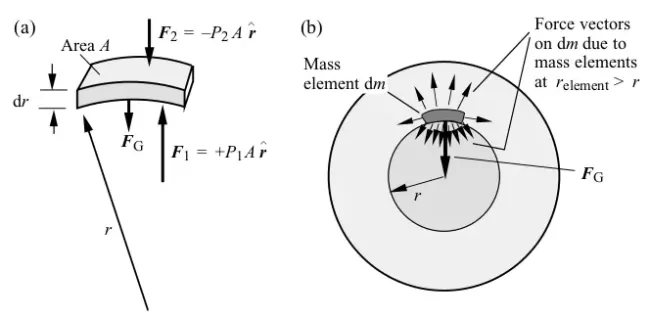
Consider a thin spherical shell of gas with thickness \( dr \) located at a distance \( r \) from the center of a star. At this radius, the gas has a density \( \rho(r) \), and the pressure is \( P(r) \). The inner surface of the shell experiences a pressure \( P_1 = P(r) \), while the outer surface experiences \( P_2 = P(r + dr) \). The differential pressure is therefore:
$$ dP = P_2 - P_1 $$
The net upward (outward) force on the element due to pressure difference is:
$$ F_P = -A \, dP $$
where \( A \) is the area of the shell and the positive direction is defined as outward from the center.
The gravitational force acting inward on this same element is:
$$ F_G = -\frac{G M(r) \, \rho(r) \, A \, dr}{r^2} $$
Here, \( M(r) \) represents the total mass enclosed within radius \( r \), and \( G \) is the gravitational constant.
For the element to remain in hydrostatic equilibrium, the net force must vanish:
$$ F_G + F_P = 0 $$
Substituting the two forces gives:
$$ A \, dP = -\frac{G M(r) \, \rho(r) \, A \, dr}{r^2} $$
Simplifying, we obtain the differential equation of hydrostatic equilibrium:
$$ \frac{dP}{dr} = -\frac{G M(r) \, \rho(r)}{r^2} $$
or equivalently,
$$ \frac{dP}{dr} = -\rho(r) \, g(r) $$
where the local gravitational acceleration is:
$$ g(r) = \frac{G M(r)}{r^2} $$
Insights
This equation states that, at every point within a star, the outward pressure gradient balances the inward gravitational pull. If the pressure gradient were smaller, the gas would collapse under gravity; if it were larger, the star would expand. Thus, hydrostatic equilibrium defines the fundamental balance governing the structure of stars and planets.
The mass function \( M(r) \) is found by integrating the density:
$$ M(r) = \int_0^r 4\pi r'^2 \rho(r') \, dr' $$
Mass outside the radius \( r \) does not contribute to the gravitational force at \( r \), in accordance with Gauss’s law for gravity. The hydrostatic equilibrium equation is one of the core equations in the theory of stellar structure, along with the equations of mass continuity, energy conservation, and energy transport.
Inquiries
- Explain how the equation of hydrostatic equilibrium represents the balance between gravity and pressure inside a star.
- Why does only the mass enclosed within radius \( r \) contribute to the gravitational force at that point?
- What happens to a star if its internal pressure gradient becomes smaller than required for hydrostatic equilibrium?