
Table of Contents
This is an old revision of the document!
Equations of state
The equation of state (EOS) links the thermodynamic quantities that describe a gas — typically pressure (\(P\)), density (\(\rho\)), and temperature (\(T\)). It determines how matter responds to compression, heating, and cooling, and thus plays a central role in the structure and evolution of stars and planets.
In stellar interiors, several distinct pressure regimes operate depending on temperature and density: ideal gas pressure, radiation pressure, and the quantum mechanical pressures of degenerate matter.
Ideal gas and radiation pressure
At low to moderate densities and high temperatures, matter behaves as a classical gas. The ideal gas law gives
$$ P = \frac{\rho kT}{m_{av}}, $$
where \(m_{av}\) is the average particle mass and \(k\) is the Boltzmann constant. This equation of state applies to most main-sequence stars, where thermal motion dominates.
At even higher temperatures, photons contribute significantly to the total pressure. The radiation pressure is given by
$$ P_{rad} = \frac{aT^4}{3}, $$
where \(a\) is the radiation constant. In the hottest, most luminous stars, radiation pressure can rival or exceed gas pressure.
Degenerate matter
When matter becomes dense enough that quantum effects dominate, fermions such as electrons or neutrons fill nearly all low-energy quantum states. The resulting degeneracy pressure arises not from temperature but from the Pauli exclusion principle. This pressure supports compact objects like white dwarfs, neutron stars, and the cores of giant planets.
Nonrelativistic degeneracy
For a nonrelativistic gas of electrons, the average energy per particle is
$$ E_{av} = \frac{3}{5}\frac{p_F^2}{2m_e}, $$
where \(p_F\) is the Fermi momentum and \(m_e\) is the electron mass. The pressure is then
$$ P_e = \frac{2}{3} n_e E_{av} = \frac{1}{20}\left(\frac{3}{\pi}\right)^{2/3}\frac{h^2}{m_e} n_e^{5/3}, $$
where \(n_e\) is the number density of electrons. Substituting \(n_e = \rho / (\mu_e m_p)\), with \(\mu_e\) the electron molecular weight, gives
$$ P_e = \frac{1}{20}\left(\frac{3}{\pi}\right)^{2/3} \frac{h^2}{m_e}\left(\frac{\rho}{\mu_e m_p}\right)^{5/3}. $$
Thus, in a nonrelativistic degenerate gas, \(P_e \propto \rho^{5/3}\), and the pressure is independent of temperature. This law provides the main pressure support in white dwarfs of low to intermediate mass.
Relativistic degeneracy
At very high densities, the electrons become relativistic (\(p_F \gtrsim m_e c\)), and their average energy per particle is approximately
$$ E_{av} = \frac{3}{4}c p_F. $$
Substituting this into the pressure relation gives
$$ P_e = \frac{1}{8}\left(\frac{3}{\pi}\right)^{1/3} ch\left(\frac{\rho}{\mu_e m_p}\right)^{4/3}. $$
In this relativistic regime, \(P_e \propto \rho^{4/3}\). Because pressure now increases more slowly with density, the gas becomes softer — it cannot indefinitely resist gravitational compression. This softening leads directly to the Chandrasekhar limit, the maximum mass (\(\sim 1.4\,M_\odot\)) that can be supported by electron degeneracy pressure.
In more massive remnants, electrons merge with protons to form neutrons, producing neutron stars, which are supported by neutron degeneracy and nuclear repulsion. At still higher densities, even these pressures fail, leading to the formation of black holes.
Unified view of equations of state
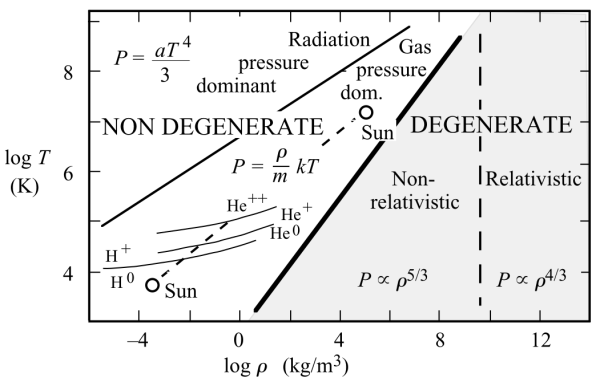
The figure above shows the dominant pressure regimes across temperature–density space:
- Radiation pressure: \(P = aT^4 / 3\)
- Ideal gas pressure: \(P = \rho kT / m_{av}\)
- Nonrelativistic degeneracy: \(P \propto \rho^{5/3}\)
- Relativistic degeneracy: \(P \propto \rho^{4/3}\)
At low density and high temperature, radiation and ideal gas laws dominate. At high density and low temperature, degeneracy pressure takes over. Between these extremes, both effects can coexist — for instance, in the cores of massive white dwarfs or brown dwarfs transitioning between ideal and degenerate conditions.
Insights
- The equation of state defines how pressure responds to changes in density and temperature.
- Classical gases follow \(P \propto \rho T\), while degenerate matter obeys quantum power laws.
- Nonrelativistic degeneracy gives \(P \propto \rho^{5/3}\); relativistic degeneracy gives \(P \propto \rho^{4/3}\).
- Degeneracy pressure depends on density, not temperature, and stems from the Pauli exclusion principle.
- The Chandrasekhar limit arises from the softening of the relativistic EOS.
- The transition between radiation, gas, and degeneracy pressures governs the life and death of stars.
Inquiries
- Derive the relation \(P_e \propto \rho^{5/3}\) for a nonrelativistic degenerate gas.
- Why does relativistic degeneracy yield \(P_e \propto \rho^{4/3}\)?
- Explain how degeneracy pressure supports white dwarfs and defines the Chandrasekhar limit.
- In what conditions does radiation pressure dominate over degeneracy pressure?
- Describe how the equation of state determines the stability of stellar remnants.