
Table of Contents
This is an old revision of the document!
Atmosphere
Stars, planets, and moons can all have atmospheres. Here we will mainly talk about the atmospheres of planets.
1. Atmospheric Pressure
To begin, we need an equation for atmospheric pressure, which can be derived using hydrostatic equilibrium. The relationship between pressure ($P$) and height ($z$) from the surface is:
$$ \frac{dP}{dz} = -\rho g $$
where $g$ is the gravitational acceleration and $\rho$ is the density of air. The equilibrium of the interior of a star or planet is also explained using a similar kind of equation. The relation between density and pressure can be written using the ideal gas law as:
$$ \frac{P \mu_a m_a}{\rho} = kT $$
where $k$ is the Boltzmann constant, $T$ is the air temperature, $\mu_a$ is the mean molecular weight (dimensionless), and $m_a$ is the atomic mass unit. Because in the equation $PV=NkT$, we can write $V/N=(M/\rho)/N= (M/N)/\rho = \mu_am_a/\rho$, where $M/N=\mu_a m_a$ is the average mass of an air particle in kilograms. From the two equations above we get:
$$ \frac{dP}{dz} = -\frac{P\mu_a m_a g}{kT} $$
Solving this gives us how pressure changes with height. The solution is easier if we assume $g$ and $T$ to be constant. For Earth’s atmosphere, this assumption isn’t too bad, because gravity hardly changes, and temperature changes much more slowly than pressure. The above differential equation can be solved by variable separation as follows:
$$ \int\frac{dP}{P} = -\frac{\mu_a m_ag}{kT} \int dz \Rightarrow \ln P = -\frac{\mu_a m_agz}{kT}+C $$
$$ \Rightarrow P = P_0 e^{-\mu_a m_a gz/(kT)}$$
where $P_0=e^C$ is the pressure at sea level ($z=0$), and $C$ is the integration constant. From the final equation it is evident that, at least for Earth, pressure decreases rapidly with height from the surface, because $P\propto e^{-z}$—that is, pressure decreases exponentially with altitude.
Important observatories like the Keck Observatory are located atop Hawaii’s Mauna Kea mountain; at 4 km altitude, the pressure is only 60% of sea level pressure. At the top of Everest, i.e., 9 km up, the pressure is just 30% of surface pressure. If pressure drops so drastically within just 9 km, it means that Earth’s atmosphere is very thin compared to its radius ($R_E$: 6,000 km). That’s why treating $g$ as constant was not a bad assumption; the acceleration doesn’t change much for just a 10–20 km change in height.
2. Mass of the Atmosphere
The mass $M$ of Earth’s atmosphere can be easily measured. The total gravitational force of the atmosphere at sea level is $F=Mg$, then the pressure $P_0=F/A=(M/A)g$, and therefore
$$ M = \frac{P_0A}{g} = \frac{4\pi R_E^2P_0}{g} $$
which comes out to approximately $5\times 10^{18}$ kg, or about one millionth of Earth’s total mass.
3. Earth’s Atmosphere
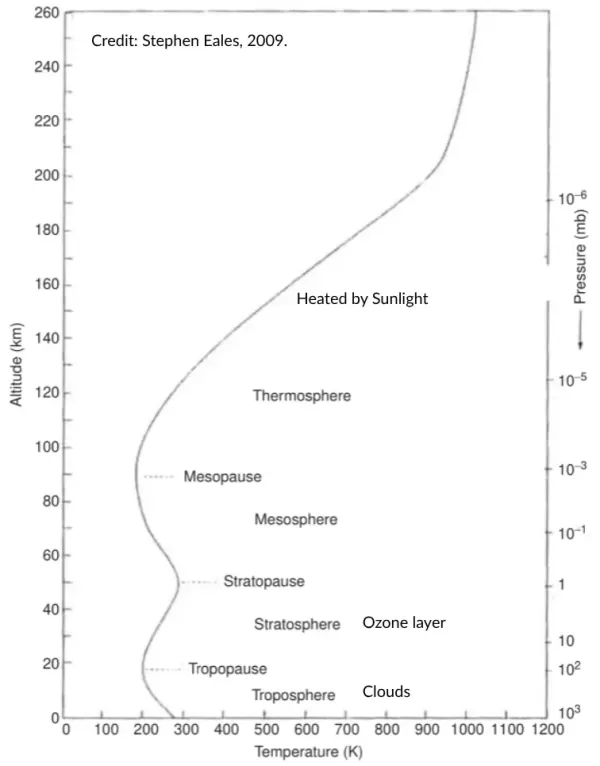
This plot shows how temperature and pressure change with altitude in Earth’s atmosphere. Pressure is given in millibars; 1 bar equals 100,000 pascals. At ground level, the pressure is about 1 bar, or roughly 1000 millibars. The temperature here is around 288 Kelvin, which keeps dropping up to the tropopause. Earth absorbs visible light from the Sun and emits infrared radiation; since it is itself a radiating source, temperature drops the higher you go from its surface. This is the reason for the temperature drop in the troposphere. All clouds and our weather systems exist in this region.
After the tropopause, temperature begins to rise again because in the stratosphere lies our protective ozone (O$_3$) layer. Because this molecule has three oxygen atoms instead of two, it absorbs ultraviolet light from the Sun, which raises its temperature, while shielding us below. This trend continues up to the stratopause, after which in the mesosphere temperature begins to drop again because ozone is absent. Temperature continues to drop up to the mesopause at around 90 km altitude, after which it starts rising again as sunlight directly affects the atmosphere in various ways in the thermosphere. The plot doesn’t show what lies above, but higher up at around 500 km is the exobase, from where the exosphere begins. In the exosphere, air density is extremely low, and the fast-moving molecules gradually escape into space.
Our atmosphere contains 78% nitrogen, 21% oxygen, and then trace amounts of argon, water vapor, and carbon dioxide. On Venus, 97% is CO$_2$, and on Mars 95% is CO$_2$. Saturn’s moon Titan has 90% to 97% nitrogen.