Table of Contents
Stellar nucleosynthesis
The stability of a star depends on a continuous energy balance between radiative losses at the surface and nuclear energy production at the core. When this balance holds, the star remains in hydrostatic equilibrium; when it breaks, the star evolves. The process by which elements are formed and energy is generated within stars is called stellar nucleosynthesis.
Nuclear reactions and equilibrium feedback
The energy radiated from a star’s surface is replenished by nuclear reactions occurring deep in the core. A stable equilibrium is maintained through a negative feedback mechanism:
- If gravity momentarily exceeds pressure, the star contracts, increasing core temperature and reaction rates. The higher energy output expands the star back toward equilibrium.
- If pressure temporarily exceeds gravity, the star expands, cooling the core and reducing nuclear reaction rates, allowing gravity to restore balance.
A star is primarily composed of hydrogen, fully ionized into free protons and electrons. The main mechanism of nuclear burning in such a plasma is the proton–proton (pp) chain. However, the average kinetic energy of protons is not high enough to overcome the Coulomb barrier arising from electrostatic repulsion due to the electromagnetic force. The required energy is about a thousand times higher than what protons typically possess.
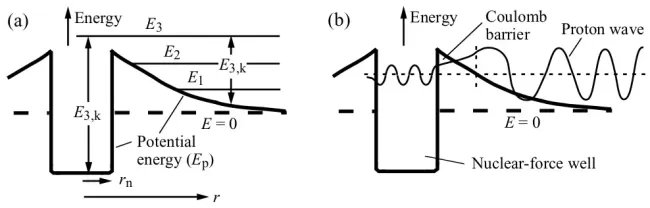
The solution lies in quantum tunneling. In the diagram above, the \(y\)-axis represents proton energy, and the \(x\)-axis represents separation distance between two protons. The square well indicates the nuclear potential (strong force), while the rising slope shows the Coulomb potential (\( \propto r^{-1} \)). Classically, only particles with energy \(E_3\) could enter the well, but at typical core temperatures (\(T \sim 10^7\) K), most protons have energies \(E_1\) or \(E_2\) far below this level. Quantum mechanics allows these low-energy protons to tunnel through the barrier, enabling fusion even at sub-threshold energies.
At solar core temperatures (≈10 MK), the high-energy tail of the Maxwell–Boltzmann distribution contains enough protons capable of tunneling to sustain fusion.
Although the nuclear energy output balances the luminosity, only a tiny fraction of nuclear energy replaces what escapes as surface radiation. A star is primarily a thermal furnace, with a nuclear “warmer” maintaining stability. For the Sun, this nuclear heater operates at roughly 400 yottawatts (YW)—comparable to its luminosity of 1000 YW.
Proton–proton chain
Hydrogen burning via the proton–proton chain dominates in stars with core temperatures above about 5 MK. The Sun’s core temperature (\(T_c \approx 16\) MK) is sufficient for this process. Initially, the Sun’s composition was about 71% H, 27% He, and 2% heavier elements, but the hydrogen fraction in the core has now dropped to about 36%.
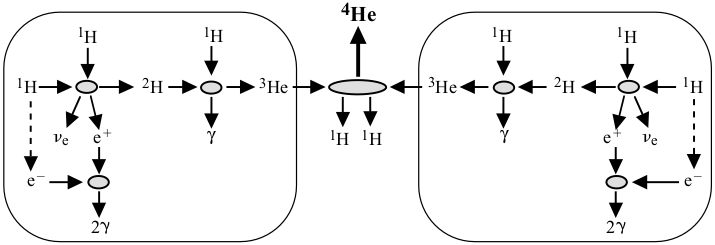
The chain of reactions converts hydrogen into helium while releasing neutrinos and gamma photons. Each full cycle converts six protons into one helium nucleus (\(^4\)He), two positrons, and two neutrinos.
The conservation laws of physics hold:
- Baryon number: 6 baryons initially → 6 baryons finally (4 protons + 2 neutrons).
- Lepton number: 6 leptons initially → 6 leptons finally (4 electrons + 2 neutrinos).
- Charge: Initially neutral; finally neutral (4 positive + 4 negative).
- Energy: Conserved via conversion of mass deficit into energy.
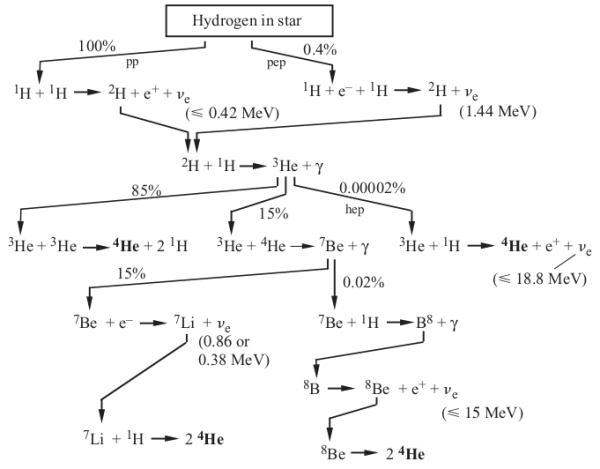
The diagram above shows the alternative pp-branches. The pp I chain dominates at solar temperatures. The pep process contributes only ~0.4% but produces a 1.44 MeV neutrino, compared with 0.42 MeV from the pp reaction, making it easier to detect. The hep reaction, though extremely rare, produces the highest-energy neutrinos (~18 MeV).
Solar neutrinos (\(\nu_e\)) are crucial for neutrino astronomy. However, detectors observe only about half of the expected flux — a discrepancy explained by neutrino oscillation, where electron neutrinos transform into other flavors before reaching Earth.
The CNO cycle
For hotter stars (\(T \gtrsim 20\) MK), the carbon–nitrogen–oxygen (CNO) cycle becomes dominant. It also fuses four protons into one helium nucleus, but uses pre-existing carbon, nitrogen, and oxygen nuclei as catalysts.

The sequence of reactions begins when \(^{12}\text{C}\) captures a proton to form \(^{13}\text{N}\) and emits a gamma photon. \(^{13}\text{N}\) undergoes beta-plus decay, producing a positron and an electron neutrino:
$$ ^{13}\text{N} \rightarrow\ ^{13}\text{C} + e^+ + \nu_e $$
The cycle proceeds through a chain of proton captures and decays, returning to \(^{12}\text{C}\), which acts purely as a catalyst.
Energy production and efficiency
The atomic masses of hydrogen and helium are \(M_H = 1.00783\,\text{amu}\) and \(M_{He} = 4.00260\,\text{amu}\), respectively, where \(1\,\text{amu} = 1.66053\times10^{-27}\,\text{kg}\). The energy released in one full pp or CNO fusion cycle is
$$ E_r = (4M_H - M_{He})c^2 = 4.29\times10^{-12}\ \text{J} = 26.75\ \text{MeV}. $$
This corresponds to 0.71% of the rest-mass energy of the original hydrogen atoms.
The specific energy yield is
$$ \frac{E_r}{4M_H} = 0.0071\, c^2 = 6.4\times10^{14}\ \text{J/kg}, $$
equivalent to 640 terajoules per kilogram — roughly 10 million times more efficient than chemical energy.
Only about 10% of hydrogen resides in the Sun’s core where conditions allow fusion, and about 2% of energy is lost via neutrinos. Thus, the total hydrogen-burning energy budget is
$$ E_H \approx (0.98 \times 6.4\times10^{14}\ \text{J/kg}) (0.1\times 2\times10^{30}\ \text{kg}) = 1.3\times10^{44}\ \text{J}. $$
The corresponding stellar lifetime is
$$ \tau_\odot = \frac{E_H}{L_\odot} \approx 10^{10}\ \text{yr} = 10\ \text{Gyr}, $$
which is much longer than the thermal (Kelvin–Helmholtz) timescale, confirming that nuclear fusion sustains stars over billions of years.
Energy generation rate
The rate of energy production per unit mass (\(\epsilon\)) depends on composition, density, and temperature:
$$ \epsilon = \epsilon_0 X^2 \left( \frac{\rho}{10^5\ \mathrm{kg\,m^{-3}}} \right) \left( \frac{T}{10^7\ \mathrm{K}} \right)^\beta, $$
where \(X\) = hydrogen mass fraction, \(\rho\) = density, \(T\) = temperature, and \(\beta\) = temperature exponent that varies by reaction type.
| Chain/Cycle | Dominant Temperature (MK) | $\beta$ | Dominant in Stars |
|---|---|---|---|
| pp | 5–15 | 4 | Sun and less massive stars |
| CNO | ≥20 | 15 | Type A and more massive stars |
For the Sun (\(X=0.71\), \(\rho = 150\,\mathrm{Mg\,m^{-3}}\), \(T = 16\,\mathrm{MK}\), \(\beta = 4\)):
$$ \epsilon_{pp} \approx 2.4\times10^{-3}\ \mathrm{W\,kg^{-1}} = 2.4\ \mathrm{mW/kg}. $$
At higher core temperatures, the CNO cycle dominates due to its extreme temperature sensitivity (\(\epsilon \propto T^{15}\)).
Insights
- The Sun’s stability arises from nuclear reactions finely balanced with radiative losses.
- Quantum tunneling allows fusion at energies far below the Coulomb barrier.
- Both pp and CNO processes fuse four protons into one helium nucleus, releasing ~27 MeV per reaction.
- Only 10% of hydrogen is available for fusion, leading to a main-sequence lifetime of ~10 Gyr.
- The transition from pp to CNO dominance marks the shift from solar-type to massive stellar cores.
Inquiries
- Why is quantum tunneling essential for fusion inside stars?
- Compare the efficiency of the pp chain and the CNO cycle at different temperatures.
- How does the Sun’s observed neutrino flux support or challenge stellar models?
- Derive the expression for stellar lifetime from total fusion energy and luminosity.
- Explain why the CNO cycle requires pre-existing heavy elements and how this relates to stellar generations.