Table of Contents
Pulsation in stars
Stars are not perfectly static objects — they breathe. All stars experience small oscillations in radius, temperature, and brightness as they strive to maintain equilibrium between gravity and pressure. These rhythmic changes are studied under asteroseismology, and for our own star, under helioseismology.
When the amplitude of oscillation is large enough to cause observable brightness variations, we call them pulsating variable stars.
The most famous classes are Cepheid variables and RR Lyrae variables, whose predictable brightness–period relationships make them vital standard candles for measuring cosmic distances.
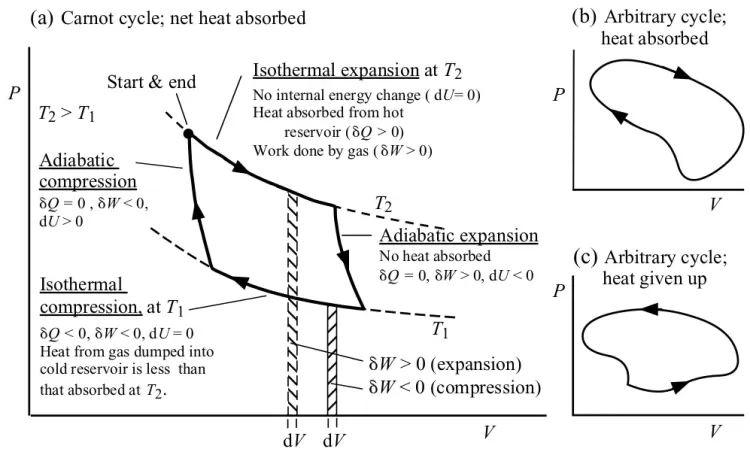
The pulsation of a star can be compared to a thermodynamic cycle, much like a Carnot engine. In this analogy, the stellar gas behaves as a compressible medium that alternately absorbs and releases heat while doing work on its surroundings.
In a pressure–volume (\(P\)-\(V\)) diagram, the work done by the gas is
$$ W = \int P\,dV. $$
Expansion (motion to the right on the diagram) corresponds to positive work, while compression (motion to the left) corresponds to negative work. For a clockwise cycle, the net work is positive — the system performs work on its surroundings, just as in a heat engine. A counterclockwise cycle would imply the reverse: work is done *on* the gas.
In stars, heat input (\(Q\)) comes from radiation within the hot interior, and the resulting work appears as physical expansion and contraction of the stellar envelope. The internal energy (\(U\)) of the gas does not change significantly over a full pulsation cycle.
The first law and condition for instability
The first law of thermodynamics governs the process:
$$ \delta Q = dU + \delta W, $$
where \(U\) is a state variable (internal energy), but \(Q\) and \(W\) depend on the process path. Over one complete cycle,
$$ \oint dU = 0 \Rightarrow W = \oint \delta Q. $$
Thus, pulsations occur only if the net work done over a cycle is positive.
Entropy (\(S\)) is also a state variable, so
$$ \oint dS = \oint \frac{\delta Q}{T} = 0. $$
Now, if temperature varies slightly with time,
$$ T(t) = T_0 + \Delta T(t) = T_0\left(1 + \frac{\Delta T}{T_0}\right), $$
and for small perturbations \((\Delta T/T_0 \ll 1)\),
$$ \frac{1}{T} \approx \frac{1}{T_0} \left(1 - \frac{\Delta T}{T_0}\right). $$
Substituting into the entropy relation gives
$$ W \approx \oint \frac{\Delta T(t)}{T_0}\, \delta Q. $$
Hence, \(W\) is positive when the temperature and heat input vary in phase: the gas absorbs heat while hot (expansion) and releases heat while cool (compression). This is the hallmark of a heat engine.
Integrating this expression throughout the stellar mass gives the global condition for self-sustained pulsation:
$$ W \approx \int_M \oint_Q \frac{\Delta T(t,m)}{T_0(m)}\, \delta Q(m)\,dm > 0. $$
Pulsation occurs only if this integral is positive — that is, if some region of the star injects more energy than it dissipates during each cycle.
The κ-mechanism: heat valve of pulsation
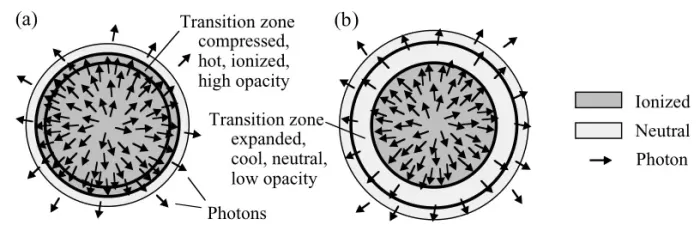
In a car engine, the *valve* controls fuel input. In a star, the analogous control is provided by opacity, the ability of gas to block radiation. The κ-mechanism (kappa mechanism) drives pulsations through cyclic changes in opacity within the partial ionization zones of hydrogen and helium near the stellar surface.
(a) Compression phase: When the star contracts, the temperature in the ionization zone rises. Hydrogen and helium become more ionized, producing more free electrons and thus increasing the opacity (\(\kappa\)). Radiation becomes trapped, and heat is absorbed at high temperature — exactly like the *heating stroke* of a heat engine. This added heat raises internal pressure and drives expansion.
(b) Expansion phase: As the star expands and cools, recombination occurs — atoms recapture electrons, reducing opacity. Radiation escapes more easily, carrying away trapped heat. This is the *cooling stroke* of the cycle. With pressure now reduced, gravity causes the layers to contract again, returning to the compression phase.
This repeating feedback between opacity and radiation flow maintains the oscillation.
Types and astrophysical importance
Cepheid variables and RR Lyrae variables are classic examples of κ-driven pulsators. Their luminosities range from hundreds to tens of thousands of solar luminosities, and their pulsation periods (from hours to months) are strongly correlated with their brightness — the period–luminosity relation discovered by Henrietta Leavitt. This relation allows astronomers to measure extragalactic distances and map the scale of the universe.
Insights
- Stellar pulsation is a thermodynamic instability analogous to a heat engine cycle.
- The κ-mechanism operates in the partial ionization zones of H and He, modulating opacity.
- Positive work per cycle (\(W > 0\)) sustains pulsations; damping occurs when \(W < 0\).
- Cepheid and RR Lyrae stars provide cosmic distance calibration via the period–luminosity relation.
- Asteroseismology and helioseismology probe stellar interiors through observed oscillation modes.
Inquiries
- Derive the condition \(W > 0\) for stellar pulsation from the first law of thermodynamics.
- Explain how changes in opacity drive the κ-mechanism during compression and expansion.
- Why are pulsations localized in the partial ionization zones of H and He?
- How does the period–luminosity relation of Cepheids enable distance measurement?
- What observable properties distinguish RR Lyrae stars from Cepheid variables?